Second Phase of the Indian National Movement: Partition of Bengal and Other Developments
Appeared in 10 of the 11 available papers.
Appears almost every year — treat as core
Average per paper it appears in · 44 marks in total
46% of this chapter's 24 questions
7 questions carry a figure — practise drawing them
Question-type distribution
- MCQ11
- Short answer8
- Reasoning3
- Source-based2
Most frequent topics
Showing 24 of 24 matching questions (44 marks).
24 questions
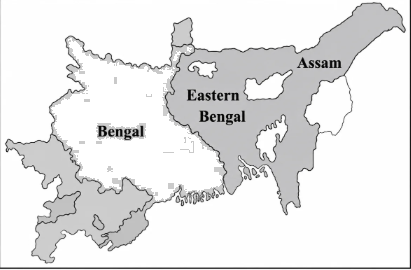
Look at the picture given and answer the question that follows.

Select the correct answers to the questions from the given options. (Do not copy the questions, write the correct answer only.)
- (a)(A) is true and (R) is false.
- (b)(R) is true but (A) is false.
- (c)Both (A) with (R) are independent of each other.
- (d)(R) is the reason for (A).
- (a)Bipin Chandra Pal
- (b)Lala Lajpat Rai
- (c)Dadabhai Naoroji
- (d)Bal Gangadhar Tilak
- (a)Passive Resistance
- (b)National Education
- (c)Swadeshi
- (d)Revivalism
The Indian National Movement is divided into three phases. With reference to the Second Phase of the Indian National Movement, answer the following questions:
Select the correct answers to the questions from the given options. (Do not copy the questions, write the correct answer only.)
- (a)Lord Canning
- (b)Lord Dalhousie
- (c)Lord Curzon
- (d)Lord Ripon
- (a)Constitutional agitation
- (b)Peaceful protests
- (c)Purna Swaraj
- (d)Self-government under British Rule
- (a)1905
- (b)1907
- (c)1906
- (d)1911
- (a)There was only Hindus in West Bengal.
- (b)To divide the Hindus and Muslims.
- (c)There were many riots in Bengal.
- (d)It was an administrative necessity as Bengal was a large territory.
Look at the picture given below and answer the questions that follow:
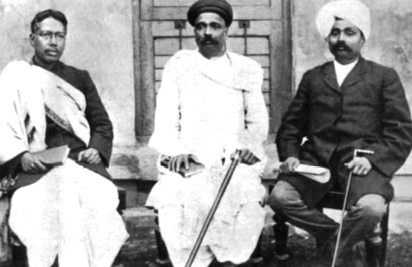
- (a)Surendranath Banerjee, Dadabhai Naoroji, Gopal Krishna Gokhale
- (b)Dadabhai Naoroji, Lala Lajpat Rai, Bipin Chandra Pal
- (c)Gopal Krishna Gokhale, Bal Gangadhar Tilak, Dadabhai Naoroji
- (d)Lala Lajpat Rai, Bal Gangadhar Tilak, Bipin Chandra Pal
- (a)Early Nationalist
- (b)Assertive Nationalist
- (c)Revolutionaries
- (d)Swarajists
- (a)Attainment of Poorna Swaraj
- (b)Self-Government under British Rule
- (c)Abolition of Indian Council
- (d)Demand for Provincial Government for Indians.
- (a)Prayers and protest
- (b)Swadeshi and Boycott
- (c)Sending Deputations of Indian leaders to Britain
- (d)Sending petitions to the British government.
Answer briefly each of the questions (a) to (j):
The conflict between two sections of the Congress came to the surface in its Session in 1906 at Calcutta. In this context, explain the following:
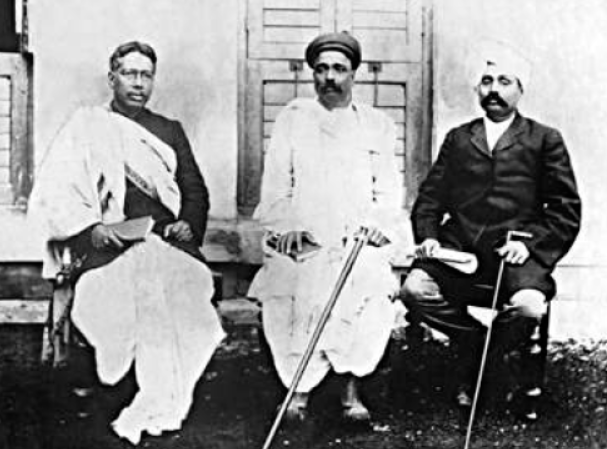
Answer briefly each of the questions (a) to (j):
With reference to the Partition of Bengal and the Muslim League, answer the following: