Geography — Suggested Paper 4
105 minutes70 marks Questions from 2016–2026
A suggested paper: every question is a real ICSE board question, chosen from different years and arranged in the current pattern. Start the timed test to have your written answers marked. Question 1 is set on a Survey of India toposheet that cannot be reproduced here.
Part I (30 marks)
Attempt all questions from this Part.
2. On the outline map of India provided:
2(i). Mark and label Mumbai.
[1 mark]2(v). Shade and label an area of laterite soil in North India.
[1 mark]2(ii). Mark and label the Arabian Sea branch of S.W. Monsoon.
[1 mark]2(iii). Shade and label a sparsely populated region in Western India.
[1 mark]2(vi). Shade and label the Gulf of Kutch.
[1 mark]2(ix). Mark with arrows and name the Southwest Monsoon winds.
[1 mark]2(iv). Shade and name the coastal plain that occupies a large part of Kerala.
[1 mark]2(viii). Mark and label Visakhapatnam.
[1 mark]2(x). Mark and label the Standard Meridian of India.
[1 mark]2(vii). Mark and name the Vindhya Mountains.
[1 mark]3. Choose the correct answers to the questions from the given options. (Do not copy the questions, write the correct answers only.)
3(i). Why is laterite soil used in Goa and Kerala for the construction of houses?
[1 mark]- (a)It become hard when dry.
- (b)This soil is generally coarse in texture and porous in nature.
- (c)It has more of clay content in it.
- (d)It looks beautiful when used in buildings.
3(ii). Which of the following pairs is correctly matched?
[1 mark]- (a)Babool-Tropical evergreen forest
- (b)Sandalwood-Tropical deciduous forest
- (c)Cinchona-Mountain forest
- (d)Sal-Tidal forest
3(iii). Why is there a need to conserve water in India?
[1 mark]- (a)A lot of water is polluted
- (b)No water is found below the land in India
- (c)Water is in abundance in India
- (d)We receive lot of rain in summer
3(iv). What is .7r in 4833?
[1 mark]- (a)Relative height of 7 m
- (b)Relative Height of 7 cm
- (c)Relative depth of 7 cm.
- (d)Relative depth of 7 m
3(v). Which of the following area receives rain from the North East Monsoon?
[1 mark]- (a)Konkan coast
- (b)Ganga basin
- (c)Coromandel coast
- (d)Malabar coast
3(vi). Copper is alloyed with Zinc to form:
[1 mark]- (a)Stainless steel
- (b)Brass
- (c)Bronze
- (d)Aluminium
3(vii). Which of the following is a biodegradable waste?
[1 mark]- (a)Broken glass
- (b)Waste paper
- (c)Polythene
- (d)Plastic bags
3(viii). Which of the following household products is associated with the petrochemical industry?
[1 mark]- (a)Glass bottle
- (b)Wooden chopping board
- (c)Kitchen knife
- (d)Plastic mug
3(ix). The residue of ______ forms an important part of the cattle feed and manure.
[1 mark]- (a)groundnut
- (b)coffee
- (c)jute
- (d)pulses
3(x). Identify the crop that is grown in the Rabi cropping season.
[1 mark]- (a)Sugarcane
- (b)Rice
- (c)Mustard
- (d)Cotton
Part II (50 marks)
Attempt any five questions from this Part.
4(i)(a). Name any three varieties of coal produced in India.
[1 mark]4(i)(b). Name the variety of coal widely used in iron and Steel Industries of India.
[1 mark]4(ii)(a). Name the state that is the largest producer of iron ore in India.
[1 mark]4(ii)(b). Name any one mining area of iron ore from the state mentioned by you.
[1 mark]4(iii)(a). Mention two ways in which Hirakud dam has helped the people of Odisha.
[2 marks]4(iii)(b). Across which river is the Hirakud dam built?
[1 mark]4(iv). Give reasons for each of the following:
4(iv)(a). Geothermal energy is not popular in India.
[1 mark]4(iv)(b). Solar energy is gaining popularity.
[1 mark]4(iv)(c). Petroleum is considered a harmful source of energy.
[1 mark]5(a). What is Mixed farming? Mention any one benefit of Mixed farming.
[2 marks]5(b). Give the Geographical requirements for the cultivation of Sugarcane.
[2 marks]5(c). Explain the following terms and name the crop with which each is associated:
5(c)(i). Retting
[1 mark]5(c)(ii). Ratooning
[1 mark]5(c)(iii). Ginning
[1 mark]5(d). Give geographical reasons for the following:
5(d)(i). Regular pruning is essential for tea bushes.
[1 mark]5(d)(ii). Coffee beans are roasted.
[1 mark]5(d)(iii). Millets are known as dry crops.
[1 mark]6(a). What impact does the waste accumulation have on the following? (i) Quality of air around us. (ii) Quality of water around us.
[2 marks]6(b). Mention two ways in which the decomposition of waste in open areas can affect human health.
[2 marks]6(c)(i). What can an individual do to reduce waste at home?
[1 mark]6(c)(ii). Why must segregation of waste be done before disposal?
[1 mark]6(c)(iii). How has composting proven to be a great help in managing waste?
[1 mark]6(d). Give a reason for each of the following:
6(d)(i). Trees must be planted in the industrial areas.
[1 mark]6(d)(ii). Chemical fertilizers must be replaced by organic manure.
[1 mark]6(d)(iii). Plastic and polythene products must be banned.
[1 mark]7(i). State two ways in which forests help in protecting the environment.
[2 marks]7(ii). Mention two ways in which Tropical Desert vegetation has adapted to its environment.
[2 marks]7(iii)(a). In which natural vegetation belt is Sundari tree found?
[1 mark]7(iii)(b). Why is the Tropical Deciduous Forest commercially the most exploited forest belt of India? (Two points)
[2 marks]7(iv)(a). Name one region in India where Tropical Evergreen Forest is found.
[1 mark]7(iv)(b). Mention the temperature and rainfall conditions found suitable for its growth.
[2 marks]8(a)(i). Name the parent rock that contributes to the formation of red soil.
[1 mark]8(a)(ii). How does this soil get its 'red' colour?
[1 mark]8(b). Name the following:
8(b)(i). a soil that occurs insitu and is good for cotton crop.
[1 mark]8(b)(ii). soil that is formed due to high temperature and heavy rainfall.
[1 mark]8(c). With reference to Alluvial Soil answer the following:
8(c)(i). What are the two types of Alluvial Soil?
[1 mark]8(c)(ii). Name an area where Alluvial soil is found.
[1 mark]8(c)(iii). Name two crops that grow well in this soil.
[1 mark]8(d)(i). Define the term 'Residual' soil.
[1 mark]8(d)(ii). Name two crops that are grown on laterite soil.
[1 mark]8(d)(iii). Name two important agents of soil erosion.
[1 mark]9(i). Why is road transport an important means of transport in India? (Any two reasons)
[2 marks]9(ii). Give a reason for each of the following:
9(ii)(a). Northern plain is best suited for the development of Railways.
[1 mark]9(ii)(b). Railways are managed completely by the Central Government.
[1 mark]9(iii). Mention two advantages and one disadvantage of Inland water transport.
[3 marks]9(iv). Why has airway become more popular than other means of transport? (Any three reasons)
[3 marks]10(i). Mention one advantage and one disadvantage of using tank irrigation.
[2 marks]10(ii)(a). What is the advantage of using Drip irrigation?
[1 mark]10(ii)(b). Why is Drip irrigation not practiced on a large scale in India?
[1 mark]10(iii). Give a reason to explain each of the following:
10(iii)(a). Sprinkler irrigation is gaining popularity in recent times.
[1 mark]10(iii)(b). Tube well irrigation is used in Punjab.
[1 mark]10(iii)(c). North India has more area under canal irrigation.
[1 mark]10(iv). With reference to the picture below, answer the questions that follow:
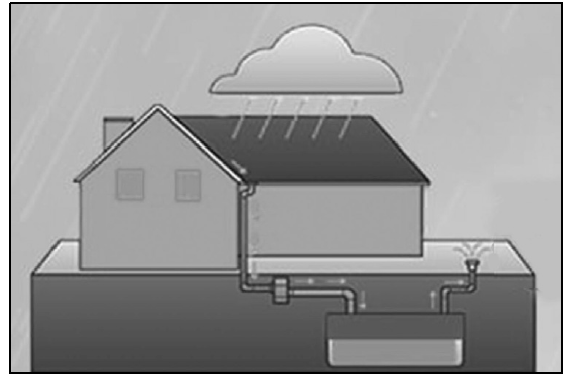
10(iv)(a). Name the water conservation practice shown in the above picture.
[1 mark]10(iv)(b). How does this system help to reduce floods?
[1 mark]10(iv)(c). Why is water conservation necessary? (Any two reasons)
[1 mark]11(a). Mention two advantages that a mini steel plant has over an integrated iron and steel plant.
[2 marks]11(b)(i). Name an iron and steel plant which was established with British collaboration.
[1 mark]11(b)(ii). From where does it get its supply of: 1. iron ore 2. manganese 3. coal
[1 mark]11(c). Give a reason for each of the following:
11(c)(i). Products made from petrochemicals are growing in popularity.
[1 mark]11(c)(ii). A heavy engineering industry requires huge capital investment.
[1 mark]11(c)(iii). The electronics industry contributes to the development of the country.
[1 mark]11(d). Name the industrial product for which the following centres are well known:
11(d)(i). Bhilai
[1 mark]11(d)(ii). Chittaranjan
[1 mark]11(d)(iii). Koraput.
[1 mark]12(a)(i). Where does the Bhilai Iron and Steel Plant get its supply of iron ore from?
[1 mark]12(a)(ii). Where does the Vishakhapatnam Steel Plant get its supply of iron ore from?
[1 mark]12(b). 'Karnataka has developed as an important state for the growth of the silk industry.' Give two reasons to justify the statement.
[2 marks]12(c). With reference to sugar industries answer the following questions:
12(c)(i). Why should these industries be located close to the sugarcane growing areas?
[1 mark]12(c)(ii). Name two by-products of the sugar industry.
[1 mark]12(c)(iii). Mention one leading sugar producing state in North India and one in South India.
[1 mark]12(d). Give a reason for each of the following:
12(d)(i). Ahmedabad is an important cotton textile producing centre in India.
[1 mark]12(d)(ii). Cottage industries are significant for our economy.
[1 mark]12(d)(iii). Petrochemical industries are usually located close to the oil refineries.
[1 mark]