Geography — Suggested Paper 2
105 minutes70 marks Questions from 2016–2026
A suggested paper: every question is a real ICSE board question, chosen from different years and arranged in the current pattern. Start the timed test to have your written answers marked. Question 1 is set on a Survey of India toposheet that cannot be reproduced here.
Part I (30 marks)
Attempt all questions from this Part.
2. On the outline map of India provided:
2(i). Mark with arrows and name South West Monsoon winds over the Bay of Bengal.
[1 mark]2(ii). Shade and name the Wular lake.
[1 mark]2(v). Mark with a dot and name Singhbhum.
[1 mark]2(iii). Mark and label the river Jhelum.
[1 mark]2(vi). Shade and label the river Cauveri.
[1 mark]2(iv). Mark and label Satpura range.
[1 mark]2(vii). Shade and label a sparsely populated region in India.
[1 mark]2(viii). Mark and name Kochi.
[1 mark]2(ix). Shade and label the Andaman Sea.
[1 mark]2(x). Label the river Godavari.
[1 mark]3. Choose the correct answers to the questions from the given options. (Do not copy the questions, write the correct answers only.)
3(i). Soil that becomes infertile because of desilication.
[1 mark]- (a)Black soil
- (b)Alluvial soil
- (c)Red soil
- (d)Laterite soil
3(ii). During which month do we celebrate VAN MAHOTSAV every year in India?
[1 mark]- (a)In December to February time period
- (b)In July to September time period
- (c)In March to May time period
- (d)In November to January time period
3(iii). Assertion (A): Irrigation is practised in large parts of India. Reason (R): India has a variety of soil types.
[1 mark]- (a)(A) is true and (R) is false.
- (b)(A) is false and (R) is true.
- (c)Both (A) and (R) are true and (R) is the correct explanation.
- (d)Both (A) and (R) are true but (R) is not the correct explanation.
3(iv). Refer to the image and answer the question that follows: With reference to the scale given in topographical map (2cm=1km), what is the area of the land enclosed between 48 to 50 easting and 28 to 31 northings?
[1 mark]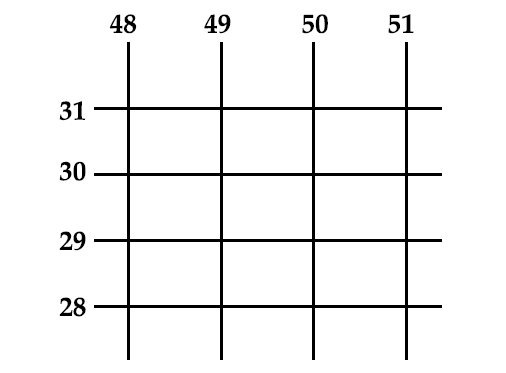
- (a)06 sq. m.
- (b)06 sq. km.
- (c)60 sq. km.
- (d)60 sq. m.
3(v). Why does Patna get more rain than Agra during the summer monsoon season?
[1 mark]- (a)Patna lies on windward side
- (b)Patna is on western side so Arabian sea branch brings more rain to it than to Agra
- (c)Patna is on eastern side, so Bay of Bengal branch brings more rain to it than to Agra
- (d)Patna gets rain throughout the year.
3(vi). Identify the type of coal that has the highest calorific value:
[1 mark]- (a)Peat
- (b)Lignite
- (c)Bituminous
- (d)Anthracite
3(vii). Which of the following is NOT a centre for the iron and steel industry?
[1 mark]- (a)Bhilai
- (b)Bengaluru
- (c)Rourkela
- (d)Vishakhapatnam
3(viii). Which of the following means of transport has best use during floods/earthquake?
[1 mark]- (a)Airways
- (b)Railways
- (c)Roadways
- (d)Waterways
3(ix). Which of the following is NOT suitable for composting?
[1 mark]- (a)Fruit peels
- (b)Egg shells
- (c)Neem soap
- (d)Used tea leaves
3(x). Which of the following farming method is used to grow tea on a large scale?
[1 mark]- (a)Subsistence farming
- (b)Plantation farming
- (c)Mixed farming
- (d)Shifting agriculture
Part II (50 marks)
Attempt any five questions from this Part.
4(i). Why is Black soil found suitable for the production of cotton? (Any two points)
[2 marks]4(ii). Give one difference between each of the following:
4(ii)(a). Alluvial soil of Uttarakhand and alluvial soil of West Bengal.
[1 mark]4(ii)(b). Transported soil and residual soil.
[1 mark]4(iii). With reference to Laterite soil, answer the questions that follow:
4(iii)(a). How is Laterite soil formed?
[1 mark]4(iii)(b). How can Laterite soil be made productive?
[1 mark]4(iii)(c). Name one region where Laterite soil is found.
[1 mark]4(iv)(a). Mention two causes of soil erosion in India.
[2 marks]4(iv)(b). Mention a soil conservation method suitable for hilly area.
[1 mark]5(a). Give two advantages that non-conventional energy source have over conventional energy sources.
[2 marks]5(b)(i). Mention one advantage of the use of natural gas over coal or petroleum.
[1 mark]5(b)(ii). Name one off shore oil field of India.
[1 mark]5(c). Answer the following:
5(c)(i). State one industrial use of copper.
[1 mark]5(c)(ii). Mention one advantage of generating power from bio-gas.
[1 mark]5(c)(iii). Name the mineral that toughens steel and makes it rust-proof.
[1 mark]5(d)(i). Name the metal obtained from Bauxite. Give any one use of the metal mentioned by you.
[2 marks]5(d)(ii). Which multi-purpose project provides power to both Punjab and Himachal Pradesh?
[1 mark]6(a). "Roadways are an important means of transport in India". Give two reasons to justify the statement.
[2 marks]6(b)(i). Why are South Indian rivers not ideal for the inland water transport?
[1 mark]6(b)(ii). Mention one advantage of coastal shipping.
[1 mark]6(c). Give a reason for each of the following:
6(c)(i). Nearly seventy percent of Indians do not use air transport.
[1 mark]6(c)(ii). A well-developed transport network is important for industrial growth.
[1 mark]6(c)(iii). Water transport is not as popular as land transport in India.
[1 mark]6(d)(i). "The railway is an important means of transport as compared to airways." State two reasons to support the statement.
[2 marks]6(d)(ii). Mention one disadvantage of rail transport.
[1 mark]7(a)(i). Name the private sector iron and steel plant of India.
[1 mark]7(a)(ii). From where does it get its supply of: 1. Iron ore 2. Manganese 3. Coal
[1 mark]7(b). Mention any two problems faced by the cotton textile industry of India.
[2 marks]7(c). Give a geographical reason for each of the following:
7(c)(i). Silk industry is doing particularly well in Karnataka.
[1 mark]7(c)(ii). Petrochemical products are gaining popularity in modern times.
[1 mark]7(c)(iii). The electronics industry is proving to be an asset for our country in the field of education.
[1 mark]7(d). Name the following:
7(d)(i). A city most famous for electronics and hence called "The Electronics Capital of India".
[1 mark]7(d)(ii). The location of an iron and steel industry set up with German collaboration.
[1 mark]7(d)(iii). A by-product of sugar industry which is used in the manufacture of wax and shoe polish.
[1 mark]8(i). How are the industries important for India? (Two points)
[2 marks]8(ii). State the difference between Agro based industry and Forest based industry. Give one example for each type of industry.
[2 marks]8(iii)(a). What has made Mumbai an important centre for cotton textile production? (Write any two points)
[2 marks]8(iii)(b). Why are the petrochemical products in great demand?
[1 mark]8(iv)(a). Mention two problems faced by the sugar industry of India.
[1 mark]8(iv)(b). Where is Tata Steel located?
[1 mark]8(iv)(c). Why is the Silk industry losing the market in recent times?
[1 mark]9(i). Mention any one advantage and any one disadvantage of well irrigation.
[2 marks]9(ii). Suggest any two measures to overcome scarcity of water in the metropolitan cities of India.
[2 marks]9(iii). Give one reason to explain each of the following:
9(iii)(a). Tank irrigation is NOT common in Northern India.
[1 mark]9(iii)(b). Canal irrigation is important in Punjab.
[1 mark]9(iii)(c). All farmers do not use tube well irrigation even if the geographical condition is favourable.
[1 mark]9(iv). State any three objectives of rainwater harvesting.
[3 marks]10(i)(a). Give a reason for a substantial rise of E-waste in India.
[1 mark]10(i)(b). What is dumping?
[1 mark]10. 'You cannot protect environment unless you empower people, you inform them and help them to understand that these resources are their own, that they must protect them'. — Wangari Maathai (recipient of Nobel Prize 2004 for Sustainable Development)
10(ii). As a responsible student how would you contribute to reduce and manage the waste generated in your surroundings. Explain by giving suitable examples.
[2 marks]10(iii). With reference to the 3Rs, give a term that best describes each of the following:
10(iii)(a). An empty soft drink can is used as a pen stand.
[1 mark]10(iii)(b). Old scrap papers are used to manufacture handmade paper.
[1 mark]10(iii)(c). No food is wasted in the household.
[1 mark]10(iv). Give a reason for the following statements:
10(iv)(a). Organic manure should replace chemical fertilisers.
[1 mark]10(iv)(b). There should be a ban on the use of polythene and plastic products.
[1 mark]10(iv)(c). Manual handling of waste must be avoided.
[1 mark]11(a). State two ways by which forests help in protecting the environment.
[2 marks]11(b). With reference to Tropical Deciduous forests answer the following questions:
11(b)(i). Name two states where it is found.
[1 mark]11(b)(ii). Name two important trees found in this forest.
[1 mark]11(c). Briefly explain the following:
11(c)(i). Why are Tropical Evergreen forests called "Evergreen"?
[1 mark]11(c)(ii). Why is afforestation essential in the cities that have Iron and Steel industries?
[1 mark]11(c)(iii). How do forests act as a source of income for the people.
[1 mark]11(d). Give a reason for each of the following:
11(d)(i). The Tropical Deciduous forest is commercially the most important forest belt in India.
[1 mark]11(d)(ii). Tropical Evergreen forests occur on the windward side of Western Ghats.
[1 mark]11(d)(iii). It is very difficult to move through tidal forests.
[1 mark]12(i). Why is agriculture considered an important sector of Indian economy? (Any two points)
[2 marks]12(ii)(a). What is mixed farming?
[1 mark]12(ii)(b). Mention any one advantage of mixed farming.
[1 mark]12(iii). Give one reason to explain each of the following:
12(iii)(a). West Bengal is a leading producer of jute.
[1 mark]12(iii)(b). Millets are fast becoming the popular food crops.
[1 mark]12(iii)(c). More than two ratoon crops are not advisable for sugarcane farmers.
[1 mark]12(iv)(a). With reference to tea cultivation, explain the term 'fine pluck'.
[1 mark]12(iv)(b). Name the Indian state that leads in coffee production.
[1 mark]12(iv)(c). Why is cotton grown as a Kharif crop in India?
[1 mark]