Geography — Suggested Paper 3
105 minutes70 marks Questions from 2016–2025
A suggested paper: every question is a real ICSE board question, chosen from different years and arranged in the current pattern. Start the timed test to have your written answers marked. Question 1 is set on a Survey of India toposheet that cannot be reproduced here.
Part I (30 marks)
Attempt all questions from this Part.
2. On the outline map of India provided:
2(i). Mark with arrows and name the wind that brings rainfall to Tamil Nadu coast during winter.
[1 mark]2(vii). Shade and label the Chota Nagpur plateau.
[1 mark]2(ii). Mark and label the Karakoram.
[1 mark]2(iii). Mark and name the Garo Hills.
[1 mark]2(viii). Mark with an arrow and name the NE monsoon over the Bay of Bengal.
[1 mark]2(ix). Mark with a dot and name Delhi.
[1 mark]2(iv). Mark and label the city Chennai.
[1 mark]2(v). Shade and label a region with Red soil in India.
[1 mark]2(vi). Mark and label 80°30' E longitude.
[1 mark]2(x). Mark and label the Karakoram Pass.
[1 mark]3. Choose the correct answers to the questions from the given options. (Do not copy the questions, write the correct answers only.)
3(i). Which is the most widespread soil of India?
[1 mark]- (a)Red soil
- (b)Alluvial soil
- (c)Laterite soil
- (d)Black soil
3(ii). Read the table and identify the pair that is correctly matched: P – Tropical evergreen : Babool Q – Tropical deciduous : Teak R – Littoral : Ebony S – Mountain forest : Banyan
[1 mark]- (a)P
- (b)Q
- (c)R
- (d)S
3(iii). Which of the following is NOT a suitable condition for the development of tank irrigation?
[1 mark]- (a)Presence of natural depressions.
- (b)Permeable rock structure.
- (c)Plenty of rain in rainy period.
- (d)Hard subsurface rock structure.
3(iv). Refer to the image and answer the question that follows: What does the number 200 in grid square 4932 represent?
[1 mark]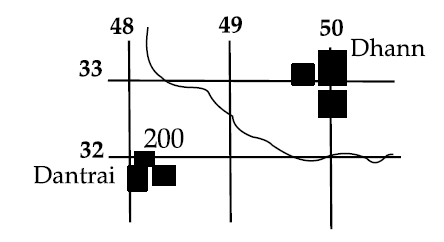
- (a)A line of latitude.
- (b)A line of longitude.
- (c)Contour height.
- (d)Spot height.
3(v). Westerly depressions are active in India during which of the following months?
[1 mark]- (a)Between September and November
- (b)Between December and January
- (c)Between June and September
- (d)Between March and May
3(vi). Identify the source of energy that leads to pollution:
[1 mark]- (a)Tidal energy
- (b)Wind energy
- (c)Natural gas
- (d)Geo-thermal energy
3(vii). Which of the following is a basic/key industry?
[1 mark]- (a)Iron and steel industry
- (b)Silk industry
- (c)Electronic industry
- (d)Cotton textile industry
3(viii). A microbiological process that loosens the bark of a crop and facilitates removal of fibre from the stalk:
[1 mark]- (a)Rolling
- (b)Ratooning
- (c)Retting
- (d)Fermentation
3(ix). Raman, a dairy farmer in Ludhiana, supplies milk within the city on a daily basis. Which mode of transport is he most likely to use?
[1 mark]- (a)Railway
- (b)Roadway
- (c)Airway
- (d)Waterway
3(x). Which of the following method of waste disposal is harmful?
[1 mark]- (a)Composting
- (b)Segregation
- (c)Dumping
- (d)Vermicomposting
Part II (50 marks)
Attempt any five questions from this Part.
4(a). Give two reasons for the importance of the jute industry in the Ganga-Brahmaputra delta region.
[2 marks]4(b). Mention two problems of the Cotton Textile industry in India.
[2 marks]4(c)(i). Give two reasons why the woollen industry is not a flourishing industry in India.
[2 marks]4(c)(ii). Name two centres for this industry.
[1 mark]4(d). With reference to the silk industry, answer the following:
4(d)(i). Why is Karnataka the largest producer of mulberry silk?
[1 mark]4(d)(ii). Mention two varieties of non-mulberry silk produced in India.
[1 mark]4(d)(iii). Name one silk weaving centre each in U.P. and in Tamil Nadu.
[1 mark]5(i). The Ganga Plain is known for its fertile soil. It is often referred to as the food bowl of India. This region supports a variety of crops such as rice, wheat, pulses, jute and sugarcane.
5(i)(a). Name the soil that is found in large parts of Ganga plain.
[1 mark]5(i)(b). Give two properties of this soil which helps it to produce a variety of crops.
[1 mark]5(ii)(a). What is meant by soil erosion?
[1 mark]5(ii)(b). Name any two agents of soil erosion.
[1 mark]5(iii). Give a geographical reason to explain each of the following:
5(iii)(a). Soil conservation is the need of the hour.
[1 mark]5(iii)(b). Red soil has a poor water retention capacity.
[1 mark]5(iii)(c). Laterite soils are infertile.
[1 mark]5(iv). With reference to black soil of India, answer the following questions.
5(iv)(a). How is this soil formed?
[1 mark]5(iv)(b). How is this soil able to retain moisture for a long period?
[1 mark]5(iv)(c). Mention any two minerals present in this soil.
[1 mark]6(a). Give two reasons for the "means of transport" being called the lifelines of a nation's economy.
[2 marks]6(b). Give two ways in which rail transport is useful for the people of India.
[2 marks]6(c)(i). State one advantage of inland waterways.
[1 mark]6(c)(ii). State one advantage of roadways.
[1 mark]6(c)(iii). State one disadvantage of water transport.
[1 mark]6(d). Give three reasons as to why airways are becoming a popular means of transport in modern India.
[3 marks]7(a). "The modern means of irrigation are gaining popularity." Give two reasons to justify this statement.
[2 marks]7(b). Mention two factors that favour the development of tube well irrigation in Punjab.
[2 marks]7(c). Give a reason for each of the following:
7(c)(i). Most of the South Indian states are not suitable for development of canal irrigation.
[1 mark]7(c)(ii). There is an urgent need for water conservation in India.
[1 mark]7(c)(iii). Development of irrigation is essential for the growth of the agriculture sector of India.
[1 mark]7(d). Briefly explain the following terms:
7(d)(i). Inundation canal.
[1 mark]7(d)(ii). Rooftop rainwater harvesting.
[1 mark]7(d)(iii). Surface water.
[1 mark]8(i). Why should waste management be practiced in every school?
[2 marks]8(ii). Mention one advantage and one disadvantage of dumping of waste.
[2 marks]8(iii). Briefly answer the following:
8(iii)(a). How is segregation of the waste helpful?
[1 mark]8(iii)(b). Mention one way in which we can reuse waste.
[1 mark]8(iii)(c). Mention one benefit of Composting.
[1 mark]8(iv)(a). How is recycling of waste helpful? Give an example of recycling of waste.
[2 marks]8(iv)(b). Mention any one initiative taken by the Government to manage waste.
[1 mark]9(a). Mention two reasons why more people use railways rather than airways.
[2 marks]9(b). Why is inland waterways declining in its importance? Give two reasons for your answer.
[2 marks]9(c). What do you mean by the following:
9(c)(i). Sewage
[1 mark]9(c)(ii). Eutrophication
[1 mark]9(c)(iii). Recycling
[1 mark]9(d). 'Methane is an air pollutant that causes Greenhouse effect.' Name three sources of this gas.
[3 marks]10(a). Mention two points of difference between subsistence farming and commercial farming.
[2 marks]10(b). Explain briefly the following terms:
10(b)(i). Ginning.
[1 mark]10(b)(ii). Ratooning.
[1 mark]10(c). With reference to the wheat crop answer the following questions:
10(c)(i). Name the state which is the leading producer of this crop in India.
[1 mark]10(c)(ii). Mention the climatic condition found suitable for the cultivation of this crop.
[2 marks]10(d). Give a geographical reason for each of the following:
10(d)(i). Cultivation of rice requires flat level land.
[1 mark]10(d)(ii). Pulses are important rotation crops.
[1 mark]10(d)(iii). Bajra and Jowar are grown as dry crops.
[1 mark]11(i). State any two factors that are responsible for the growth of the cotton textile industry in Kolkata.
[2 marks]11(ii). 'Karnataka is the leading state for silk production in India'. Give any two reasons to justify the above statement.
[2 marks]11(iii)(a). Name the Iron and Steel industry located at Chhattisgarh.
[1 mark]11(iii)(b). From where does the industry named by you above get its supply of the following? 1. Iron ore 2. Coal
[2 marks]11(iv). Raghav has been given a project by his teacher in which he has to write about the by-products of an industry that is used for preparing shoe polish, carbon paper and cardboard.
11(iv)(a). Which industry will he be writing about?
[1 mark]11(iv)(b). Name any two by-products of the industry mentioned by you.
[2 marks]12(i). 'Himalayas act as a climatic divide'. Justify the statement giving two reasons.
[2 marks]12(ii). Differentiate between Southwest Monsoon and Retreating Monsoon. (Any two differences)
[2 marks]12(iii). Give a geographical reason for the following:
12(iii)(a). Kolkata gets more rain than Delhi during rainy season.
[1 mark]12(iii)(b). Though both are hill stations, Shimla experiences snowfall during the winters but Ooty does not.
[1 mark]12(iii)(c). Winter monsoons bring less rain.
[1 mark]12(iv). Study the climate data of Station X and answer the questions that follow:
12(iv). Month: Jan Feb Mar Apr May Jun Jul Aug Sep Oct Nov Dec | Temp °C: 8.4, 11.5, 21.6, 28.3, 35.1, 38.5, 41.0, 38.0, 30.8, 29.2, 15.6, 10.2 | Rainfall cm: 1.5, 0.9, 0.5, –, –, 12.5, 17.8, 18.5, 12.5, 12.5, 6.2, 2.1
12(iv)(a). Calculate the annual range of temperature of Station X.
[1 mark]12(iv)(b). Name the rainiest month of the Station X.
[1 mark]12(iv)(c). Is the Station X located in coastal area or in the continental interior?
[1 mark]