Chemistry — Suggested Paper 5
Two hours80 marks Questions from 2016–2026
A suggested paper: every question is a real ICSE board question, chosen from different years and arranged in the current pattern. Start the timed test to have your written answers marked.
Instructions to Candidates: 1. Answers to this Paper must be written on the paper provided separately. 2. You will not be allowed to write during the first 15 minutes. 3. This time is to be spent in reading the question paper. 4. The time given at the head of this Paper is the time allowed for writing the answers. 5. Section A is compulsory. Attempt any four questions from Section B 6. The intended marks for questions or parts of questions are given in brackets [ ]
Section A (40 marks)
Attempt all questions from this Section.
1. Choose the correct answers to the questions from the given options. (Do not copy the questions, write the correct answers only.)
1(i). The aqueous solution that contains both ions and molecules:
[1 mark]- (a)sulphuric acid
- (b)nitric acid
- (c)acetic acid
- (d)hydrochloric acid
1(ii). In the periodic Table, elements of period 3 are arranged in the increasing order of ionization potential as:
[1 mark]- (a)B, N, Cl, Ar
- (b)Mg, Si, S, Ar
- (c)Ar, Si, S, Mg
- (d)Si, Ar, Cl, Mg
1(iii). An electrolyte which completely dissociates into ions is:
[1 mark]- (a)Alcohol
- (b)Carbonic acid
- (c)Sucrose
- (d)Sodium hydroxide
1(iv). The ratio between the number of molecules in 2g of hydrogen and 32g of oxygen is:
[1 mark]- (a)1:2
- (b)1:0.01
- (c)1:1
- (d)0.01:1
1(v). Substance which helps to lower the fusion point of the mixture in Hall Heroult Process:
[1 mark]- (a)Coke
- (b)Concentrated sodium hydroxide
- (c)Fluorspar
- (d)Concentrated potassium hydroxide
1(vi). The indicator which changes to pink colour in an alkaline solution is:
[1 mark]- (a)Blue Litmus
- (b)Methyl Orange
- (c)Red Litmus
- (d)Phenolphthalein
1(vii). A non-metal which reacts with concentrated sulphuric acid to form two gases which turn lime water milky is ............... .
[1 mark]- (a)Sulphur
- (b)Carbon
- (c)Oxygen
- (d)Nitrogen
1(viii). A compound with low boiling point, is:
[1 mark]- (a)Sodium chloride
- (b)Calcium chloride
- (c)Potassium chloride
- (d)Carbon tetrachloride
1(ix). A chloride which forms a precipitate that is soluble in excess of ammonium hydroxide, is:
[1 mark]- (a)Calcium chloride
- (b)Ferrous chloride
- (c)Ferric chloride
- (d)Copper chloride
1(x). The property exhibited by concentrated sulphuric acid when it is used to prepare hydrogen chloride gas from potassium chloride:
[1 mark]- (a)Dehydrating property
- (b)Drying property
- (c)Oxidizing property
- (d)Non-volatile acid property
1(xi). X, Y & Z are three metallic atoms in successive order belonging to the same group such that atomic radii of ‘X’ is the smallest. Which of the three atoms is the best reducing agent?
[1 mark]- (a)X
- (b)Y
- (c)Z
- (d)All three have the same reducing power.
1(xii). The tendency of an atom to attract shared pair of electrons to itself when forming a chemical bond is known as:
[1 mark]- (a)Electron affinity
- (b)Electronegativity
- (c)Ionization potential
- (d)Nuclear charge
1(xiii). The inert electrode used in the electrolysis of acidified water, is:
[1 mark]- (a)Nickel
- (b)Platinum
- (c)Copper
- (d)Silver
1(xiv). If the empirical mass of the formula PQ₂ is 10 and the Relative Molecular Mass is 30, then the molecular formula will be:
[1 mark]- (a)PQ₂
- (b)P₃Q₂
- (c)P₆Q₂
- (d)P₃Q₆
1(xv). The compound that is not an ore of aluminium:
[1 mark]- (a)Cryolite
- (b)Corundum
- (c)Fluorspar
- (d)Bauxite
2(i). Fill in the blanks from the choices given in brackets:
2(i)(i). The energy required to remove an electron from a neutral isolated gaseous atom and convert it into a positively charged gaseous ion is called .............. (electron affinity, ionisation potential, electronegativity)
[1 mark]2(i)(ii). The compound that does not have a lone pair of electrons is .............. (water, ammonia, carbon tetra chloride)
[1 mark]2(i)(iii). When a metallic oxide is dissolved in water, the solution formed has a high concentration of .............. ions. (H⁺, H₃O⁺, OH⁻)
[1 mark]2(i)(iv). Potassium sulphite on reacting with hydrochloric acid releases .............. gas. (Cl₂, SO₂, H₂S)
[1 mark]2(i)(v). The compound formed when ethene reacts with Hydrogen is .............. (CH₄, C₂H₆, C₃H₈)
[1 mark]2(ii). Fill in the blanks with the choices given in brackets:
2(ii)(i). Conversion of ethanol to ethene by the action of concentrated sulphuric acid is an example of ............... (dehydration/dehydrogenation/dehydrohalogenation)
[1 mark]2(ii)(ii). When sodium chloride is heated with concentrated sulphuric acid below 200°C, one of the products formed is ............... (sodium hydrogen sulphate / sodium sulphate / chlorine)
[1 mark]2(ii)(iii). Ammonia reacts with excess chlorine to form ............... (nitrogen / nitrogen trichloride / ammonium chloride)
[1 mark]2(ii)(iv). Substitution reactions are characteristic reactions of ............... (alkynes / alkenes / alkanes)
[1 mark]2(ii)(v). In Period 3, the most metallic element is ............... (sodium / magnesium / aluminium)
[1 mark]2(iii). Match the Column A with Column B:
[5 marks]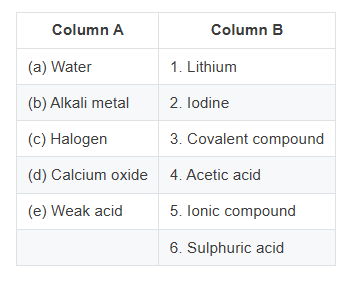
2(iv). Write a balanced chemical equation for each of the following:
2(iv)(i). Action of concentrated sulphuric acid on carbon.
[1 mark]2(iv)(ii). Reaction of sodium hydroxide solution with iron (III) chloride solution.
[1 mark]2(iv)(iii). Action of heat on aluminum hydroxide.
[1 mark]2(iv)(iv). Reaction of zinc with potassium hydroxide solution.
[1 mark]2(iv)(v). Action of dilute hydrochloric acid on magnesium sulphite.
[1 mark]2(v)(i). Calculate:
2(v)(i)(1). The number of moles in 12g of oxygen gas. [O = 16]
[2 marks]2(v)(i)(2). The weight of 1022 atoms of carbon. [C = 12, Avogadro’s No. = 6 x 10²³]
[2 marks]2(v)(ii). Molecular formula of a compound is C₆H₁₈O₃. Find its empirical formula.
[1 mark]Section B (40 marks)
Attempt any four questions from this Section.
3(i). State a relevant reason for the following:
3(i)(a). Hydrogen chloride gas cannot be dried over quick lime.
[1 mark]3(i)(b). Ammonia gas is not collected over water.
[1 mark]3(ii). Identify the alloy in each case from the given composition:
3(ii)(a). aluminium, magnesium, manganese, copper
[1 mark]3(ii)(b). iron, nickel, chromium, carbon
[1 mark]3(iii). Solve the following numerical problem. Ethane burns in oxygen according to the chemical equation: 2C₂H₆ + 7O₂ ⟶ 4CO₂ + 6H₂O If 80 ml of ethane is burnt in 300 ml of oxygen, find the composition of the resultant gaseous mixture when measured at room temperature.
[3 marks]3(iv). The following questions are pertaining to the laboratory preparation of Ammonia gas from Magnesium nitride:
3(iv)(a). Write a balanced chemical equation for its preparation.
[1 mark]3(iv)(b). Why is this method seldom used?
[1 mark]3(iv)(c). How do you identify the gas formed?
[1 mark]4(a). Name the gas evolved when the following mixtures are heated:
4(a)(i). Calcium hydroxide and Ammonium Chloride
[1 mark]4(a)(ii). Sodium Nitrite and Ammonium Chloride
[1 mark]4(b). Write balanced chemical equations for each of the following:
4(b)(i). When excess of ammonia is treated with chlorine.
[1 mark]4(b)(ii). An equation to illustrate the reducing nature of ammonia.
[1 mark]4(c). A, B, C and D summarize the properties of sulphuric acid depending on whether it is dilute or concentrated. A: Typical acid property B: Non-volatile acid C: Oxidizing agent D: Dehydrating agent Choose the property [A, B, C or D] depending on which is relevant to each of the following:
4(c)(i). Preparation of hydrogen chloride gas.
[1 mark]4(c)(ii). Preparation of copper sulphate from copper oxide.
[1 mark]4(c)(iii). Action of conc. sulphuric acid on sulphur.
[1 mark]4(d). Give reasons why:
4(d)(i). Sodium Chloride will conduct electricity only in fused or aqueous solution state.
[1 mark]4(d)(ii). In the electroplating of an article with silver, the electrolyte sodium argento-cyanide solution is preferred over silver nitrate solution.
[1 mark]4(d)(iii). Although copper is a good conductor of electricity, it is a non-electrolyte.
[1 mark]5(a). Give the chemical formula of:
5(a)(i). Bauxite
[1 mark]5(a)(ii). Cryolite
[1 mark]5(a)(iii). Sodium aluminate
[1 mark]5(b). Answer the following questions based on the extraction of aluminium from alumina by Hall-Heroult's Process.:
5(b)(i). What is the function of cryolite used along with alumina as the electrolyte?
[1 mark]5(b)(ii). Why is powdered coke sprinkled on top of the electrolyte?
[1 mark]5(b)(iii). Name the electrode, from which aluminium is collected.
[1 mark]5(c). Match the alloys given in column I to the uses given in column II:
[4 marks]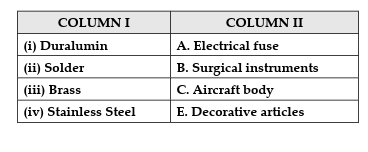
6(a). Identify the salts P, Q, R from the following observations:
6(a)(i). Salt P has light bluish green colour. On heating, it produces a black coloured residue. Salt P produces brisk effervescence with dil. HCl and the gas evolved turns lime water milky, but no action with acidified potassium dichromate solution.
[1 mark]6(a)(ii). Salt Q is white in colour. On strong heating, it produces buff yellow residue and liberates reddish brown gas. Solution of salt Q produces chalky white insoluble precipitate with excess of ammonium hydroxide.
[1 mark]6(a)(iii). Salt R is black in colour. On reacting with concentrated HCl, it liberates a pungent greenish yellow gas which turns moist starch iodide paper blue black.
[1 mark]6(b). Identify the substance underlined in each of the following:
6(b)(i). The electrode that increases in mass during the electro-refining of silver.
[1 mark]6(b)(ii). The acid that is a dehydrating as well as a drying agent.
[1 mark]6(b)(iii). The catalyst used to oxidize ammonia into nitric oxide.
[1 mark]6(c). Copy and complete the following paragraph using the options given in brackets: Alkenes are a homologous series of (i) ............... (saturated / unsaturated) hydrocarbons characterized by the general formula (ii) ............... (CnH2n/CnH2n). Alkenes undergo (iii)............... (addition / substitution) reactions and also undergo (iv) ............... (hydrogenation / dehydrogenation) to form alkanes.
[4 marks]7(a). A gas cylinder contains 12 x 1024 molecules of oxygen gas. If Avogadro's number is 6 x 10²³; Calculate:
7(a)(i). the mass of oxygen present in the cylinder.
[1 mark]7(a)(ii). the volume of oxygen at S.T.P. present in the cylinder. [O=16]
[1 mark]7(b). A gaseous hydrocarbon contains 82.76% of carbon. Given that its vapour density is 29, find its molecular formula. [C=12, H=1]
[3 marks]7(c). The equation : 4NH₃ + 5O₂ ⟶ 4NO + 6H₂O represents the catalytic oxidation of ammonia. If 100 cm³ of ammonia is used calculate the volume of oxygen required to oxidize the ammonia completely.
[3 marks]7(d). By drawing an electron dot diagram show the formation of ammonium ion [N = 7, H = 1]
[2 marks]8(a)(i). What do you understand by a lone pair of electrons?
[1 mark]8(a)(ii). Draw the electron dot diagram of Hydronium ion. (H=1; O=8)
[2 marks]8(b). In Period 3 of the Periodic Table, element B is placed to the left of element A. On the basis of this information, choose the correct word from the brackets to complete the following statements:
8(b)(i). The element B would have (lower / higher) metallic character than A.
[1 mark]8(b)(ii). The element A would probably have (lesser / higher) electron affinity than B.
[1 mark]8(b)(iii). The element A would have (greater / smaller) atomic size than B.
[1 mark]8(c). Copy and complete the following table which refers to the conversion of ions to neutral particles.
[4 marks]