Chemistry — Suggested Paper 3
Two hours80 marks Questions from 2016–2026
A suggested paper: every question is a real ICSE board question, chosen from different years and arranged in the current pattern. Start the timed test to have your written answers marked.
Instructions to Candidates: 1. Answers to this Paper must be written on the paper provided separately. 2. You will not be allowed to write during the first 15 minutes. 3. This time is to be spent in reading the question paper. 4. The time given at the head of this Paper is the time allowed for writing the answers. 5. Section A is compulsory. Attempt any four questions from Section B 6. The intended marks for questions or parts of questions are given in brackets [ ]
Section A (40 marks)
Attempt all questions from this Section.
1. Choose the correct answers to the questions from the given options. (Do not copy the questions, write the correct answers only.)
1(i). Identify the equation that shows the reaction of ethane with chlorine in the presence of ultraviolet light.
[1 mark]- (a)C₂H₆ + Cl₂ → C₂H₆Cl₂
- (b)C₂H₆ + Cl₂ → C₂H₄Cl₂ + H₂
- (c)C₂H₆ + Cl₂ → C₂H₅Cl + HCl
- (d)C₂H₆ + Cl₂ → 2CH₃Cl
1(ii). An element in period 3, whose electron affinity is zero:
[1 mark]- (a)Neon
- (b)Sulphur
- (c)Sodium
- (d)Argon
1(iii). Which of the following reactions takes place at the anode during the electroplating of an article with silver?
[1 mark]- (a)Ag - 1e⁻ ⟶ Ag¹⁺
- (b)Ag + 1e⁻ ⟶ Ag¹⁻
- (c)Ag - 1e⁻ ⟶ Ag
- (d)None of the above
1(iv). If Relative Molecular Mass of Butane (C₄H₁₀) is 58 then its vapour density will be:
[1 mark]- (a)58
- (b)29
- (c)32
- (d)16
1(v). The compound that is not a constituent of the electrolytic mixture used in the Hall-Heroult's process is:
[1 mark]- (a)Al₂O₃
- (b)NaAlO₂
- (c)Na₃AlF₆
- (d)CaF₂
1(vi). The products formed when an acid reacts with a base is:
[1 mark]- (a)salt and hydrogen
- (b)salt and oxygen
- (c)salt and water
- (d)salt and carbon dioxide
1(vii). Vanadium pentoxide is used as a catalyst in the preparation of:
[1 mark]- (a)Nitrogen gas
- (b)Nitrogen dioxide gas
- (c)Sulphur trioxide gas
- (d)Carbon dioxide gas
1(viii). Which one of the following is a non-metallic cation?
[1 mark]- (a)K⁺
- (b)NH₄⁺
- (c)Cu²⁺
- (d)Na⁺
1(ix). The metallic hydroxide which forms a deep inky blue solution with excess ammonium hydroxide solution is:
[1 mark]- (a)Fe(OH)₂
- (b)Cu(OH)₂
- (c)Ca(OH)₂
- (d)Fe(OH)₃
1(x). The aim of the Fountain Experiment is to prove that:
[1 mark]- (a)HCI turns blue litmus red
- (b)HCI is denser than air
- (c)HCl is highly soluble in water
- (d)HCl fumes in moist air.
1(xi). Ammonia gas is collected by downward displacement of air since ammonia is:
[1 mark]- (a)very slightly soluble in water.
- (b)heavier than air.
- (c)lighter than air.
- (d)insoluble in water.
1(xii). The metal whose oxide can be reduced by common reducing agents:
[1 mark]- (a)Copper
- (b)Sodium
- (c)Aluminium
- (d)Potassium
1(xiii). If an element has low ionization potential, then it is likely to be a:
[1 mark]- (a)metal
- (b)metalloid
- (c)non metal
- (d)inert gas
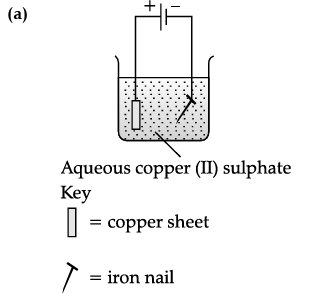
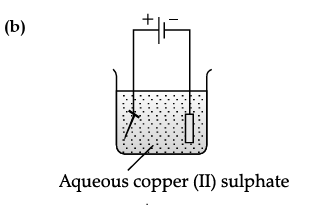
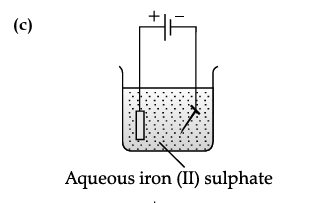
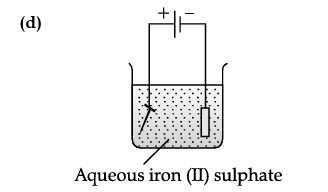
1(xiv). Which apparatus could be used to electroplate an iron nail with copper?
[1 mark]- a
- b
- c
- d
1(xv). An organic compound has a vapour density of 22. The molecular formula of the organic compound is: [Atomic weight: C = 12, H = 1]
[1 mark]- (a)CH₄
- (b)C₂H₄
- (c)C₂H₆
- (d)C₃H₈
2. Write a balanced chemical equation for each of the following:
2(i)(i). Action of cold and dilute Nitric acid on Copper.
[1 mark]2(i)(ii). Reaction of Ammonia with heated copper oxide.
[1 mark]2(i)(iii). Preparation of methane from iodomethane.
[1 mark]2(i)(iv). Action of concentrated sulphuric acid on Sulphur.
[1 mark]2(i)(v). Laboratory preparation of ammonia from ammonium chloride.
[1 mark]2(ii)(i). Reaction of carbon powder and concentrated nitric acid.
[1 mark]2(ii)(ii). Reaction of excess ammonia with chlorine.
[1 mark]2(ii)(iii). Reaction of lead nitrate solution with ammonium hydroxide.
[1 mark]2(ii)(iv). Producing ethane from bromo ethane using Zn/Cu couple in alcohol.
[1 mark]2(ii)(v). Complete combustion of ethane.
[1 mark]2(iii). The following sketch illustrates the process of conversion of Alumina to Aluminium: Study the diagram and answer the following:
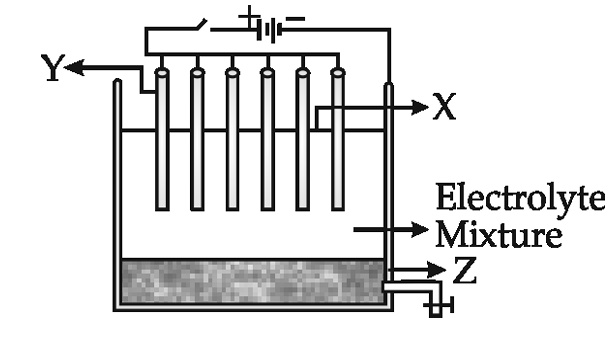
2(iii)(a). Name the constituent of the electrolyte mixture which has a divalent metal in it.
[1 mark]2(iii)(b). Name the powdered substance 'X' sprinkled on the surface of the electrolyte mixture.
[1 mark]2(iii)(c). What is the name of the process?
[1 mark]2(iii)(d). Write the reactions taking place at the electrodes 'Y' (anode) and 'Z' (cathode) respectively.
[2 marks]2(iv). Name the gas that is produced in each of the following cases:
2(iv)(i). Sulphur is oxidized by concentrated nitric acid.
[1 mark]2(iv)(ii). Action of dilute hydrochloric acid on sodium sulphide.
[1 mark]2(iv)(iii). Action of cold and dilute nitric acid on copper.
[1 mark]2(iv)(iv). At the anode during the electrolysis of acidified water.
[1 mark]2(iv)(v). Reaction of ethanol and sodium.
[1 mark]2(v). Match the Column A with Column B:
[5 marks]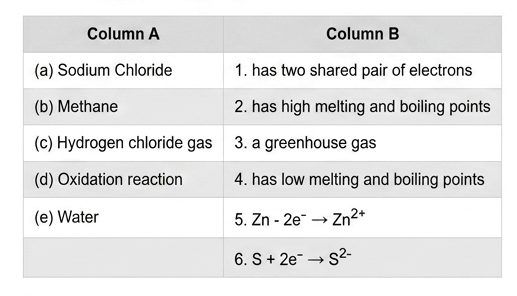
Section B (40 marks)
Attempt any four questions from this Section.
3(i). Define / State:
3(i)(a). Electronegativity
[1 mark]3(i)(b). Gay-Lussac's Law of combining volumes
[1 mark]3(ii). The Empirical formula of an organic compound is CHCl₂ If its relative molecular mass is 168, what is its molecular formula? [At. Wt. C = 12, H = 1, Cl = 35.5]
[2 marks]3(iii). Choose the substances given in the box below to answer the following questions:
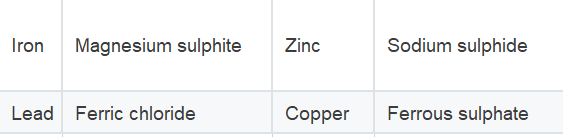
3(iii)(a). The metal that will not produce hydrogen gas when reacted with dilute acids.
[1 mark]3(iii)(b). The compound that will produce sulphur dioxide gas when reacted with dilute HCl.
[1 mark]3(iii)(c). The solution of this compound produces dirty green precipitate with NaOH.
[1 mark]3(iv). State one relevant observation for each of the following:
3(iv)(a). To the copper nitrate solution, initially few drops of sodium hydroxide solution is added and then added in excess.
[1 mark]3(iv)(b). Burning of ammonia in excess of oxygen.
[1 mark]3(iv)(c). Dry ammonia gas is passed over heated PbO.
[1 mark]4(i). Given below is a diagram showing the placement of five different oxides. With respect to the given diagram answer the following questions:
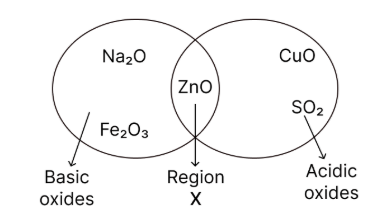
4(i)(a). Name the type of oxide represented in region X in the diagram.
[1 mark]4(i)(b). Identify the oxide which has been incorrectly placed in the above diagram.
[1 mark]4(i)(c). Name the oxide from the above diagram which will form an alkali when dissolved in water.
[1 mark]4(ii). Given below are organic compounds labelled A to F. Answer the questions that follow:
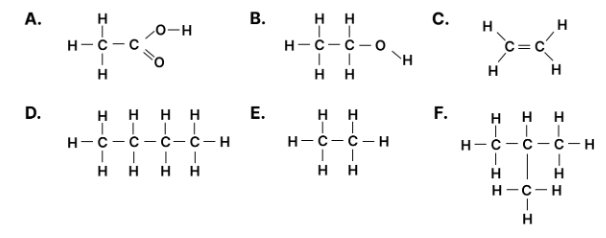
4(ii)(a). Which compound forms a single product with bromine?
[1 mark]4(ii)(b). Which two compounds have the same molecular formula?
[1 mark]4(ii)(c). Which two compounds will react together in the presence of concentrated H₂SO₄ to form a product with a fruity smell?
[1 mark]4(iii). An organic compound ‘X’ contains carbon, oxygen and hydrogen only. The percentage of carbon and hydrogen are 47.4% and 10.5% respectively. The relative molecular mass of ‘X’ is 76. Find the empirical formula and the molecular formula of ‘X’. [Atomic weight: C = 12, O = 16, H = 1]
[4 marks]5(a)(i). Complete the following table which relates to the homologous series of hydrocarbons.
[6 marks]
5(b)(i). Name the most common ore of the metal aluminum from which the metal is extracted. Write the chemical formula of the ore.
[2 marks]5(b)(ii). Name the process by which impure ore of aluminum gets purified by using concentrated solution of an alkali.
[1 mark]5(b)(iii). Write the equation for the formation of aluminum at the cathode during the electrolysis of alumina.
[1 mark]6(a). Differentiate between the following pairs based on the information given in the brackets.
6(a)(i). Conductor and electrolyte (conducting particles)
[1 mark]6(a)(ii). Cations and anions (formation from an atom)
[1 mark]6(a)(iii). Acid and Alkali (formation of type of ions)
[1 mark]6(b). Draw the structures of isomers of pentane.
[3 marks]6(c). Hydrogen chloride gas is prepared in the laboratory using concentrated sulphuric acid and sodium chloride. Answer the questions that follow based on this reaction:
6(c)(i). Give the balanced chemical equation for the reaction with suitable condition(s) if any.
[1 mark]6(c)(ii). Why is concentrated sulphuric acid used instead of concentrated nitric acid?
[1 mark]6(c)(iii). How is the gas collected?
[1 mark]6(c)(iv). Name the drying agent not used for drying the gas.
[1 mark]7(a). Give a chemical test to distinguish between the following pairs of chemicals:
7(a)(i). Lead nitrate solution and Zinc nitrate solution
[2 marks]7(a)(ii). Sodium chloride solution and Sodium nitrate solution
[2 marks]7(b). Write a balanced equation for the preparation of each of the following salts:
7(b)(i). Copper sulphate from Copper carbonate.
[1 mark]7(b)(ii). Zinc carbonate from Zinc sulphate.
[1 mark]7(c)(i). What is the type of salt formed when the reactants are heated at a suitable temperature for the preparation of Nitric acid?
[1 mark]7(c)(ii). State why for the preparation of Nitric acid, the complete apparatus is made up of glass.
[1 mark]7(d). Which property of sulphuric acid is shown by the reaction of concentrated sulphuric acid with:
7(d)(i). Ethanol?
[1 mark]7(d)(ii). Carbon?
[1 mark]8(a). Identify the substances underlined :
8(a)(i). The catalyst used to oxidise ammonia.
[1 mark]8(a)(ii). The organic compound which when solidified, forms an ice like mass.
[1 mark]8(a)(iii). The dilute acid which is an oxidizing agent.
[1 mark]8(b). Copper sulphate solution reacts with sodium hydroxide solution to form a precipitate of copper hydroxide according to the equation: 2NaOH + CuSO₄ ⟶ Na₂SO₄ + Cu(OH)₂↓
8(b)(i). What mass of copper hydroxide is precipitated by using 200 g of sodium hydroxide. [H = 1, O = 16, Na = 23, S = 32, Cu = 64]
[2 marks]8(b)(ii). What is the colour of the precipitate formed.
[1 mark]8(c). Find the empirical formula and the molecular formula of an organic compound from the data given below: C = 75.92%, H = 6.32% and N = 17.76% The vapour density of the compound is 39.5. [C = 12, H = 1, N = 14]
[4 marks]