Chemistry — Suggested Paper 1
Two hours80 marks Questions from 2017–2026
A suggested paper: every question is a real ICSE board question, chosen from different years and arranged in the current pattern. Start the timed test to have your written answers marked.
Instructions to Candidates: 1. Answers to this Paper must be written on the paper provided separately. 2. You will not be allowed to write during the first 15 minutes. 3. This time is to be spent in reading the question paper. 4. The time given at the head of this Paper is the time allowed for writing the answers. 5. Section A is compulsory. Attempt any four questions from Section B 6. The intended marks for questions or parts of questions are given in brackets [ ]
Section A (40 marks)
Attempt all questions from this Section.
1. Choose the correct answers to the questions from the given options. (Do not copy the questions, write the correct answers only.)
1(i). Which of the following options has all the compounds which are members of the same homologous series?
[1 mark]- (a)CH₄, C₂H₆, C₃H₈
- (b)CH₄, C₂H₆, C₃H₆
- (c)C₃H₄, C₃H₆, C₃H₈
- (d)C₂H₄, C₃H₆, C₄H₁₀
1(ii). Which statement about conduction of electricity is correct?
[1 mark]- (a)Electricity is conducted in aqueous solution by electrons
- (b)Electricity is conducted in a metal wire by ions
- (c)Electricity is conducted in a molten electrolyte by electrons
- (d)Electricity is conducted in an acid solution by ions
1(iii). Given below are four ions: Cl⁻, Li⁺, Al³⁺, K⁺ Identify the pair of ions which have the same electronic configuration. [Atomic number: Cl = 17, Li = 3, Al = 13, K = 19]
[1 mark]- (a)& Li⁺
- (b)Al³⁺ & K⁺
- (c)Cl⁻ & K⁺
- (d)Li⁺ & K⁺
1(iv). If the pH of a solution is ‘2’, then solution is a:
[1 mark]- (a)strong acid
- (b)strong alkali
- (c)weak acid
- (d)weak alkali
1(v). What volume of carbon dioxide is produced at STP when 5 litres of propane is burnt completely according to the equation given below? C₃H₈ + 5O₂ → 3CO₂ + 4H₂O
[1 mark]- (a)10 litres
- (b)15 litres
- (c)20 litres
- (d)25 litres
1(vi). The compound that has the highest melting point amongst the following is:
[1 mark]- (a)Methane
- (b)Sodium chloride
- (c)Ammonia
- (d)Ethanol
1(vii). The acid which is least volatile is:
[1 mark]- (a)Hydrochloric acid
- (b)Nitric acid
- (c)Dilute sulphuric acid
- (d)Concentrated sulphuric acid
1(viii). Which of the following compounds neither dissociate not ionise in water?
[1 mark]- (a)Hydrochloric acid
- (b)Sodium hydroxide
- (c)Potassium Nitrate
- (d)Carbon tetrachloride
1(ix). A student added excess of sodium hydroxide solution to each of the salt solution. An insoluble precipitate formed was observed in:
[1 mark]- (a)Calcium nitrate
- (b)Zinc nitrate
- (c)Lead nitrate
- (d)Sodium nitrate
1(x). In the laboratory preparation, HCl gas is dried by passing through:
[1 mark]- (a)dilute nitric acid
- (b)concentrated sulphuric acid
- (c)dilute sulphuric acid
- (d)acidified water
1(xi). On passing ammonia gas over heated copper oxide for some time, a reddish-brown residue is left behind. What property of ammonia is demonstrated here?
[1 mark]- (a)Basic property
- (b)Oxidising property
- (c)Reducing property
- (d)Acidic property
1(xii). The gas formed, when calcium bisulphite reacts with dilute HNO₃:
[1 mark]- (a)Sulphur trioxide
- (b)Hydrogen
- (c)Sulphur dioxide
- (d)Hydrogen sulphide
1(xiii). Rita added dilute hydrochloric acid to four metals. She recorded her observations in the table given below. While noting her observations she made some errors. Which observation(s) made by Rita is/are correct?
[1 mark]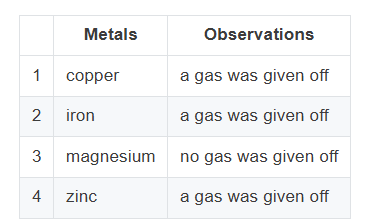
- (a)1 only
- (b)3 only
- (c)Both 1 and 4
- (d)Both 2 and 4
1(xiv). If the molecular formula of an organic compound is C₁₀H₁₈ it is:
[1 mark]- (a)alkene
- (b)alkane
- (c)alkyne
- (d)Not a hydrocarbon
1(xv). Solid sodium chloride does not conduct electricity as:
[1 mark]- (a)The strength of the bond is weak
- (b)It contains free ions
- (c)It does not contain any free ions
- (d)It contains free ions as well as molecules
2(i). Give the appropriate term defined by the statements given below:
2(i)(i). The formula that represents the simplest ratio of the various elements present in one molecule of the compound.
[1 mark]2(i)(ii). The substance that releases hydronium ion as the only positive ion when dissolved in water.
[1 mark]2(i)(iii). The tendency of an atom to attract electrons towards itself when combined in a covalent compound.
[1 mark]2(i)(iv). The process by which certain ores, specially carbonates, are converted to oxides in the absence of air.
[1 mark]2(i)(v). The covalent bond in which the electrons are shared equally between the combining atoms.
[1 mark]2(ii). A student was instructed by the teacher to prepare and collect ammonia gas in the laboratory by using aluminium nitride. The student had set up the apparatus as shown in the diagram below. Study the given diagram and answer the following questions:
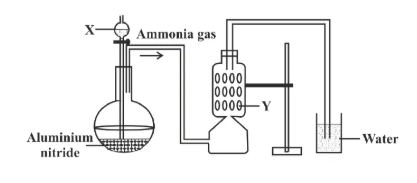
2(ii)(a). Name the substance X added through the thistle funnel by the student.
[1 mark]2(ii)(b). Write a balanced equation for the reaction occurring between Aluminium nitride and substance X.
[1 mark]2(ii)(c). Identify the substance Y.
[1 mark]2(ii)(d). State the function of Y.
[1 mark]2(ii)(e). Why could the student not collect ammonia gas at the end of the experiment?
[1 mark]2(iii). The following sketch represents the electroplating of an Iron cup with Nickel metal. Study the diagram and answer the following questions:
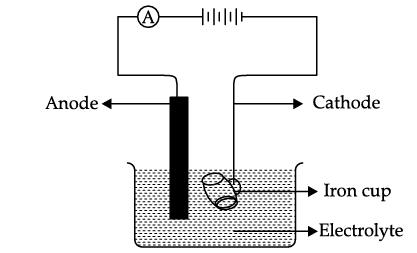
2(iii)(a). During electroplating the iron cup is placed at the cathode. Why?
[1 mark]2(iii)(b). Name the ion that must be present in the electrolyte.
[1 mark]2(iii)(c). State one condition that is necessary to ensure that the deposit is smooth, firm and even.
[1 mark]2(iii)(d). Write the reaction taking place at the cathode.
[1 mark]2(iii)(e). What change would you observe at the anode?
[1 mark]2(iv). State the terms for the following:
2(iv)(a). The group obtained by removing one hydrogen atom from the parent alkane.
[1 mark]2(iv)(b). Two metal plates or wires through which the current enters and leaves the electrolytic cell.
[1 mark]2(iv)(c). The amount of substance which contains the same number of units as the number of atoms in carbon-12.
[1 mark]2(iv)(d). The tendency of an atom to pull a shared pair of electrons towards itself in a compound.
[1 mark]2(iv)(e). The formula which represents the simplest ratio between the atoms of elements present in a compound.
[1 mark]2(v). Arrange the following according to the instructions given in brackets:
2(v)(i). K, Pb, Ca, Zn. (In the increasing order of the reactivity)
[1 mark]2(v)(ii). Mg²⁺, Cu²⁺, Na¹⁺, H¹⁺ (In the order of preferential discharge at the cathode)
[1 mark]2(v)(iii). Li, K, Na, H (In the decreasing order of their ionization potential)
[1 mark]2(v)(iv). F, B, N, O (In the increasing order of electron affinity)
[1 mark]2(v)(v). Ethane, methane, ethene, ethyne. (In the increasing order of the molecular weight) [H = 1, C = 12]
[1 mark]Section B (40 marks)
Attempt any four questions from this Section.
3(i). Write one use of the following alloys:
3(i)(a). Bronze
[1 mark]3(i)(b). Fuse metal
[1 mark]3(ii). Draw the electron dot structure for the following: [At. No.: N=7, H=1]
3(ii)(a). Ammonium ion
[1 mark]3(ii)(b). A molecule of nitrogen
[1 mark]3(iii). Give a balanced chemical equation for the following conversions with conditions:
3(iii)(a). Ethene from ethanol
[1 mark]3(iii)(b). Ethyne from calcium carbide
[1 mark]3(iii)(c). Monochloromethane from methane
[1 mark]3(iv). Study the following observations and name the anions present in each of the reactions.
3(iv)(a). When a crystalline solid 'P' is warmed with concentrated H₂SO₄ and copper turnings a reddish brown gas is released.
[1 mark]3(iv)(b). When few drops of dilute sulphuric acid is added to Salt 'R' and heated, a colourless gas is released which turns moist lead acetate paper silvery black.
[1 mark]3(iv)(c). When few drops of barium nitrate solution is added to the salt solution 'Q', a white precipitate is formed which is insoluble in HCl.
[1 mark]4(i). Rita was given an unknown salt for identification. She prepared a solution of the salt and divided it into two parts. To the first part of the salt solution, she added a few drops of ammonium hydroxide and obtained a reddish-brown precipitate To the second part of the salt solution, she added a few drops of silver nitrate solution and obtained a white precipitate. Name:
4(i)(a). the cation present and
[1 mark]4(i)(b). the anion present in the salt given for identification.
[1 mark]4(ii). Fill in the blanks by choosing the correct answer from the bracket
4(ii)(a). Carbon tetrachloride is a ............... [polar / non-polar] covalent molecule.
[1 mark]4(ii)(b). During electrolysis of acidulated water, the gas liberated at the anode is ............... [oxygen / hydrogen].
[1 mark]4(iii). Ammonia burns in oxygen as shown below. 4NH₃ + 3O₂ → 2N₂ + 6H₂O If 240 cc of ammonia is burnt in 300 cc of oxygen, find out the composition of the resultant gaseous mixture at room temperature.
[3 marks]4(iv). The following table shows the electronic configuration of the atoms A, B, C and D.
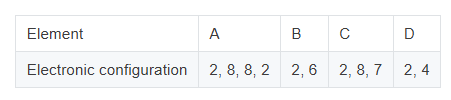
4(iv)(a). Write the formula of the compound formed between: 1. A and B 2. D and C
[2 marks]4(iv)(b). Which of the above elements will exhibit catenation?
[1 mark]5(a). Baeyer's process is used to concentrate bauxite ore to alumina. Give balanced chemical equations for the reaction taking place for its conversion from bauxite to alumina.
[3 marks]5(c). Match the gases given in column I to the identification of the gases mentioned in column II:
[4 marks]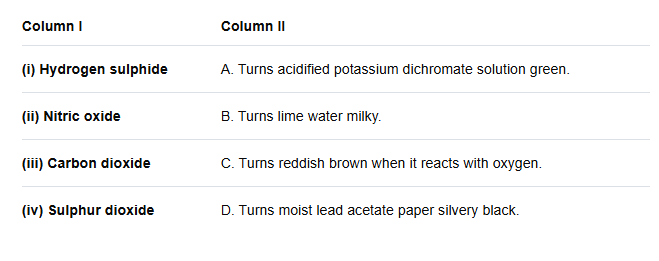
5(b)(i). pH of acetic acid is greater than dilute sulphuric acid. So acetic acid contains ............... concentration of H⁺ ions. (greater, same, low)
[1 mark]5(b)(ii). The indicator which does not change colour on passage of HCl gas is ................ (methyl orange, moist blue litmus, phenolphthalein)
[1 mark]5(b)(iii). The acid which cannot act as an oxidizing agent is ................ (conc. H₂SO₄, conc. HNO₃, conc. HCl)
[1 mark]6(a)(i). Write the balanced chemical equation to prepare ammonia gas in the laboratory by using an alkali.
[1 mark]6(a)(ii). State why concentrated sulphuric acid is not used for drying ammonia gas.
[1 mark]6(a)(iii). Why is ammonia gas not collected over water?
[1 mark]6(b)(i). Name the acid used for the preparation of hydrogen chloride gas in the laboratory. Why is this particular acid preferred to other acids?
[2 marks]6(b)(ii). Write the balanced chemical equation for the laboratory preparation of hydrogen chloride gas.
[1 mark]6(c). For the preparation of hydrochloric acid in the laboratory:
6(c)(i). Why is direct absorption of hydrogen chloride gas in water not feasible?
[1 mark]6(c)(ii). What arrangement is done to dissolve hydrogen chloride gas in water?
[1 mark]6(d). For the electro-refining of copper:
6(d)(i). What is the cathode made up of?
[1 mark]6(d)(ii). Write the reaction that takes place at the anode.
[1 mark]7(a). Write balanced chemical equations, for the preparation of the given salts. (i) to (iii) by using the methods A to C respectively: A: Neutralization B: Precipitation C: Titration
7(a)(i). Copper sulphate
[1 mark]7(a)(ii). Zinc carbonate
[1 mark]7(a)(iii). Ammonium sulphate
[1 mark]7(b). Name the following elements:
7(b)(i). An alkaline earth metal present in group 2 and period 3.
[1 mark]7(b)(ii). A trivalent metal used to make light tools.
[1 mark]7(b)(iii). A monovalent non-metal present in fluorspar.
[1 mark]7(c). An aqueous solution of nickel (II) sulphate was electrolyzed using nickel electrodes. Observe the diagram and answer the questions that follow:
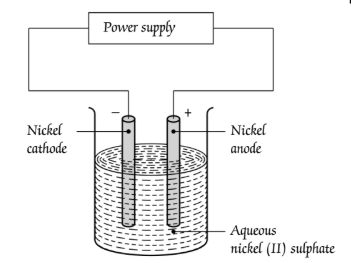
7(c)(i). What do you observe at the cathode and anode respectively?
[2 marks]7(c)(ii). Name the cation that remains as a spectator ion in the solution.
[1 mark]7(c)(iii). Which equation for the reaction at the anode is correct? 1 Ni ⟶ Ni²⁺ + 2e⁻ 2 Ni + 2e⁻ ⟶ Ni²⁺ 3 Ni²⁺ ⟶ Ni + 2e⁻ 4 Ni²⁺ + 2e⁻ ⟶ Ni
[1 mark]8(i). Rewrite the following statements by adding the correct word as shown in the example:
8(i)(a). Sulphuric acid acts as a dehydrating agent.
[1 mark]8(i)(b). Ammonia reacts with chlorine to give ammonium chloride and nitrogen.
[1 mark]8(ii). Identify only the anion present in the following compound:
8(ii)(a). The compound on heating produces a colourless, odourless gas which turns lime water milky and has no effect on acidified potassium dichromate solution.
[1 mark]8(ii)(b). The solution of the compound which on treating with concentrated sulphuric acid and freshly prepared ferrous sulphate solution produces a brown ring.
[1 mark]8(iii). Mohan has three solutions P, Q and R having a pH of 13, 5 and 2 respectively. Which of the above solutions P, Q or R:
8(iii)(a). will react with Magnesium to liberate hydrogen gas?
[1 mark]8(iii)(b). will liberate ammonia gas when it reacts with ammonium chloride?
[1 mark]8(iii)(c). will contain molecules as well as ions?
[1 mark]8(iv). The following table is related to an Industrial process of an acid. Identify (a), (b) and (c).
[3 marks]