Chemistry — Suggested Paper 2
Two hours80 marks Questions from 2016–2026
A suggested paper: every question is a real ICSE board question, chosen from different years and arranged in the current pattern. Start the timed test to have your written answers marked.
Instructions to Candidates: 1. Answers to this Paper must be written on the paper provided separately. 2. You will not be allowed to write during the first 15 minutes. 3. This time is to be spent in reading the question paper. 4. The time given at the head of this Paper is the time allowed for writing the answers. 5. Section A is compulsory. Attempt any four questions from Section B 6. The intended marks for questions or parts of questions are given in brackets [ ]
Section A (40 marks)
Attempt all questions from this Section.
1. Choose the correct answers to the questions from the given options. (Do not copy the questions, write the correct answers only.)
1(i). The organic compound which undergoes substitution reaction is:
[1 mark]- (a)C₂H₂
- (b)C₂H₄
- (c)C₁₀H₁₈
- (d)C₂H₆
1(ii). The most electronegative element from the following elements is:
[1 mark]- (a)Magnesium
- (b)Chlorine
- (c)Aluminium
- (d)Sulphur
1(iii). Assertion (A): In the electrolysis of acidified water, the volume of hydrogen liberated is twice the volume of oxygen formed. Reason (R): Water has hydrogen and oxygen in the ratio of 1:2 by volume.
[1 mark]- (a)(A) is true but (R) is false.
- (b)(A) is false but (R) is true.
- (c)Both (A) and (R) are true and (R) is the correct explanation of (A).
- (d)Both (A) and (R) are true, but (R) is not the correct explanation of (A).
1(iv). Which of the following is a tribasic acid?
[1 mark]- (a)H₂SO₄
- (b)Al(OH)₃
- (c)H₃PO₄
- (d)Ca(OH)₂
1(v). The percentage of hydrogen present in NaOH is: (Relative Molecular Mass of NaOH = 40) (At. Wt. of H = 1)
[1 mark]- (a)2.5
- (b)25
- (c)0.25
- (d)0.025
1(vi). Copper, Zinc and Tin are the metals alloyed to form:
[1 mark]- (a)Duralumin
- (b)Brass
- (c)Bronze
- (d)Solder
1(vii). Rotten egg smell is due to the liberation of:
[1 mark]- (a)HCl gas
- (b)H₂S gas
- (c)Cl₂ gas
- (d)SO₂ gas
1(viii). Which of the following is a common characteristic of a covalent compound?
[1 mark]- (a)high melting point
- (b)consists of molecules
- (c)always soluble in water
- (d)conducts electricity when it is in the molten state
1(ix). Anhydrous iron (III) chloride is prepared by:
[1 mark]- (a)direct combination
- (b)simple displacement
- (c)decomposition
- (d)neutralization
1(x). he drying agent used to dry HCl gas is:
[1 mark]- (a)Conc. H₂SO₄
- (b)ZnO
- (c)Al₂O₃
- (d)CaO
1(xi). An aqueous solution of ammonia is:
[1 mark]- (a)Neutral
- (b)Acidic
- (c)Basic
- (d)Amphoteric
1(xii). An atom of X forms an ion according to the equation X ⟶ X⁺2. The atomic number of the atom X is:
[1 mark]- (a)16
- (b)10
- (c)12
- (d)14
1(xiii). The element with highest ionization potential, is:
[1 mark]- (a)Hydrogen
- (b)Caesium
- (c)Radon
- (d)Helium
1(xiv). The electrolysis of acidified water is an example of:
[1 mark]- (a)Reduction
- (b)Oxidation
- (c)Redox reaction
- (d)Synthesis
1(xv). Hydracids are those acids which contain:
[1 mark]- (a)Hydrogen with any metal
- (b)Hydrogen, a non-metal and oxygen
- (c)Hydrogen and a non-metal other than oxygen
- (d)Hydrogen and oxygen only
2(i). State one observation for each of the following:
2(i)(i). Concentrated nitric acid is reacted with sulphur.
[1 mark]2(i)(ii). Ammonia gas is passed over heated copper (II) oxide.
[1 mark]2(i)(iii). Copper sulphate solution is electrolysed using copper electrodes.
[1 mark]2(i)(iv). A small piece of zinc is added to dilute hydrochloric acid.
[1 mark]2(i)(v). Lead nitrate is heated strongly in a test tube.
[1 mark]2(ii). Write balanced chemical equations for each of the following:
2(ii)(i). Action of warm water on AlN.
[1 mark]2(ii)(ii). Action of hot and concentrated Nitric acid on copper.
[1 mark]2(ii)(iii). Action of Hydrochloric acid on sodium bicarbonate.
[1 mark]2(ii)(iv). Action of dilute Sulphuric acid on Sodium Sulphite.
[1 mark]2(ii)(v). Preparation of ethanol from Ethyl Chloride.
[1 mark]2(iii). Complete the following sentences by choosing the correct answer from the brackets:
2(iii)(a). The salt that can be prepared by Direct Combination is ............... . [FeCl₃ / FeCl₂]
[1 mark]2(iii)(b). The metallic oxide which can be reduced by using common reducing agents is ............... .[ Fe₂O₃ / Al₂O₃]
[1 mark]2(iii)(c). The metal nitrate which on thermal decomposition forms a black residue is ............... . [zinc nitrate / copper nitrate]
[1 mark]2(iii)(d). During the electrolysis of copper sulphate solution, if ............... is used as electrodes, the colour of the electrolyte does not fade. [copper / platinum]
[1 mark]2(iii)(e). The process of heating the concentrated ore in a limited supply or absence of air is ............... . [roasting / calcination]
[1 mark]2(iv)(i). Draw the structural formula for each of the following:
2(iv)(i)(1). 2, 3 – dimethyl butane
[1 mark]2(iv)(i)(2). Diethyl ether
[1 mark]2(iv)(i)(3). Propanoic acid
[1 mark]2(iv)(ii). From the list of terms given, choose the most appropriate term to match the given description. (calcination, roasting, pulverisation, smelting)
2(iv)(ii)(1). Crushing of the ore into a fine powder.
[1 mark]2(iv)(ii)(2). Heating of the ore in the absence of air to a high temperature.
[1 mark]2(v). State the terms/process for the following:
2(v)(a). The energy released when an atom in the gaseous state accepts an electron to form an anion.
[1 mark]2(v)(b). Tendency of an element to form chains of identical atoms.
[1 mark]2(v)(c). The name of the process by which Ammonia is manufactured on a large scale.
[1 mark]2(v)(d). A type of salt formed by partial replacement of hydroxyl radicals with an acid radical.
[1 mark]2(v)(e). The ratio of the mass of a certain volume of gas to the same volume of hydrogen measured under the same conditions of temperature and pressure.
[1 mark]Section B (40 marks)
Attempt any four questions from this Section.
3(i). Name the main metal used in making of the alloys given below:
3(i)(a). Duralumin
[1 mark]3(i)(b). Stainless steel
[1 mark]3(ii). Differentiate between the following pairs based on the criteria given:
3(ii)(a). Sulphuric acid and Nitric acid (using barium chloride solution)
[1 mark]3(ii)(b). Unsaturated and Saturated hydrocarbons (type of bond present)
[1 mark]3(iii). Calcium carbonate reacts with dilute hydrochloric acid as given below: CaCO₃ + 2HCl → CaCl₂ + H₂O + CO₂
3(iii)(a). What is the mass of 5 moles of calcium carbonate? (Relative molecular mass of calcium carbonate is 100)
[1 mark]3(iii)(b). How many moles of HCl will react with 5 moles of calcium carbonate?
[1 mark]3(iii)(c). What is the volume of carbon dioxide liberated at S.T.P. at the same time?
[1 mark]3(iv). Identify the gas evolved in each of the following reactions:
3(iv)(a). Methane undergoes complete combustion.
[1 mark]3(iv)(b). Copper carbonate is heated.
[1 mark]3(iv)(c). MnO₂ reacts with concentrated HCl.
[1 mark]4(i). Identify the cation in each of the following cases:
4(i)(a). Ammonium hydroxide solution when added to Solution B gives a white precipitate which does not dissolve in excess of ammonium hydroxide solution.
[1 mark]4(i)(b). Sodium hydroxide solution when added to Solution C gives a white precipitate which is insoluble in excess of sodium hydroxide solution.
[1 mark]4(ii). Fill in the blanks by choosing the correct answer from the brackets:
4(ii)(a). During electrolysis, the compound ............... in its molten state liberates reddish brown fumes at the anode. [NaCl/PbBr₂]
[1 mark]4(ii)(b). The ion which could be discharged most readily during electrolysis is ............... [Fe²⁺/Cu²⁺]
[1 mark]4(iii). Arrange the following as per the instruction given in the brackets:
4(iii)(a). Al, K, Mg, Ca (decreasing order of its reactivity)
[1 mark]4(iii)(b). N, Be, O, C (increasing order of non-metallic character)
[1 mark]4(iii)(c). P, Si, F, Be (decreasing order of valence electrons)
[1 mark]4(iv). Complete and balance the following equations:
4(iv)(a). NH₄Cl + Ca(OH)₂ ⟶
[1 mark]4(iv)(b). CuSO₄ + NH₄OH ⟶
[1 mark]4(iv)(c). Cu + Conc. HNO₃ ⟶
[1 mark]5(i). Choose the correct answer from the list given below:

5(i)(a). The ore which can be concentrated by magnetic separation.
[1 mark]5(i)(b). Empirical formula of Ethyne.
[1 mark]5(ii). Give balanced equation for the following reactions:
5(ii)(a). Copper reacts with concentrated Nitric acid.
[1 mark]5(ii)(b). Aluminium nitride is treated with warm water.
[1 mark]5(iii). Match the salts underlined in Column A with the most suitable method of preparation given in Column B.
[3 marks]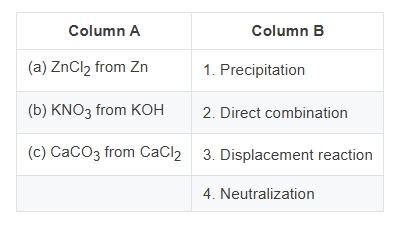
5(iv). Hydrogen chloride gas is prepared in the laboratory by the action of concentrated sulphuric acid on sodium chloride.
5(iv)(a). Give balanced chemical equation for the above reaction.
[1 mark]5(iv)(b). State the method of collection of the gas formed above.
[1 mark]5(iv)(c). What is the property of sulphuric acid that makes it a suitable reagent for the reaction?
[1 mark]6(a). Certain blank spaces are left in the following table and these are labelled as A, B, C, D and E. Identify each of them.
[5 marks]
6(c). Write balanced chemical equations to show how SO₃ is converted to Sulphuric acid in the contact process.
[2 marks]6(b). Write balanced chemical equations to show:
6(b)(i). The oxidizing action of conc. Sulphuric acid on Carbon.
[1 mark]6(b)(ii). The behavior of H₂SO₄ as an acid when it reacts with Magnesium.
[1 mark]6(b)(iii). The dehydrating property of conc. Sulphuric acid with sugar.
[1 mark]7(i). Seema added a few pieces of copper turnings to a test tube containing concentrated acid P and she noticed that a reddish-brown gas evolved.
7(i)(a). Name the acid P used by Seema.
[1 mark]7(i)(b). Write a balanced chemical equation for the reaction that took place.
[1 mark]7(ii). Answer the following questions with reference to the concentration of bauxite ore.
7(ii)(a). Name the process used to concentrate the ore.
[1 mark]7(ii)(b). Give a balanced chemical equation for the conversion of aluminium hydroxide to pure alumina.
[1 mark]7(iii). Draw the dot and cross structure of the following: [Atomic number: Mg = 12, Cl = 17, H = 1, N = 7]
7(iii)(a). An ionic compound formed when Mg reacts with the dilute HCl.
[1 mark]7(iii)(b). A covalent compound formed when H₂ reacts with Cl₂.
[1 mark]7(iii)(c). The positive ion produced when ammonia gas is dissolved in water.
[1 mark]7(iv). Acidulated water is electrolysed using platinum electrodes. Answer the following questions:
7(iv)(a). Why is dilute sulphuric acid added to water?
[1 mark]7(iv)(b). Write the reaction taking place at the cathode.
[1 mark]7(iv)(c). What is the observation at the anode?
[1 mark]8(i)(a). State Avogadro’s Law.
[1 mark]8(i)(b). Define Co⁻ordinate bond.
[1 mark]8(ii). Differentiate between the following pairs of compounds using the reagent given in the bracket:
8(ii)(a). Ammonium chloride and Sodium chloride (using an alkali)
[1 mark]8(ii)(b). Zinc Nitrate solution and Calcium Nitrate solution (using excess sodium hydroxide solution)
[1 mark]8(iii). You are provided with some compounds in the box. Choose the most appropriate compound which fits the descriptions (a) to (c) given below:
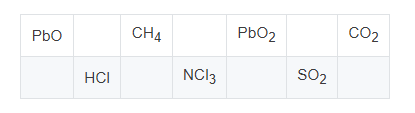
8(iii)(a). A colourless gas which turns acidified K₂Cr₂O₇ from orange to green.
[1 mark]8(iii)(b). A yellow explosive oily liquid formed when excess chlorine gas reacts with ammonia gas.
[1 mark]8(iii)(c). A yellow metallic oxide formed on thermal decomposition of PbCO₃.
[1 mark]8(iv). P, Q, R and S are the different methods of preparation of salts. P – Simple displacement Q – Neutralisation by titration R – Precipitation S – Direct combination Choose the most appropriate method to prepare the following salts:
8(iv)(a). PbCl₂
[1 mark]8(iv)(b). FeCl₃
[1 mark]8(iv)(c). Na₂SO₄
[1 mark]