Chemistry — Suggested Paper 4
Two hours80 marks Questions from 2016–2026
A suggested paper: every question is a real ICSE board question, chosen from different years and arranged in the current pattern. Start the timed test to have your written answers marked.
Instructions to Candidates: 1. Answers to this Paper must be written on the paper provided separately. 2. You will not be allowed to write during the first 15 minutes. 3. This time is to be spent in reading the question paper. 4. The time given at the head of this Paper is the time allowed for writing the answers. 5. Section A is compulsory. Attempt any four questions from Section B 6. The intended marks for questions or parts of questions are given in brackets [ ]
Section A (40 marks)
Attempt all questions from this Section.
1. Choose the correct answers to the questions from the given options. (Do not copy the questions, write the correct answers only.)
1(i). Which pair of reactants can be best used to produce lead (II) sulphate?
[1 mark]- (a)Sulphuric acid + Lead
- (b)Sulphuric acid + Lead hydroxide
- (c)Sodium sulphate + Lead nitrate
- (d)Potassium sulphate + Lead oxide
1(ii). Alkaline earth metals have the same:
[1 mark]- (a)number of valence electrons
- (b)number of shells
- (c)metallic property
- (d)ionization potential
1(iii). In the electrolysis of molten aluminium oxide for extraction of aluminium, the following reactions take place: Al³⁺ + 3e⁻ → Al 2O²⁻ → O₂ + 4e⁻ C + O₂ → CO₂ Al₂O₃ ⇌ 2Al³⁺ + 3O²⁻ The reaction that takes place at the negative electrode is:
[1 mark]- (a)1
- (b)2
- (c)3
- (d)4
1(iv). The ore that can be concentrated by using magnetic separation:
[1 mark]- (a)Corundum
- (b)Haematite
- (c)Calamine
- (d)Bauxite
1(v). The basic oxide which is an alkali:
[1 mark]- (a)Copper oxide
- (b)Sodium oxide
- (c)Ferric oxide
- (d)Zinc oxide
1(vi). If the imperial formula of a compound is CH and its vapour density is 13, then its molecular formula will be: (At. Wt. C=12, H=1)
[1 mark]- (a)CH
- (b)C₂H₂
- (c)C₄H₄
- (d)C₃H₃
1(vii). The acid which can produce carbon from cane sugar, is:
[1 mark]- (a)Concentrated Hydrochloric acid
- (b)Concentrated Nitric acid
- (c)Concentrated Sulphuric acid
- (d)Concentrated Acetic acid
1(viii). Which of the following element pairs will form an ionic bond? Pair P Elements of Group 1 & Group 2 Q Elements of Group 14 & Group 16 R Elements of Group 2 & Group 17 S Elements of Group 15 & Group 18
[1 mark]- (a)P
- (b)Q
- (c)R
- (d)S
1(ix). Aqueous solution of Cupric chloride forms a deep blue solution on addition of:
[1 mark]- (a)dropwise sodium hydroxide
- (b)excess sodium hydroxide
- (c)dropwise ammonium hydroxide
- (d)excess ammonium hydroxide
1(x). Hydrogen chloride gas is not collected over water, as:
[1 mark]- (a)It is highly soluble in water.
- (b)It is less soluble in water.
- (c)It is lighter than air.
- (d)It is heavier than air.
1(xi). The catalyst used for the conversion of ethene to ethane:
[1 mark]- (a)Iron
- (b)Nickel
- (c)Cobalt
- (d)Molybdenum
1(xii). Assertion (A): The tendency of losing electrons increases down the Group. Reason (R): The most reactive metal is placed at the top of Group 1.
[1 mark]- (a)Both (A) and (R) are true, and (R) is the correct explanation of (A).
- (b)Both (A) and (R) are true, and (R) is not the correct explanation of (A).
- (c)(A) is true but (R) is false.
- (d)(A) is false but (R) is true.
1(xiii). The particles present in strong electrolytes are:
[1 mark]- (a)only molecules
- (b)mainly ions
- (c)ions and molecules
- (d)only atoms.
1(xiv). A mineral from which the metal can be extracted economically and conveniently is known as:
[1 mark]- (a)Matrix
- (b)Ore
- (c)Flux
- (d)Alloy
1(xv). The metal hydroxide which reacts with both acids and alkalis to form salt and water is:
[1 mark]- (a)Calcium hydroxide
- (b)Magnesium hydroxide
- (c)Aluminium hydroxide
- (d)Ferric hydroxide
2(i). Match the salts given in Column I with their method of preparation given in Column II:
[5 marks]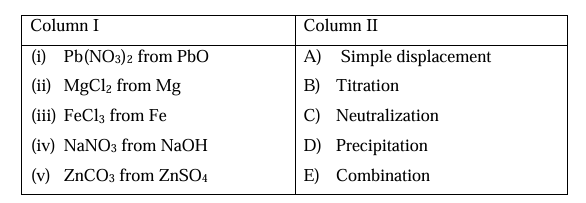
2(ii). Fill in the blanks from the choices given in brackets:
2(ii)(i). Metals are good ............... (oxidizing agents / reducing agents) because they are electron ............... (acceptors/ donors).
[1 mark]2(ii)(ii). Electrovalent compounds have ............... (high/low) melting points.
[1 mark]2(ii)(iii). Higher the pH value of a solution, the more ...............(acidic/alkaline) it is.
[1 mark]2(ii)(iv). ............... (AgCl / PbCl₂), a white precipitate is soluble in excess NH₄OH.
[1 mark]2(ii)(v). Conversion of ethene to ethane is an example of ...............(hydration/hydrogenation).
[1 mark]2(iii). Calculate:
2(iii)(i). The amount of each reactant required to produce 750 ml of carbon dioxide, when two volumes of carbon monoxide combine with one volume of oxygen to produce two volumes of carbon dioxide. 2CO + O₂ ⟶ 2CO₂
[2 marks]2(iii)(ii). The volume occupied by 80 g of carbon dioxide at STP.
[1 mark]2(iii)(iii). Calculate the number of molecules in 4.4 gm of CO₂. [Atomic mass of C= 12, O=16]
[1 mark]2(iii)(iv). State the law associated in question no. (f)(i) above.
[1 mark]2(iv). State one relevant reason for each of the following:
2(iv)(i). Graphite anode is preferred to platinum in the electrolysis of molten lead bromide.
[1 mark]2(iv)(ii). Soda lime is preferred to sodium hydroxide in the laboratory preparation of methane.
[1 mark]2(iv)(iii). Hydrated copper sulphate crystals turn white on heating.
[1 mark]2(iv)(iv). Concentrated nitric acid appears yellow, when it is left for a while in a glass bottle.
[1 mark]2(iv)(v). Hydrogen chloride gas fumes in moist air.
[1 mark]2(v). State one relevant observation for each of the following:
2(v)(i). Lead nitrate solution is treated with sodium hydroxide solution drop wise till it is in excess.
[1 mark]2(v)(ii). At the anode, when molten lead bromide is electrolyzed using graphite electrodes.
[1 mark]2(v)(iii). Lead nitrate solution is mixed with dilute hydrochloric acid and heated.
[1 mark]2(v)(iv). Anhydrous calcium chloride is exposed to air for some time.
[1 mark]2(v)(v). Barium chloride solution is slowly added to sodium sulphate solution.
[1 mark]Section B (40 marks)
Attempt any four questions from this Section.
3(a). Draw the electron dot structure of:
3(a)(i). Nitrogen molecule [N = 7]
[1 mark]3(a)(ii). Sodium chloride [Na = 11, Cl = 17]
[1 mark]3(a)(iii). Ammonium ion [N = 7, H = 1]
[1 mark]3(b). The pH values of three solutions A, B and C are given in the table. Answer the following questions:
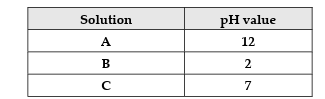
3(b)(i). Which solution will have no effect on litmus solution?
[1 mark]3(b)(ii). Which solution will liberate CO₂ when reacted with sodium carbonate?
[1 mark]3(b)(iii). Which solution will turn red litmus solution blue?
[1 mark]3(c). Study the extract of the Periodic Table given below and answer the questions that follow. Give the alphabet corresponding to the element in question. DO NOT repeat an element.

3(c)(i). Which element forms electrovalent compound with G?
[1 mark]3(c)(ii). The ion of which element will migrate towards the cathode during electrolysis?
[1 mark]3(c)(iii). Which non-metallic element has the valency of 2?
[1 mark]3(c)(iv). Which is an inert gas?
[1 mark]4(a)(i). Name the solution used to react with Bauxite as a first step in obtaining pure aluminium oxide, in the Baeyer's process.
[1 mark]4(a)(ii). Write the equation for the reaction where the aluminium oxide for the electrolytic extraction of aluminium is obtained by heating aluminium hydroxide.
[1 mark]4(a)(iii). Name the compound added to pure alumina to lower the fusion temperature during the electrolytic reduction of alumina.
[1 mark]4(a)(iv). Write the equation for the reaction that occurs at the cathode during the extraction of aluminium by electrolysis.
[1 mark]4(a)(v). Explain why it is preferable to use a number of graphite electrodes as anode instead of a single electrode, during the above electrolysis.
[1 mark]4(b)(i). Washing Soda Crystals are exposed to the atmosphere.
[1 mark]4(b)(ii). The salt ferric chloride is exposed to the atmosphere.
[1 mark]4(c)(i). NaOH solution when added to the solution 'A' gives a reddish brown precipitate.
[1 mark]4(c)(ii). NH₄OH solution when added to the solution 'B' gives a white ppt which does not dissolve in excess.
[1 mark]4(c)(iii). NaOH solution when added to the solution 'C' gives a white ppt which is insoluble in excess.
[1 mark]5(a). Write a balanced chemical equation for each of the following:
5(a)(i). Burning of ethane in plentiful supply of air.
[1 mark]5(a)(ii). Action of water on Calcium carbide.
[1 mark]5(a)(iii). Heating of Ethanol at 170°C in the presence of conc. Sulphuric acid.
[1 mark]5(b). Give the structural formulae of each of the following :
5(b)(i). 2-methyl propane
[1 mark]5(b)(ii). Ethanoic acid
[1 mark]5(b)(iii). Butan-2-ol
[1 mark]5(c). Equation for the reaction when compound A is bubbled through bromine dissolved in carbon tetrachloride is as follows:
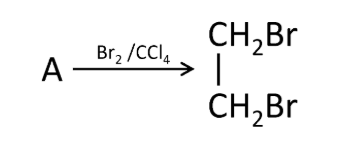
5(c)(i). Draw the structure of A.
[1 mark]5(c)(ii). State your observation during this reaction.
[1 mark]5(d). Fill in the blanks using the appropriate words given below: (Sulphur dioxide, Nitrogen dioxide, Nitric oxide, Sulphuric acid)
5(d)(i). Cold, dilute nitric acid reacts with copper to give ...............
[1 mark]5(d)(ii). Hot, concentrated nitric acid reacts with sulphur to form ...............
[1 mark]6(i). Arrange the following according to the instructions given in brackets:
6(i)(a). C₂H₂, C₃H₆, CH₄, C₂H₄ (In the increasing order of the molecular weight)
[1 mark]6(i)(b). Cu²⁺, Na⁺, Zn²⁺, Ag⁺ (The order of Preferential discharge at the cathode)
[1 mark]6(ii). Differentiate between the following pairs based on the criteria given in the brackets:
6(ii)(a). Cane sugar and hydrated copper sulphate [using concentrated H₂SO₄]
[1 mark]6(ii)(b). Sulphuric acid and hydrochloric acid [type of salts formed]
[1 mark]6(iii). Convert the following reactions into a balanced chemical equation:
6(iii)(a). Ammonia to nitric oxide using oxygen and platinum catalyst.
[1 mark]6(iii)(b). Sodium hydroxide to sodium sulphate using sulphuric acid.
[1 mark]6(iii)(c). Ferrous sulphide to hydrogen sulphide using hydrochloric acid.
[1 mark]6(iv). Choose the answer from the list which fits in the description: [CCl₄, PbO, NaCl, CuO, NH₄Cl]
6(iv)(a). A compound which undergoes thermal dissociation.
[1 mark]6(iv)(b). An amphoteric oxide.
[1 mark]6(iv)(c). A compound which is a non-electrolyte.
[1 mark]7(a). Name the gas evolved in each of the following cases:
7(a)(i). Alumina undergoes electrolytic reduction.
[1 mark]7(a)(ii). Ethene undergoes hydrogenation reaction.
[1 mark]7(a)(iii). Ammonia reacts with heated copper oxide.
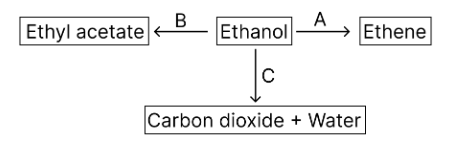
[1 mark]7(b). Study the flow chart given and give balanced equations to represent the reactions A, B and C:
[3 marks]
7(c). Copy and complete the following table which refers to the industrial method for preparation of ammonia and sulphuric acid.
[4 marks]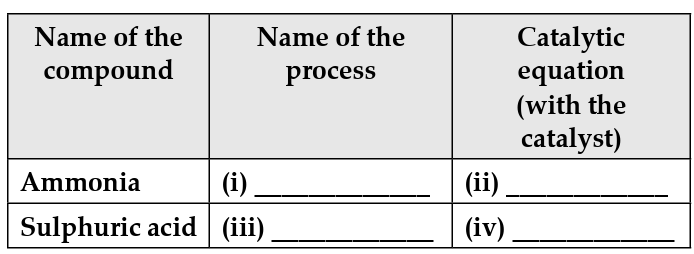
8(i). Carbon reacts with an acid to form carbon dioxide, water and nitrogen dioxide.
8(i)(a). Name the acid used in the reaction.
[1 mark]8(i)(b). Write a balanced chemical equation for the reaction that occurs.
[1 mark]8(ii). Bauxite is the principal ore used in the commercial extraction of aluminium. The Bayer's process is used to refine bauxite into pure alumina, with caustic soda playing a crucial role in the initial stage of the process. Based on this, answer the following questions:
8(ii)(a). Explain the reason behind the addition of caustic soda during the Bayer's process.
[1 mark]8(ii)(b). Write a balanced chemical equation representing the reaction between bauxite and caustic soda during the Bayer's process.
[1 mark]8(iii). Give one relevant observation for the following:
8(iii)(a). Sodium hydroxide is added dropwise to Calcium nitrate solution.
[1 mark]8(iii)(b). Dilute Hydrochloric acid is added to Iron (II) sulphide.
[1 mark]8(iii)(c). An amphoteric metal is added to hot concentrated alkali.
[1 mark]8(iv). Study the reaction scheme shown below and identify the reactants A, B and C.
[3 marks]