Biology — Suggested Paper 5
120 minutes80 marks Questions from 2017–2026
A suggested paper: every question is a real ICSE board question, chosen from different years and arranged in the current pattern. Start the timed test to have your written answers marked.
Section A (40 marks)
Attempt all questions from this Section.
1. Choose the correct answers to the questions from the given options. (Do not copy the questions, write the correct answers only.)
1(i). The nitrogenous base Adenine always pairs with __________
[1 mark]- (a)Thymine
- (b)Guanine
- (c)Cytosine
- (d)Thiamine
1(ii). The genotype of a person who cannot roll his tongue is __________.
[1 mark]- (a)Rr
- (b)RR
- (c)rr
- (d)RRr
1(iii). While recording the pulse rate, where exactly does a doctor press on our wrist?
[1 mark]- (a)Nerve
- (b)Vein
- (c)Artery
- (d)Capillary
1(iv). The paper used to demonstrate unequal transpiration in a dicot leaf is:
[1 mark]- (a)Filter paper
- (b)Litmus paper
- (c)Starch paper
- (d)Cobalt chloride paper
1(v). Assertion (A): Sympathetic nervous system prepares the body for violent action against abnormal conditions. Reason (R): Sympathetic nervous system accelerates heartbeat. Which of the following is correct?
[1 mark]- (a)Both A and R are True
- (b)A is True, R is False
- (c)A is False but R is True
- (d)Both A and R are False
1(vi). Marine fish when placed in tap water bursts because of:
[1 mark]- (a)Endosmosis
- (b)Exosmosis
- (c)Diffusion
- (d)Plasmolysis
1(vii). The optimum temperature for photosynthesis is:
[1 mark]- (a)10 – 15°C
- (b)60 – 65°C
- (c)40 – 45°C
- (d)25 – 35°C
1(viii). Owls are nocturnal animals. They are active at night and hunt small animals for food. Owls have large eyes and can see well at night. This is due to:
[1 mark]- (a)Cones and Rhodopsin
- (b)Rods and Iodopsin
- (c)Rods and Rhodopsin
- (d)Cones and Iodopsin
1(ix). Islets of Langerhans are located in:
[1 mark]- (a)Liver
- (b)Pituitary gland
- (c)Spleen
- (d)Pancreas
1(x). Which one of the following is non-biodegradable?
[1 mark]- (a)DDT
- (b)Vegetable peel
- (c)Cardboard
- (d)Bark of trees
1(xi). A person suffering from kidney failure has proteins in the urine. What is this condition called?
[1 mark]- (a)Haematuria
- (b)Glycosuria
- (c)Albuminuria
- (d)Anaemia
1(xii). During which phase of the menstrual cycle does the endometrium shed?
[1 mark]- (a)Follicular phase
- (b)Ovulatory phase
- (c)Menstrual phase
- (d)Luteal phase
1(xiii). After mitosis, a female human cell will have:
[1 mark]- (a)44+XX chromosomes
- (b)22+X chromosomes
- (c)22+Y chromosomes
- (d)44+XY chromosomes
1(xiv). The type of gene, which in presence of a contrasting allele is not expressed:
[1 mark]- (a)Homozygous
- (b)Heterozygous
- (c)Dominant
- (d)Recessive
1(xv). Oxygenated blood to liver is supplied by:
[1 mark]- (a)Hepatic artery
- (b)Hepatic vein
- (c)Inferior vena cava
- (d)Hepatic portal vein
2. Given below is an outline of the human body showing the important endocrine glands. Match the glands marked (a) to (e) with their correct functions. (Example: (f) – 6. Secretes Testosterone.)
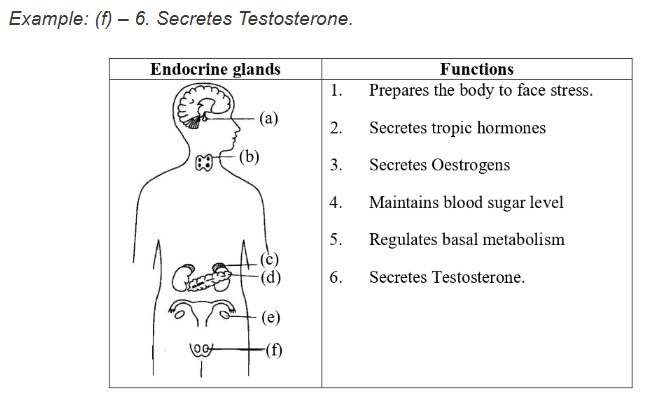
2(i). Match the glands marked (a) to (e) in the diagram with their functions: 1. Prepares the body to face stress. 2. Secretes tropic hormones 3. Secretes Oestrogens 4. Maintains blood sugar level 5. Regulates basal metabolism 6. Secretes Testosterone.
[5 marks]2(ii). Given below are certain groups of terms. In each group the first pair indicates a relationship between the two terms. Rewrite and complete the second pair on a similar basis. Example: Cytoplasm : Cytokinesis :: Nucleus : Karyokinesis.
2(ii)(i). Widening of hips : Oestrogen :: Deepening of voice in males : __________
[1 mark]2(ii)(ii). Brain : Meninges :: Heart : __________
[1 mark]2(ii)(iii). Insulin : Beta-cells :: Glucagon : __________
[1 mark]2(ii)(iv). Kidney : Renal artery :: Liver : __________
[1 mark]2(ii)(v). Uterus : Implantation :: Fallopian tube : __________
[1 mark]2(iii). Choose between the two options to answer the question specified in the brackets for the following: Example: Corolla or Calyx (Which is the outer whorl?) Answer: Calyx
2(iii)(i). Blood in the renal artery or renal vein (Which one has more urea?)
[1 mark]2(iii)(ii). Perilymph or endolymph (Which one surrounds the organ of Corti?)
[1 mark]2(iii)(iii). Lenticels or stomata (Which one remains open always?)
[1 mark]2(iii)(iv). Sclerotic layer or choroid layer (Which one forms the Iris?)
[1 mark]2(iii)(v). Blood in the pulmonary artery or pulmonary vein (Which one contains less oxyhaemoglobin?)
[1 mark]2(iv). Choose the odd one out from the following terms and name the category to which the others belong:
2(iv)(a). Prothrombin, Thrombin, Fibrinogen, Albumin
[1 mark]2(iv)(b). Tonsils, Glomerulus, Spleen, Lymph nodes
[1 mark]2(iv)(c). Neutrophils, Basophils, Monocytes, Eosinophils
[1 mark]2(iv)(d). Leaves, Styrofoam, Grass, Cow Dung
[1 mark]2(iv)(e). Pulmonary artery, Renal artery, Coronary artery, Hepatic artery
[1 mark]2(v). Choose the ODD one out from the following terms given and name the CATEGORY to which the others belong:
2(v)(i). Detergent, X-rays, Sewage, Oil spills
[1 mark]2(v)(ii). Lumen, Muscular tissue, Connective tissue, Pericardium
[1 mark]2(v)(iii). Dendrites, Medullary sheath, Axon, Spinal cord
[1 mark]2(v)(iv). Centrosome, Cell wall, Cell membrane, Large vacuoles
[1 mark]2(v)(v). Prostate gland, Cowper’s gland, Seminal vesicle, Seminiferous tubules
[1 mark]Section B (40 marks)
Attempt any four questions from this Section.
3(i). Define the term Transpiration.
[1 mark]3(ii). State any two adaptations in plants to reduce transpiration.
[2 marks]3(iii). Mention any two functions of the human foetal placenta.
[2 marks]3(iv). What is the significance of the human testes being located in scrotal sacs outside the abdomen?
[2 marks]3(v). Draw a neat, labelled diagram of Malpighian capsule.
[3 marks]4(i). Define the term ultrafiltration.
[1 mark]4(iii). Mention two harmful effects of noise pollution.
[2 marks]4(iv). Why are RBCs efficient in their functions though they lack nucleus and mitochondria?
[2 marks]4(ii). Name the mineral elements required for:
4(ii)(a). Clotting of blood
[1 mark]4(ii)(b). Synthesis of thyroxine
[1 mark]4(v). The diagram given below represents a stage in mitosis.
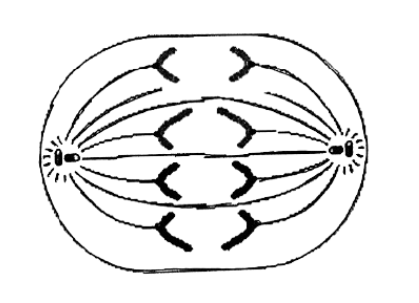
4(v)(a). Identify the stage given above.
[1 mark]4(v)(b). Give one reason to support your answer in (a).
[1 mark]4(v)(c). Mention the number of chromosomes given in the diagram.
[1 mark]5(a). In a homozygous pea plant, axial flowers (A) are dominant over terminal flowers (a).
5(a)(i). What is the phenotype and genotype of the F1 generation if a plant bearing pure axial flowers is crossed with a plant bearing pure terminal flowers?
[1 mark]5(a)(ii). Draw a Punnett square board to show the gametes and offsprings when both the parent plants are heterozygous for axial flowers.
[1 mark]5(a)(iii). What is the phenotypic ratio and genotypic ratio of the above cross shown in (ii)?
[1 mark]5(a)(iv). State Mendel’s Law of Dominance.
[1 mark]5(a)(v). Name two genetic disorders commonly seen in human males.
[1 mark]5(b). The diagram given below is an external view of the human brain. Study the same and answer the questions that follow:
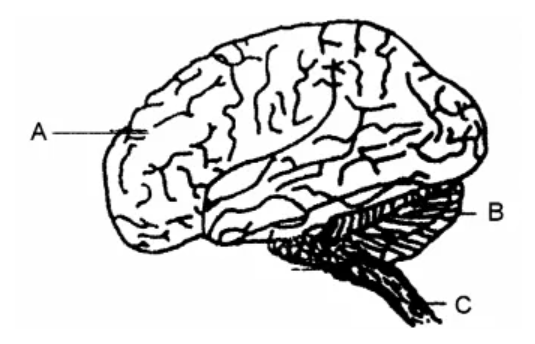
5(b)(i). Name the parts labelled A, B and C in the diagram.
[1 mark]5(b)(ii). State the main functions of the parts labelled A and B.
[1 mark]5(b)(iii). What are the structural and functional units of the brain? How are the parts of these units arranged in A and C?
[1 mark]5(b)(iv). Mention the collective term for the membranes covering the brain.
[1 mark]5(b)(v). What is the function of Cerebrospinal fluid?
[1 mark]6(i). Write the overall chemical equation for photosynthesis.
[1 mark]6(ii). Mention any two functions of blood.
[2 marks]6(iii). Differentiate between Karyokinesis and Cytokinesis.
[2 marks]6(iv). Excessive use of fertilisers in agricultural fields reduces the yield of crops. Justify the statement.
[2 marks]6(v). Study the diagram given below and answer the questions that follow:
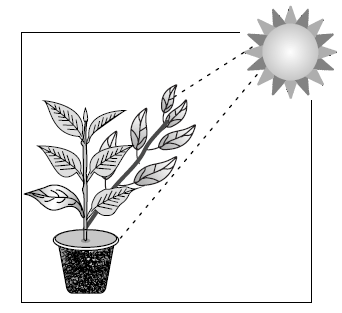
6(v)(a). Name the phenomenon shown by the shoot and the root in the diagram.
[1 mark]6(v)(b). Name the plant hormone responsible for this response.
[1 mark]6(v)(c). Explain the direction of growth shown by the shoot and the root.
[1 mark]7(a). The diagram given below represents an experiment to prove the importance of a factor in photosynthesis (a leaf partly covered with black paper held by clips). Answer the questions that follow:
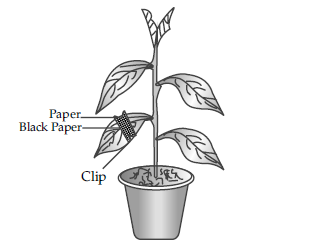
7(a)(i). Name the factor studied in this experiment.
[1 mark]7(a)(ii). What will you observe in the experimental leaf after the starch test?
[1 mark]7(a)(iii). Explain the process of Photosynthesis.
[1 mark]7(a)(iv). Give a balanced chemical equation to represent the process of photosynthesis.
[1 mark]7(a)(v). Draw a neat, labelled diagram of an experimental setup to show that oxygen is released during photosynthesis.
[1 mark]7(b). State the main functions of the following:
7(b)(i). Medulla Oblongata
[1 mark]7(b)(ii). Cytokinins
[1 mark]7(b)(iii). Tears
[1 mark]7(b)(iv). Coronary Artery
[1 mark]7(b)(v). Seminal Vesicles
[1 mark]8(a). The diagram given below shows the internal structure of a spinal cord depicting a phenomenon. Study the diagram and answer the questions:
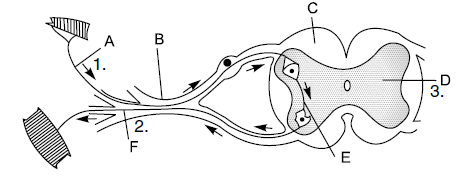
8(a)(i). Name the phenomenon that is depicted in the diagram. Define the phenomenon.
[1 mark]8(a)(ii). Give the technical term for the point of contact between the two nerve cells.
[1 mark]8(a)(iii). Name the parts numbered 1, 2 and 3.
[1 mark]8(a)(iv). How does the arrangement of neurons in the spinal cord differ from that of the brain?
[1 mark]8(a)(v). Mention two ways by which the spinal cord is protected in our body.
[1 mark]8(b). Give appropriate biological or technical terms for the following:
8(b)(i). Process of maintaining water and salt balance in the blood.
[0.5 marks]8(b)(ii). Hormones which regulate the secretion of other endocrine glands.
[0.5 marks]8(b)(iii). Movement of molecules of a substance from their higher concentration to lower concentration when they are in direct contact.
[0.5 marks]8(b)(iv). The condition in which a pair of chromosomes carry similar alleles of a particular character.
[0.5 marks]8(b)(v). The complex consisting of a DNA strand and a core of histones.
[0.5 marks]8(b)(vi). The onset of menstruation in a young girl.
[0.5 marks]8(b)(vii). Squeezing out of white blood cells from the capillaries into the surrounding tissues.
[0.5 marks]8(b)(viii). The fluid which surrounds the foetus.
[0.5 marks]8(b)(ix). The relaxation phase of the heart.
[0.5 marks]8(b)(x). The difference between the birth rate and the death rate.
[0.5 marks]