Biology — Suggested Paper 1
120 minutes80 marks Questions from 2016–2026
A suggested paper: every question is a real ICSE board question, chosen from different years and arranged in the current pattern. Start the timed test to have your written answers marked.
Section A (40 marks)
Attempt all questions from this Section.
1. Choose the correct answers to the questions from the given options. (Do not copy the questions, write the correct answers only.)
1(i). A sequence of DNA has 300 nitrogenous base pairs, of which 75 are Guanine. What is the number of Thymine in this sequence?
[1 mark]- (a)150
- (b)100
- (c)50
- (d)75
1(ii). If a person has a heart attack, what must be done immediately? P. Loosen his/her clothing Q. Make him/her lie down in an airy room R. Rush him/her to the hospital S. Engage him/her in a conversation
[1 mark]- (a)P and Q
- (b)P and S
- (c)R and S
- (d)P, Q and R
1(iii). Four friends P, Q, R, and S were discussing the examples of genetic disorders. The examples they quoted were as follows: P. Colour blindness and Malaria Q. Albinism and Cholera R. Haemophilia and Colour blindness S. Haemophilia and Albinism Who gave the correct examples?
[1 mark]- (a)P and Q
- (b)R and S
- (c)P and R
- (d)Q and S
1(iv). Cuticle on leaves:
[1 mark]- (a)Prevents photosynthesis
- (b)Reduces transpiration
- (c)Protects leaves from grazing animals
- (d)Gives colour to leaves
1(v). Stimulation of the nerves of the sympathetic nervous system:
[1 mark]- (a)Accelerates heartbeat
- (b)Constricts pupil of eyes
- (c)Increases peristalsis
- (d)Retards heartbeat
1(vi). When a cell is placed in a __________ solution it becomes plasmolysed.
[1 mark]- (a)Distilled water
- (b)Hypertonic
- (c)Isotonic
- (d)Hypotonic
1(vii). Adjusting the focal length of the eye lens to view objects at different distances is done by:
[1 mark]- (a)Cornea
- (b)Iris
- (c)Ciliary muscles
- (d)Sclera
1(viii). The hormone that induces vigorous contractions of the uterus in a pregnant mother is:
[1 mark]- (a)Oestrogen
- (b)Prolactin
- (c)Oxytocin
- (d)Progesterone
1(ix). NADP is expanded as:
[1 mark]- (a)Nicotinamide Adenosine Dinucleotide Phosphate
- (b)Nicotinamide Adenine Dinucleotide Phosphate
- (c)Nicotinamide Adenine Dinucleolus Phosphate
- (d)Nicotinamide Adenosine Dinucleolus Phosphate
1(x). Which one of the following is a Greenhouse gas?
[1 mark]- (a)Oxygen
- (b)Methane
- (c)Sulphur dioxide
- (d)Nitrogen
1(xi). The structure that stores urine temporarily is:
[1 mark]- (a)Ureter
- (b)Urethra
- (c)Urinary bladder
- (d)Kidneys
1(xii). Assertion (A): Seminal vesicles pour an alkaline secretion into the semen as it passes through the ureter. Reason (R): The female vagina is acidic and needs to be neutralized for sperm survival.
[1 mark]- (a)(A) is true and (R) is false
- (b)(A) is false and (R) is true
- (c)Both (A) and (R) are true
- (d)Both (A) and (R) are false
1(xiii). A health organisation wants to educate the rural audience about population control using visually engaging methods. Which of these would be effective? P. Posters Q. Loudspeakers R. Film shows S. Street plays
[1 mark]- (a)P, R and S
- (b)Q, R and S
- (c)P, Q and R
- (d)P, Q and S
1(xiv). Sunil tried to match the tropic movements in plants with the stimulus they respond to. The tabulation is given below: P. Thigmotropism — Touch Q. Geotropism — Water R. Chemotropism — Chemicals S. Phototropism — Gravity Identify the correct pair:
[1 mark]- (a)P and R
- (b)Q and S
- (c)R and S
- (d)P and S
1(xv). Industrial melanism was observed in:
[1 mark]- (a)Mice
- (b)Peppered moth
- (c)House flies
- (d)Crow
2(i). State the exact location of the following structures:
2(i)(i). Centromere
[1 mark]2(i)(ii). Chordae tendinae
[1 mark]2(i)(iii). Thyroid gland
[1 mark]2(i)(iv). Ciliary body
[1 mark]2(i)(v). Proximal convoluted tubule
[1 mark]2(ii). Identify the ODD term in each set and name the CATEGORY to which the remaining three belong. Example: glucose, starch, cellulose, calcium — Odd term: calcium; Category: the others are different types of carbohydrates.
2(ii)(i). Addison’s disease, Cushing’s Syndrome, Acromegaly, Leukemia.
[1 mark]2(ii)(ii). Insulin, Adrenaline, Pepsin, Thyroxine.
[1 mark]2(ii)(iii). Axon, Dendron, Photon, Cyton.
[1 mark]2(ii)(iv). Chicken pox, Colour blindness, Haemophilia, Albinism.
[1 mark]2(ii)(v). Polythene bag, Crop residue, Animal waste, Decaying vegetable.
[1 mark]2(iii). Given below is a diagram depicting a defect of the human eye. Study the same and then answer the questions that follow:
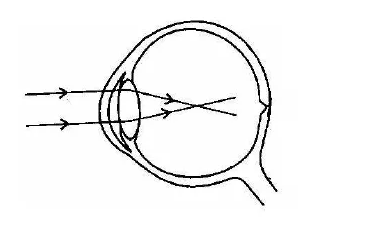
2(iii)(i). Name the defect shown in the diagram.
[1 mark]2(iii)(ii). What are the two possible reasons that cause this defect?
[1 mark]2(iii)(iii). Name the type of lens used to correct this defect.
[1 mark]2(iii)(iv). With the help of a diagram show how the defect shown above is rectified using a suitable lens.
[2 marks]2(iv). Explain the following terms:
2(iv)(i). Allele
[1 mark]2(iv)(ii). Diffusion
[1 mark]2(iv)(iii). Photolysis
[1 mark]2(iv)(iv). Phenotype
[1 mark]2(iv)(v). Population density
[1 mark]2(v). Name the following:
2(v)(i). The process of transformation of several glucose molecules into one molecule of starch.
[1 mark]2(v)(ii). The point of attachment of two chromatids.
[1 mark]2(v)(iii). The iron containing pigment in erythrocytes.
[1 mark]2(v)(iv). The duct which transports urine from the kidney to the urinary bladder.
[1 mark]2(v)(v). The part of the brain which is concerned with memory.
[1 mark]Section B (40 marks)
Attempt any four questions from this Section.
3(i). Define the term – Diapedesis.
[1 mark]3(ii). Distinguish between diabetes mellitus and diabetes insipidus (endocrine gland concerned).
[2 marks]3(iii). Carbon monoxide is dangerous when inhaled in excess. Comment on the statement.
[2 marks]3(v). Draw a neat, labelled diagram of a chloroplast.
[3 marks]3(iv). The diagram given below shows a section of the human ovary.
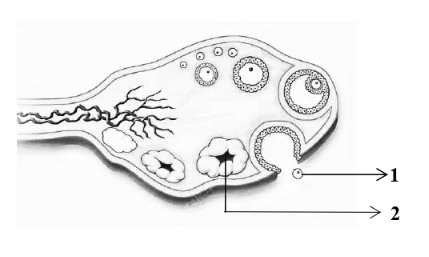
3(iv)(a). Name the process for the release of the part labelled 1.
[1 mark]3(iv)(b). Write the name of the structure marked 2.
[1 mark]4(a). Answer the following questions briefly:
4(a)(i). How are the cytons and axons placed in the brain and the spinal cord?
[1 mark]4(a)(ii). Which part of the human ear gives ‘Dynamic balance’ and ‘Static balance’ to the body?
[1 mark]4(a)(iii). Explain how the human eye adapts itself to bright light and dim light.
[1 mark]4(a)(iv). What is Parthenocarpy? Give one example.
[1 mark]4(a)(v). Mention any two objectives of ‘Swachh Bharat Abhiyan’.
[1 mark]4(b). The diagram given below represents a system in the human body. Study the diagram and answer the following questions:
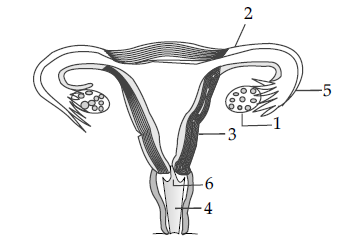
4(b)(i). Identify the system.
[1 mark]4(b)(ii). Label the parts marked 5 and 6.
[1 mark]4(b)(iii). Name the two hormones secreted by part 1.
[1 mark]4(b)(iv). Mention the number and the name of the part involved in fertilization and implantation from the above diagram.
[1 mark]4(b)(v). Mention the surgical methods of contraception in: 1. Human males 2. Human females.
[1 mark]5(i). Write the overall chemical equation for photosynthesis.
[1 mark]5(iii). Mention the two pairs of nitrogenous bases that are present in a DNA strand and pair with each other by hydrogen bonds.
[2 marks]5(iv). State any two disadvantages of living close to an airport.
[2 marks]5(v). Draw a neat, labelled diagram of an animal cell showing Metaphase with four chromosomes.
[3 marks]5(ii). Ramesh is a farmer who has a vineyard and cultivates grapes. To improve the shape of the grapes and make them elongated he sprays a particular phytohormone at the time of fruiting.
5(ii)(a). Name the phytohormone that Ramesh sprays on the plant at the time of fruiting.
[1 mark]5(ii)(b). These grapes are said to be seedless. What is the technical term for the formation of such fruits?
[1 mark]6(a). Given below is the outline of the human body showing the important glands:
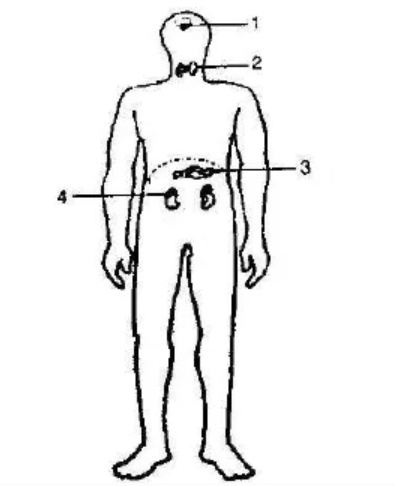
6(a)(i). Name the glands marked 1 to 4.
[1 mark]6(a)(ii). Name the hormone secreted by part 2. Give one important function of this hormone.
[1 mark]6(a)(iii). Name the endocrine part of the part numbered 3.
[1 mark]6(a)(iv). Why is the part labelled 1 called the master gland? Which part of the forebrain controls the gland labelled 1?
[1 mark]6(a)(v). Name the gland that secretes the ‘emergency hormone’.
[1 mark]6(b). The diagram of an apparatus given below demonstrates a particular process in plants. Study the same and answer the questions that follow:
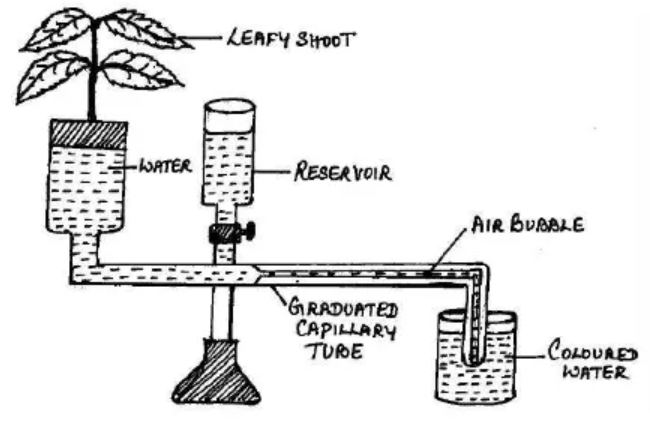
6(b)(i). Name the apparatus.
[0.5 marks]6(b)(ii). Which phenomenon is demonstrated by this apparatus?
[0.5 marks]6(b)(iii). Explain the phenomenon mentioned in (ii) above.
[1 mark]6(b)(iv). State two limitations of using this apparatus.
[1 mark]6(b)(v). What is the importance of the air bubble in the experiment?
[1 mark]6(b)(vi). Name the structures in a plant through which the above process takes place.
[1 mark]7(a). The diagram given below represents a plant cell after being placed in a strong sugar solution. Study the diagram and answer the questions that follow:
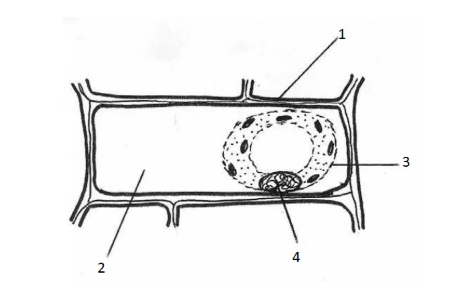
7(a)(i). What is the state of the cell shown in the diagram?
[1 mark]7(a)(ii). Name the structure that acts as a selectively permeable membrane.
[1 mark]7(a)(iii). Label the parts numbered 1 to 4 in the diagram.
[1 mark]7(a)(iv). How can the above cell be brought back to its original condition? Mention the scientific term for the recovery of the cell.
[1 mark]7(a)(v). State any two features of the above plant cell which is not present in animal cells.
[1 mark]7(b). Given below is a representation of a kind of pollution (a scene showing heavy traffic, horns and loudspeakers). Study the same and answer the questions that follow:
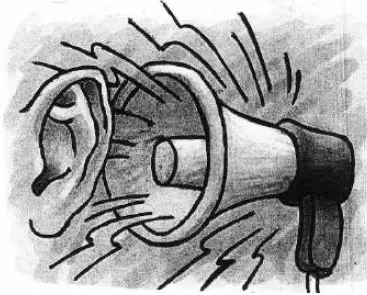
7(b)(i). Name the kind of pollution.
[1 mark]7(b)(ii). List any three common sources of this pollution.
[1 mark]7(b)(iii). Mention three harmful effects of this pollution on human health.
[1 mark]7(b)(iv). Explain the term ‘Pollutant’.
[1 mark]7(b)(v). Name two soil pollutants.
[1 mark]8(a). The diagram given below represents an organ system in the human body. Study the same and answer the questions that follow:
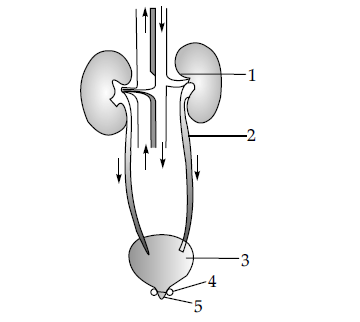
8(a)(i). Identify the system.
[1 mark]8(a)(ii). Label the parts marked 2 and 4. Mention the function of part 5.
[1 mark]8(a)(iii). Name the structural and functional units of the part marked 1.
[1 mark]8(a)(iv). What is the fluid that accumulates in part 3? Which is the main nitrogenous waste present in it?
[1 mark]8(a)(v). Draw a neat, labelled diagram showing the longitudinal section of part 1.
[1 mark]8(b). The diagram given below represents an endocrine gland in the human body. Study the diagram and answer the following questions:
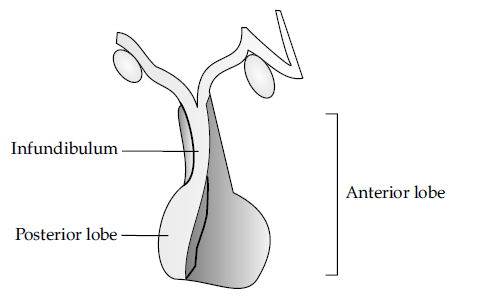
8(b)(i). Identify the endocrine gland. Where is it located?
[1 mark]8(b)(ii). Why is the above gland referred to as the ‘Master gland’?
[1 mark]8(b)(iii). Name the hormone which in deficiency causes Diabetes Insipidus. How does this disorder differ from Diabetes Mellitus?
[1 mark]8(b)(iv). Explain the term ‘Hormone’. What is the role of Tropic hormones in the human body?
[1 mark]8(b)(v). Which lobe of the above gland secretes: 1. Oxytocin 2. ACTH 3. Growth hormone
[1 mark]