Biology — Suggested Paper 4
120 minutes80 marks Questions from 2016–2025
A suggested paper: every question is a real ICSE board question, chosen from different years and arranged in the current pattern. Start the timed test to have your written answers marked.
Section A (40 marks)
Attempt all questions from this Section.
1. Choose the correct answers to the questions from the given options. (Do not copy the questions, write the correct answers only.)
1(i). At the end of __________, cytokinesis is completed.
[1 mark]- (a)Metaphase
- (b)Prophase
- (c)Interphase
- (d)Telophase
1(ii). The mineral element in haemoglobin:
[1 mark]- (a)Manganese
- (b)Iron
- (c)Sodium
- (d)Calcium
1(iii). In a human male, a sperm will contain:
[1 mark]- (a)Both X and Y chromosomes
- (b)Only Y chromosome
- (c)Only X chromosome
- (d)Either X or Y chromosome
1(iv). Guard cells:
[1 mark]- (a)Around the root hairs
- (b)Around the lenticels
- (c)Around the thylakoids
- (d)Around the stoma
1(v). The numbers of Spinal nerves in the human being are:
[1 mark]- (a)31 pairs
- (b)20 pairs
- (c)10 pairs
- (d)30 pairs
1(vi). Osmosis takes place when there is:
[1 mark]- (a)A freely permeable membrane
- (b)A cell wall
- (c)A selectively permeable membrane
- (d)An impermeable membrane
1(vii). The structure that lies at the junction of the choroid and the iris and is itself a part of the choroid is called:
[1 mark]- (a)Ciliary body
- (b)Suspensory ligament
- (c)Pupil
- (d)Lens
1(viii). Photosynthesis:
[1 mark]- (a)It is the synthesis of glucose from carbon dioxide by non-green plants using light energy.
- (b)It is the synthesis of glucose by green plants from carbon dioxide using light energy.
- (c)It is the synthesis of glucose from carbon dioxide and water by non-green plants using light energy.
- (d)It is the synthesis of glucose from carbon dioxide and water by green plants using light energy.
1(ix). The hormone that affects urination is:
[1 mark]- (a)Adrenaline
- (b)Vasopressin
- (c)Oestrogen
- (d)Thyroxine
1(x). Many nuclear power plants are constructed near water sources. They use water for cooling their machinery and release it back into the water stream. Identify the kind of pollution caused.
[1 mark]- (a)Radiation pollution
- (b)Water pollution
- (c)Industrial pollution
- (d)Thermal pollution
1(xi). The nephrons discharge their urine at the:
[1 mark]- (a)Urinary bladder
- (b)Urethra
- (c)Renal pelvis
- (d)Renal pyramid
1(xii). On which day of the menstrual cycle does ovulation take place?
[1 mark]- (a)5th day
- (b)28th day
- (c)14th day
- (d)1st day
1(xiii). The number of live births per thousand people per year is called:
[1 mark]- (a)Mortality
- (b)Population density
- (c)Population growth rate
- (d)Natality
1(xiv). Haploid number chromosomes are found in:
[1 mark]- (a)Nephrons
- (b)Neurons
- (c)Skin cells
- (d)Sperms
1(xv). The life span of a RBC is:
[1 mark]- (a)120 days
- (b)220 days
- (c)20 days
- (d)2 weeks
2(i). Identify the ODD term in each set and name the CATEGORY to which the remaining three belong:
2(i)(i). Auxin, Ethylene, Adrenaline, Cytokinin
[1 mark]2(i)(ii). Tympanum, Ear ossicles, Auditory canal, Pinna
[1 mark]2(i)(iii). Syringes, Soiled dressings, Discarded needles, Household detergents
[1 mark]2(i)(iv). Exophthalmic Goitre, Simple Goitre, Cretinism, Myxoedema
[1 mark]2(i)(v). Adenine, Guanine, Creatinine, Cytosine
[1 mark]2(ii). Name the following:
2(ii)(a). The fully developed part of the ovary containing a mature ovum.
[1 mark]2(ii)(b). A waxy layer on the upper epidermis of leaves meant to reduce Transpiration.
[1 mark]2(ii)(c). The ear ossicle which opens into the oval window of Cochlea.
[1 mark]2(ii)(d). The physiological process which is the starting point of all food chains.
[1 mark]2(ii)(e). An insect which is a classic example of natural selection due to industrial melanism.
[1 mark]2(iii). Choose the odd one out from the following terms and name the category to which the others belong:
2(iii)(a). Used bandages, Pesticides, Face masks, Syringes.
[1 mark]2(iii)(b). Dust, Smoke, Carbon monoxide, Effluents.
[1 mark]2(iii)(c). Uterus, Urethra, Urinary bladder, Ureter.
[1 mark]2(iii)(d). Menstrual phase, Telophase, Follicular phase, Luteal phase.
[1 mark]2(iii)(e). Malleus, Incus, Cochlea, Stapes.
[1 mark]2. Given below is the diagram of a human heart. Read the information below the diagram and fill in the blanks.
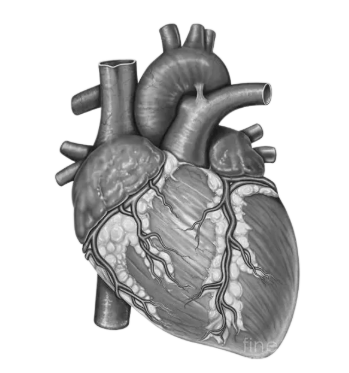
2. The human heart pumps blood throughout the body. It is the size of a large fist. The heart is located between the lungs in the thoracic cavity. It has four chambers. The heart functions all through the lifespan of a person and is responsible for the survival of the person.
2(iv). The heart is enclosed by a membrane called (a) __________. The ventricles give rise to two large blood vessels called (b) __________ and (c) __________. The flaps of the cuspid valves are kept in position by (d) __________. (e) __________ arteries supply oxygenated blood to the walls of the heart.
[5 marks]2. Given in the box below are a set of 14 biological terms. Of these, 12 can be paired into 6 matching pairs. One has been done for you as an example. Identify the remaining five matching pairs. Example: Endosmosis – Turgid cell.
2(v). Cushing’s syndrome, Turgid cell, Iris, Free of rod and cone cells, Colour of eyes, Hypoglycemia, Active transport, Acrosome, Addison’s disease, Blind spot, Hyperglycemia, Spermatozoa, Endosmosis, Clotting of blood.
[5 marks]Section B (40 marks)
Attempt any four questions from this Section.
3(a). The diagram given below represents a stage during cell division. Study the same and answer the questions that follow:
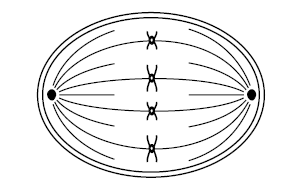
3(a)(i). Identify whether it is a plant cell or an animal cell. Give a reason in support of your answer.
[1 mark]3(a)(ii). Name the stage depicted in the diagram. What is the unique feature observed in this stage?
[1 mark]3(a)(iii). Name the type of cell division that occurs during: 1. Replacement of old leaves by new ones. 2. Formation of gametes.
[1 mark]3(a)(iv). What is the stage that comes before the stage shown in the diagram?
[1 mark]3(a)(v). Draw a neat, labelled diagram of the stage mentioned in (iv).
[1 mark]3(b). Mention the exact location of the following:
3(b)(i). Epididymis
[1 mark]3(b)(ii). Lacrimal gland
[1 mark]3(b)(iii). Malleus
[1 mark]3(b)(iv). Hydathodes
[1 mark]3(b)(v). Pulmonary semilunar valve
[1 mark]4(a). A homozygous dominant tall pea plant bearing red flowers (TTRR) is crossed with a homozygous recessive dwarf pea plant bearing white flowers (ttrr).
4(a)(i). What is the phenotype and genotype of F1 individuals?
[1 mark]4(a)(ii). Write the possible combination of gametes that are obtained when two F1 hybrid plants are crossed.
[1 mark]4(a)(iii). Mention the phenotypic ratio of the F2 generation.
[1 mark]4(a)(iv). State Mendel’s Law of Independent Assortment.
[1 mark]4(a)(v). Name two X-linked disorders found in humans.
[1 mark]4(b). The diagram given below is that of a developing human foetus. Answer the questions that follow:
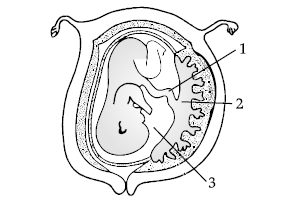
4(b)(i). Label the parts numbered 1 to 3 in the diagram.
[1 mark]4(b)(ii). Mention any two functions of the part labelled 2 in the diagram.
[1 mark]4(b)(iii). Explain the significance of the part numbered 3 in the diagram.
[1 mark]4(b)(iv). Define the term ‘Gestation’. What is the normal gestational period of the developing embryo?
[1 mark]4(b)(v). Mention the sex chromosomes in a male and female embryo.
[1 mark]5(i). Define the term hormone.
[1 mark]5(iii). Mention two structural differences between an artery and a vein.
[2 marks]5(iv). Write any two limitations of using a Ganong’s Potometer to demonstrate the uptake of water.
[2 marks]5(ii). Which parts of the ear are responsible for:
5(ii)(a). Static equilibrium?
[1 mark]5(ii)(b). Dynamic equilibrium?
[1 mark]5(v). A teacher drew the diagram of heart on the blackboard and told the students to copy it in their notebooks. Mahesh couldn’t see the diagram clearly as it appeared blurred to him.
5(v)(a). Name the defect of the eye Mahesh is suffering from.
[1 mark]5(v)(b). Where is the image formed in this defect?
[1 mark]5(v)(c). Mahesh consults an eye doctor and is prescribed suitable lenses to correct the defect. Which type of lens do his spectacles have?
[1 mark]6(a). The diagram below represents an experiment to demonstrate a certain phenomenon in a green plant (a leafy shoot fixed by rubber tubing to a glass tube standing in mercury):
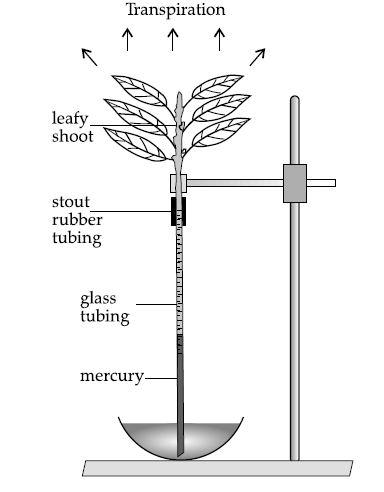
6(a)(i). Will the level of mercury in the glass tubing rise or fall? Which conducting tissue of the plant does the glass-tubing represent?
[1 mark]6(a)(ii). Define Transpiration.
[1 mark]6(a)(iii). How would the rate of the above process differ if the environment of the plant has: 1. Less humidity 2. High temperature?
[1 mark]6(a)(iv). State any two advantages of transpiration to the plant.
[1 mark]6(a)(v). Draw a neat labelled diagram of a Plasmolysed cell.
[1 mark]6(b). Give appropriate biological / technical terms for the following:
6(b)(i). The sensory organ in Cochlea.
[0.5 marks]6(b)(ii). Number of live births per 1000 people per year.
[0.5 marks]6(b)(iii). The point of contact between two neurons.
[0.5 marks]6(b)(iv). The accessory gland in human males whose secretion neutralises the acid in the vagina.
[0.5 marks]6(b)(v). Condition when blood sugar level is lowered in the blood.
[0.5 marks]6(b)(vi). Structure which helps in the adjustment of the size of the pupil.
[0.5 marks]6(b)(vii). A surgical method of fertility control in human males.
[0.5 marks]6(b)(viii). Process by which leucocytes migrate through the walls of capillaries.
[0.5 marks]6(b)(ix). A sudden inheritable change in one or more genes.
[0.5 marks]6(b)(x). A non-dividing phase of the cell cycle where more DNA is synthesised.
[0.5 marks]7(a). Given below are diagrams showing the different stages in the process of fertilisation of an egg in the human female reproductive tract. Study the diagrams and answer the questions:
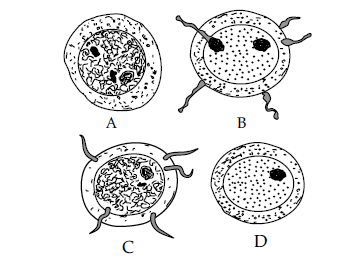
7(a)(i). Arrange the letters given below each diagram in a logical sequence to show the correct order in the process of fertilisation.
[1 mark]7(a)(ii). Where does fertilisation normally take place? What is ‘Implantation’ that follows fertilisation?
[1 mark]7(a)(iii). Mention the chromosome number of the egg and zygote in humans.
[1 mark]7(a)(iv). Explain the term ‘Gestation’. How long does gestation last in humans?
[1 mark]7(a)(v). Draw a neat, labelled diagram of a mature human sperm.
[1 mark]7(b). A potted plant with variegated leaves was taken in order to prove a factor necessary for photosynthesis. The potted plant was kept in the dark for 24 hours and then placed in bright sunlight for a few hours. Observe the diagram and answer the questions:
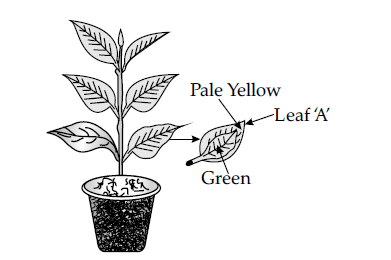
7(b)(i). What aspect of photosynthesis is being tested in the above diagram?
[1 mark]7(b)(ii). Represent the process of photosynthesis in the form of a balanced equation.
[1 mark]7(b)(iii). Why was the plant kept in the dark before beginning the experiment?
[1 mark]7(b)(iv). What will be the result of the starch test performed on leaf ‘A’ shown in the diagram? Give an example of a plant with variegated leaves.
[1 mark]7(b)(v). Draw a neat labelled diagram of a chloroplast.
[1 mark]8(a). The figure given below shows a part of a nephron. Answer the questions that follow:
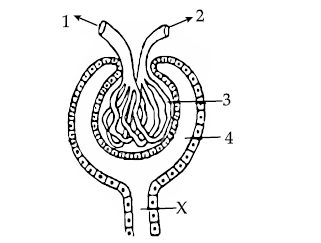
8(a)(i). In which region of the kidney is the above structure present?
[1 mark]8(a)(ii). Label the parts numbered 1 to 4.
[1 mark]8(a)(iii). What is the technical term for the process that occurs in part 3?
[1 mark]8(a)(iv). Why is fluid X not called urine? Justify your answer.
[1 mark]8(a)(v). Draw a neat, labelled diagram of the urinary system of man.
[1 mark]8(b). Differentiate between the following pairs on the basis of what is mentioned in the brackets:
8(b)(i). Transpiration and Guttation (place of occurrence)
[1 mark]8(b)(ii). Biodegradable waste and Non-biodegradable waste (One example)
[1 mark]8(b)(iii). Population control and Swachh Bharat Abhiyan (One objective)
[1 mark]8(b)(iv). Osmosis and Active Transport (Substances undergoing movement)
[1 mark]8(b)(v). Metaphase and Anaphase (Position of chromosomes)
[1 mark]