Biology — Suggested Paper 3
120 minutes80 marks Questions from 2016–2026
A suggested paper: every question is a real ICSE board question, chosen from different years and arranged in the current pattern. Start the timed test to have your written answers marked.
Section A (40 marks)
Attempt all questions from this Section.
1. Choose the correct answers to the questions from the given options. (Do not copy the questions, write the correct answers only.)
1(i). In a human female, ovum consists of:
[1 mark]- (a)23 pairs of autosomes
- (b)22 pairs of autosomes and 1 pair of sex chromosomes
- (c)22 autosomes and 1 Y-chromosome
- (d)22 autosomes and 1 X-chromosome
1(ii). The mineral ion needed for the formation of blood clot is:
[1 mark]- (a)Potassium
- (b)Sodium
- (c)Calcium
- (d)Iron
1(iii). A zygote which has Y chromosome inherited from the father will develop into a:
[1 mark]- (a)Will depend on the chromosome inherited from the mother
- (b)Girl
- (c)Either boy or a girl
- (d)Boy
1(iv). Xylem tissue:
[1 mark]- (a)Conducts water and minerals in leaves
- (b)Does not conduct water and minerals in stems
- (c)Conducts food and nutrients to roots
- (d)Conducts food and nutrients to all parts of the plant
1(v). Karan was standing on a high stool and cleaning the ceiling fan. He suddenly loses balance and sustains a head injury. An examination reveals that his pupils have lost the capacity to constrict in bright light. Which structure has been damaged?
[1 mark]- (a)Suspensory ligaments
- (b)Medulla oblongata
- (c)Eye lens
- (d)Eye lid
1(vi). A plant cell may burst when:
[1 mark]- (a)Turgor pressure equalises wall pressure
- (b)Turgor pressure exceeds wall pressure
- (c)Wall pressure exceeds turgor pressure
- (d)None of the above
1(vii). Aqueous humour is present between the:
[1 mark]- (a)Lens and Retina
- (b)Iris and Lens
- (c)Cornea and Iris
- (d)Cornea and Lens
1(viii). The process of conversion of ADP to ATP during photosynthesis:
[1 mark]- (a)Polymerisation
- (b)Photophosphorylation
- (c)Photorespiration
- (d)Photolysis
1(ix). Gigantism and Acromegaly are due to:
[1 mark]- (a)Hypersecretion of Growth hormone
- (b)Hypersecretion of Thyroxine
- (c)Hyposecretion of Growth hormone
- (d)Hyposecretion of Thyroxine
1(x). The prime source of chlorofluorocarbons is:
[1 mark]- (a)Vehicular emissions
- (b)Industrial effluents
- (c)Domestic sewage
- (d)Refrigeration equipments
1(xi). The main nitrogenous waste formed in the human body:
[1 mark]- (a)Uric acid
- (b)Urea
- (c)Ammonia
- (d)Creatinine
1(xii). Surgical method of sterilization in a woman involves cutting and tying of:
[1 mark]- (a)Ureter
- (b)Uterus
- (c)Urethra
- (d)Oviduct
1(xiii). The statistical study of human population is called:
[1 mark]- (a)Mortality
- (b)Demography
- (c)Natality
- (d)Equality
1(xiv). Centromere:
[1 mark]- (a)It is the point of attachment of two sister chromatids
- (b)It is the point of attachment of two centrioles
- (c)It is the point of attachment of two centrosomes
- (d)It is the point of attachment between two daughter nuclei
1(xv). Pericardium covers the:
[1 mark]- (a)Heart
- (b)Brain
- (c)Spinal cord
- (d)Eyeball
2(i). Study the picture given below (industrial effluent and oil being discharged into a water body, with dead fish visible) and answer the following questions:
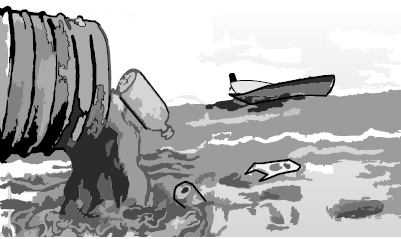
2(i)(i). Identify the type of pollution.
[1 mark]2(i)(ii). Name one pollutant that causes the above pollution.
[1 mark]2(i)(iii). Mention the impact of this pollution on human health.
[1 mark]2(i)(iv). State one measure to control this pollution.
[1 mark]2(i)(v). What is a ‘Pollutant’? Explain the term.
[1 mark]2(ii). Read the explanations given below and name the structures:
2(ii)(a). The canal through which the testes descend down into the scrotum just before the birth of a male baby.
[1 mark]2(ii)(b). The part of the brain that regulates the peristaltic movement of the alimentary canal.
[1 mark]2(ii)(c). A structure that collects the soundwaves and conducts them through the external auditory canal.
[1 mark]2(ii)(d). The point of attachment of two chromatids of a chromosome.
[1 mark]2(ii)(e). Regulation of the opening and closing of stomata.
[1 mark]2. Match the items given in column A with the most appropriate ones in Column B and REWRITE the correct matching pairs:
2(iii). Column A: (i) Biston betularia (ii) Testes (iii) Clotting of blood (iv) Stroma (v) Stomata Column B: – Calcium – balance of the body – Light independent reaction – diffusion of gases – gonad – Peppered moth – Light dependent reaction – Chlorophyll
[5 marks]2(iv). The diagram given below represents a plant movement. Answer the following questions:
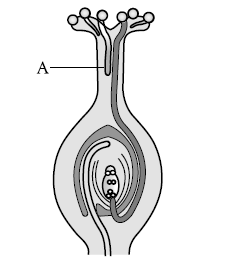
2(iv)(i). Name the tropic movement shown in the diagram.
[1 mark]2(iv)(ii). Explain the tropic movement mentioned in (i).
[1 mark]2(iv)(iii). Label the part marked ‘A’.
[1 mark]2(iv)(iv). What is part A attracted to?
[1 mark]2(iv)(v). Give an example of a plant which shows Thigmotropism.
[1 mark]2(v). Given below are sets of five terms each. Rewrite the terms in correct order in a logical sequence. Example: Large intestine, Stomach, Mouth, Small intestine, Oesophagus. Answer: Mouth → Oesophagus → Stomach → Small intestine → Large intestine.
2(v)(i). Fibrin, Platelets, Thromboplastin, Fibrinogen, Thrombin.
[1 mark]2(v)(ii). Cochlea, Malleus, Pinna, Stapes, Incus.
[1 mark]2(v)(iii). Receptor, Spinal cord, Effector, Motor neuron, Sensory neuron.
[1 mark]2(v)(iv). Uterus, Parturition, Fertilisation, Gestation, Implantation.
[1 mark]2(v)(v). Caterpillar, Snake, Owl, Frog, Green leaves.
[1 mark]Section B (40 marks)
Attempt any four questions from this Section.
3(a). The diagram below represents a process in plants (a leafy shoot in a flask of water with a layer of oil on top, the whole standing on a weighing machine). The setup was placed in bright sunlight. Answer the following questions:
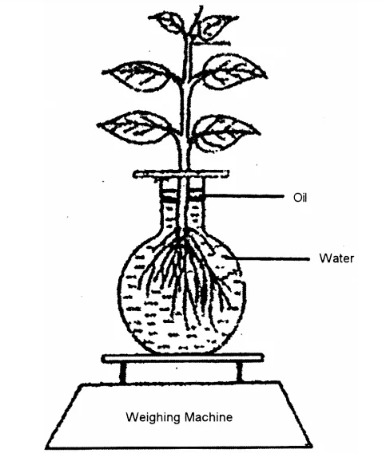
3(a)(i). Name the physiological process depicted in the diagram. Why was oil added to the water?
[1 mark]3(a)(ii). When placed in bright sunlight for four hours, what do you observe with regard to the initial and final weight of the plant? Give a suitable reason for your answer.
[1 mark]3(a)(iii). What happens to the level of water when this setup is placed in: 1. Humid conditions? 2. Windy conditions?
[1 mark]3(a)(iv). Mention any three adaptations found in plants to overcome the process mentioned in (i).
[1 mark]3(a)(v). Explain the term ‘Guttation’.
[1 mark]3(b). A pea plant which is homozygous for green pods which are inflated [GGII] is crossed with a homozygous plant for yellow pods which are constricted [ggii]. Answer the following questions:
3(b)(i). Give the phenotype and genotype of the F1 generation. Which type of pollination has occurred to produce F1 generation?
[1 mark]3(b)(ii). Write the phenotypic ratio of the F2 generation.
[1 mark]3(b)(iii). Write the possible combinations of the gametes that can be obtained if two F1 hybrid plants are crossed.
[1 mark]3(b)(iv). State Mendel’s law of ‘Segregation of Gametes’.
[1 mark]3(b)(v). What is the scientific name of the plant which Mendel used for his experiments on inheritance?
[1 mark]4(i). Explain the term Excretion.
[1 mark]4(ii). State the difference between Nephron and Neuron.
[2 marks]4(iii). Mention any two objectives of Swachh Bharat Abhiyan.
[2 marks]4(iv). Give any two characteristic features of a Cro-Magnon man.
[2 marks]4(v). A farmer cultivates a unique species of tomato plants. The two traits selected for breeding were the colour of the fruits and the height of the plants. The farmer initially crosses a homozygous tall plant bearing red fruits (TTRR) with a dwarf plant bearing yellow fruits (ttrr), and the genotype of all the offsprings of the F1 generation was TtRr. Next, he crosses two F1 generation plants (TtRr).
4(v)(a). Explain the phenotype of the offsprings of the F1 generation obtained from the initial cross.
[1 mark]4(v)(b). Mention the phenotypic ratio of the F2 generation offsprings.
[1 mark]4(v)(c). State Mendel’s Law of Independent Assortment.
[1 mark]5(a). The diagrams given below represent the relationship between a mouse and a physiological process that occurs in green plants. Bell jar A contains a mouse with a green plant; bell jar B contains a mouse with a burning candle and no plant. Study the diagrams and answer the questions that follow:
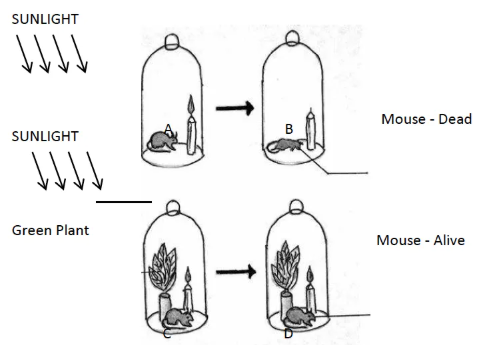
5(a)(i). Name the physiological process occurring in the green plant that has kept the mouse alive.
[1 mark]5(a)(ii). Explain the physiological process mentioned above.
[1 mark]5(a)(iii). Why did the mouse die in bell jar B?
[1 mark]5(a)(iv). What is the significance of the process as stated in (i) for life on earth?
[1 mark]5(a)(v). Represent the above mentioned physiological process in the form of a chemical equation.
[1 mark]5(b). Mention the exact location of the following:
5(b)(i). Prostate gland
[1 mark]5(b)(ii). Myelin sheath
[1 mark]5(b)(iii). Islets of Langerhans
[1 mark]5(b)(iv). Semi-circular canals
[1 mark]5(b)(v). Eustachian tube
[1 mark]6(i). What is Micturition? Explain.
[1 mark]6(ii). What are biomedical wastes? Give an example.
[2 marks]6(iii). Differentiate between the functions of Urethra and Uterus.
[2 marks]6(v). Draw a neat, labelled diagram to show that oxygen is released during photosynthesis.
[3 marks]6(iv). Rachna is an expert gymnast on the balance beam. She has been vigorously practising for the Olympic Games. Lately, she has been experiencing dizziness and losing her balance during the practice sessions.
6(iv)(a). Which part of the membranous labyrinth is responsible for maintaining the body balance on the beam?
[1 mark]6(iv)(b). Which type of balance is maintained by the structure mentioned in (a)?
[1 mark]7(a). Based on the diagram drawn above in (i) give a suitable term for each of the following descriptions:
7(a)(i). Draw a well labelled diagram of the membranous labyrinth found in the inner ear.
[2 marks]7(a)(ii)(1). The sensory cells that help in hearing.
[0.6 marks]7(a)(ii)(2). The part that is responsible for static balance of the body.
[0.6 marks]7(a)(ii)(3). The membrane covered opening that connects the middle ear to the inner ear.
[0.6 marks]7(a)(ii)(4). The fluid present in the middle chamber of cochlea.
[0.6 marks]7(a)(ii)(5). The structure that maintains dynamic equilibrium of the body.
[0.6 marks]7(b). Give the Biological / technical term for the following:
7(b)(i). Complete stoppage of menstrual cycle in females.
[0.5 marks]7(b)(ii). Pigment providing colour to urine.
[0.5 marks]7(b)(iii). The vein which drains the blood from the intestine to the liver.
[0.5 marks]7(b)(iv). The canal through which the testes descend into the scrotum just before the birth of a male baby.
[0.5 marks]7(b)(v). The process causing an undesirable change in the environment.
[0.5 marks]7(b)(vi). The removal of nitrogenous wastes from the body.
[0.5 marks]7(b)(vii). The repeating components of each DNA strand lengthwise.
[0.5 marks]7(b)(viii). An alteration in the genetic material that can be inherited.
[0.5 marks]7(b)(ix). The process of uptake of mineral ions against the concentration gradient using energy from the cell.
[0.5 marks]7(b)(x). Blood vessels carrying blood to the left atrium.
[0.5 marks]8(i). Explain the term ‘Population density’.
[1 mark]8(ii). Name the two surgical methods of population control.
[2 marks]8(iii). Mention two factors responsible for population explosion in India.
[2 marks]8(iv). Name any two resources which come under pressure due to rising population.
[2 marks]8(v). Answer the following questions:

8(v). The diagram given below depicts the climate change on planet Earth. The poster reads: "THE CLIMATE IS CHANGING — WHY AREN’T WE?"
8(v)(a). Name the climate phenomenon for the increase in Earth’s temperature.
[1 mark]8(v)(b). Mention one reason for this warming.
[1 mark]8(v)(c). What measure can be taken to prevent this climate change?
[1 mark]