Biology — Suggested Paper 2
120 minutes80 marks Questions from 2016–2026
A suggested paper: every question is a real ICSE board question, chosen from different years and arranged in the current pattern. Start the timed test to have your written answers marked.
Section A (40 marks)
Attempt all questions from this Section.
1. Choose the correct answers to the questions from the given options. (Do not copy the questions, write the correct answers only.)
1(i). Aster:
[1 mark]- (a)Around the centrioles in plant cells
- (b)Around the centrioles in animal cells
- (c)Around the chromatids in animal cells
- (d)Around the chromatids in plant cells
1(ii). Agranulocytes are:
[1 mark]- (a)Lymphocytes, Monocytes
- (b)Lymphocytes, Basophils
- (c)Eosinophils, Basophils
- (d)Eosinophils, Monocytes
1(iii). A family has a history of colour blindness. During genetic testing it was found that the mother is a carrier of colour blindness (XᶜX) and the father has normal vision (XY). What is the probability of their sons being colour blind?
[1 mark]- (a)25%
- (b)50%
- (c)75%
- (d)0%
1(iv). The process in which water is lost from the margins of strawberry leaves is:
[1 mark]- (a)Osmosis
- (b)Imbibition
- (c)Diffusion
- (d)Guttation
1(v). Assertion (A): Arachnoid layer helps in speeding up the transmission of nerve impulses along the axons. Reason (R): Axon endings at the synapse secrete acetylene.
[1 mark]- (a)(A) is true and (R) is false
- (b)(A) is false and (R) is true
- (c)Both (A) and (R) are true
- (d)Both (A) and (R) are false
1(vi). Assertion (A): A turgid plant cell is in a balanced state. Reason (R): In a turgid cell, turgor pressure and wall pressure are equal and in the same direction.
[1 mark]- (a)(A) is true and (R) is false
- (b)(A) is false and (R) is true
- (c)Both (A) and (R) are true
- (d)Both (A) and (R) are false
1(vii). The ear ossicle that transports sound vibrations to the inner ear:
[1 mark]- (a)Stapes
- (b)Malleus
- (c)Incus
- (d)Cochlea
1(viii). Grana of chloroplast is not the:
[1 mark]- (a)Site of Light Independent Phase
- (b)Site of Light Dependent Phase
- (c)Site of Photolysis
- (d)Site of Photon absorption
1(ix). Assertion (A): Deficiency of Antidiuretic hormone causes an increase in urination. Reason (R): Antidiuretic hormone acts on the kidney to reabsorb water from the kidney tubules.
[1 mark]- (a)(A) is true and (R) is false
- (b)(A) is false and (R) is true
- (c)Both (A) and (R) are true
- (d)Both (A) and (R) are false
1(x). What does Swachh Bharat Abhiyan aim to achieve in India?
[1 mark]- (a)Increase in deforestation to dump waste.
- (b)Expansion of landfill areas to accommodate more waste.
- (c)Improved sanitation and solid waste management.
- (d)Greater industrial waste production.
1(xi). The pale yellow colour of normal human urine is due to the pigment:
[1 mark]- (a)Melanin
- (b)Anthocyanin
- (c)Urochrome
- (d)Haemoglobin
1(xii). The fusion of the sperm and ovum is termed as:
[1 mark]- (a)Reproduction
- (b)Development
- (c)Fertilization
- (d)Embryo
1(xiii). Birth rate is the number of live births per thousand persons in:
[1 mark]- (a)1 year
- (b)2 years
- (c)10 years
- (d)20 years
1(xiv). Assertion (A): Abscisic acid promotes stomatal closure during a drought. Reason (R): Abscisic acid helps the plant to conserve water during stress.
[1 mark]- (a)(A) is true and (R) is false
- (b)(A) is false and (R) is true
- (c)Both (A) and (R) are true and (R) is the correct explanation of (A)
- (d)Both (A) and (R) are true but (R) is not the correct explanation of (A)
1(xv). Cell wall:
[1 mark]- (a)Regulates entry of solutes in plant cells
- (b)Regulates entry of solutes in animal cells
- (c)Gives rigidity and shape to plant cells
- (d)Gives rigidity and shape to animal cells
2(i). Correct the following statements by changing the underlined words:
2(i)(i). Normal pale yellow colour of the urine is due to the presence of the pigment MELANIN.
[1 mark]2(i)(ii). The outermost layer of Meninges is PIAMATER.
[1 mark]2(i)(iii). The cell sap of root hair is HYPOTONIC.
[1 mark]2(i)(iv). XYLEM transports starch from the leaves to all parts of the plant body.
[1 mark]2(i)(v). NITROGEN bonds are present between the complementary nitrogenous bases of DNA.
[1 mark]2(ii). Arrange and rewrite the terms in each group in correct order to be in a logical sequence beginning with the term that is underlined:
2(ii)(a). Snake, Rabbit, CABBAGE, Hawk. (Begin with: Cabbage)
[1 mark]2(ii)(b). Xylem, SOIL WATER, Cortical cells, Root hair. (Begin with: Soil water)
[1 mark]2(ii)(c). RECEPTOR, Response, Effector, Spinal Cord. (Begin with: Receptor)
[1 mark]2(ii)(d). Fovea, Lens, Cornea, CONJUNCTIVA. (Begin with: Conjunctiva)
[1 mark]2(ii)(e). TESTIS, Urethra, Sperm duct, Epididymis. (Begin with: Testis)
[1 mark]2(iii). Arrange the terms in each group in the correct order. Write them in a logical sequence beginning with the term that is underlined.
2(iii)(a). Palisade cells, CUTICLE, Upper epidermis, Spongy cells. (Begin with: Cuticle)
[1 mark]2(iii)(b). Hepatic portal vein, STOMACH, Hepatic vein, Liver. (Begin with: Stomach)
[1 mark]2(iii)(c). Cyton, DENDRITES, Synaptic cleft, Axon endings. (Begin with: Dendrites)
[1 mark]2(iii)(d). Insulin release, HIGH BLOOD SUGAR, Lowers blood sugar, Stimulates glucose uptake from blood. (Begin with: High blood sugar)
[1 mark]2(iii)(e). Sperm duct, SEMINIFEROUS TUBULE, Epididymis, Efferent ducts. (Begin with: Seminiferous tubule)
[1 mark]2(iv). Name the following:
2(iv)(i). The process by which root hairs absorb water from the soil.
[1 mark]2(iv)(ii). The organ which produces urea.
[1 mark]2(iv)(iii). The kind of lens required to correct Myopia.
[1 mark]2(iv)(iv). The pituitary hormone which stimulates contraction of uterus during child birth.
[1 mark]2(iv)(v). The international health organization which educates people in accident prevention.
[1 mark]2. Match the items given in Column I with most appropriate ones in Column II and rewrite the correct matching pairs:
2(v). Column I: (a) Leydig Cells, (b) Stoma, (c) Ova, (d) Cranial nerve, (e) Cretinism Column II: 1. Lack of thyroxine in children, 2. 12 pairs, 3. Testosterone, 4. Diffusion of respiratory gases, 5. Haploid cells, 6. 31 pairs, 7. Diploid cells
[5 marks]Section B (40 marks)
Attempt any four questions from this Section.
3(i). Expand the abbreviation – NADP.
[1 mark]3(ii). Mention two adaptations in roots for absorption of water from the soil.
[2 marks]3(iii). Differentiate between Afferent arteriole and Efferent arteriole (diameter).
[2 marks]3(iv). Give two examples of water pollutants.
[2 marks]3(v). Ali has some pea plants in his garden which need a support to grow as seen in the picture given below.
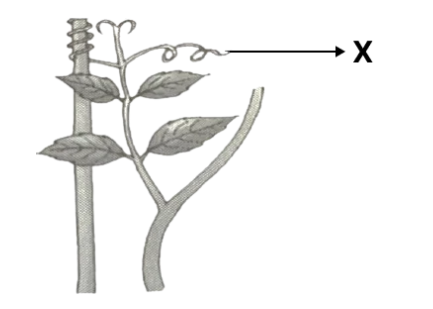
3(v)(a). Name the phenomenon depicted by the shoot in the given figure.
[1 mark]3(v)(b). Define the above phenomenon.
[1 mark]3(v)(c). Write the name of the part marked X.
[1 mark]4(a). A homozygous tall plant (T) bearing red coloured (R) flowers is crossed with a homozygous dwarf (t) plant bearing white (r) flowers:
4(a)(i). Give the genotype and phenotype of the plants of F1 generation.
[1 mark]4(a)(ii). Mention the possible combinations of the gametes that can be obtained from the F1 hybrid plant.
[1 mark]4(a)(iii). State Mendel’s law of Independent Assortment.
[1 mark]4(a)(iv). Mention the phenotypes of the offsprings obtained in F2 generation.
[1 mark]4(a)(v). What is the phenotypic ratio obtained in F2 generation?
[1 mark]4(b). Briefly explain the following terms:
4(b)(i). Reflex action
[1 mark]4(b)(ii). Power of accommodation
[1 mark]4(b)(iii). Photophosphorylation
[1 mark]4(b)(iv). Hormone
[1 mark]4(b)(v). Synapse
[1 mark]5(i). Define the term Allele.
[1 mark]5(iii). Mention any two functions of amniotic fluid.
[2 marks]5(ii). In the last century, the human population has increased tremendously. Death rate has reduced and life expectancy has increased. This rapid growth has placed significant pressure on resources. Global cooperation is needed for environmental preservation.
5(ii)(a). Mention any one reason for reduction in the death rate.
[1 mark]5(ii)(b). Name any one resource that is under pressure due to population explosion.
[1 mark]5(iv). Expand the following abbreviations:
5(iv)(a). CFC
[1 mark]5(iv)(b). CNG
[1 mark]5(v). Vineet’s day begins with a cup of piping hot coffee. Caffeine is a stimulant present in coffee which increases the circulation of Adrenaline in the body. Vineet feels refreshed, alert and focussed.
5(v)(a). Name the organ that is stimulated by caffeine which makes Vineet alert and focussed.
[1 mark]5(v)(b). Give the collective term for the protective membranes of the organ mentioned in (a).
[1 mark]5(v)(c). Which part of the autonomic nervous system increases the secretion of Adrenaline?
[1 mark]6(i). Explain the abbreviation – DNA.
[1 mark]6(ii). What is Active transport?
[2 marks]6(iii). Mention the two pairs of nitrogenous bases which pair with each other with hydrogen bonds.
[2 marks]6(iv). State Mendel’s Law of Segregation.
[2 marks]6(v). Draw a neat, labelled diagram of a human sperm.
[3 marks]7(i). What is the structure of DNA as proposed by Watson and Crick?
[1 mark]7(iii). Complete the food chain by mentioning the names of the organisms in (c) and (d).
[2 marks]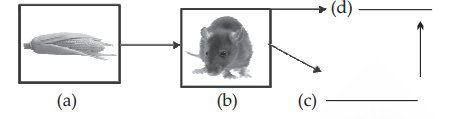
7(iv). State any two harmful effects of acid rain.
[2 marks]7(v). Given below is a picture of a tree. Mention the scientific phenomena occurring in the parts labelled (a), (b) and (c).
[3 marks]7(ii). Name the white blood cells that:
7(ii)(a). show phagocytosis
[1 mark]7(ii)(b). produce antibodies
[1 mark]8(a). The diagram shown below is the longitudinal section of a testis of man. Study it carefully and answer the questions that follow:
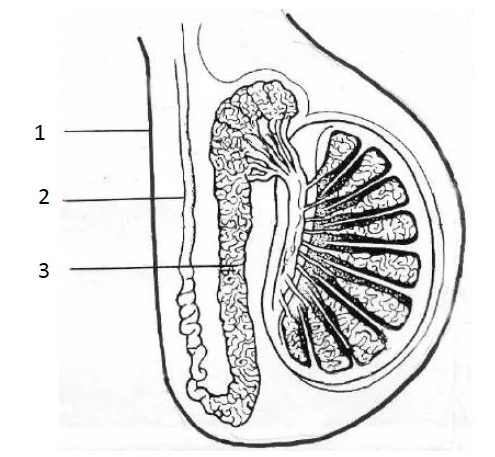
8(a)(i). Label the parts numbered 1 to 3 in the diagram.
[1 mark]8(a)(ii). In which part of the testis are the sperms produced?
[1 mark]8(a)(iii). State the functions of the parts labelled 1 and 3 in the diagram.
[1 mark]8(a)(iv). Name the cells that secrete Testosterone.
[1 mark]8(a)(v). Draw a neat, labelled diagram of a sperm.
[1 mark]8(b). Give biological reasons for the following statements:
8(b)(i). Some women have facial hair like beard and moustache.
[1 mark]8(b)(ii). Cutting of trees should be discouraged.
[1 mark]8(b)(iii). In some xerophytes leaves are modified into spines.
[1 mark]8(b)(iv). There is frequent urination in winter than in summer.
[1 mark]8(b)(v). The left ventricle of the heart has a thicker wall than the right ventricle.
[1 mark]