The diagram given below represents the location and structure of an endocrine gland. Study the same and answer the questions that follow: The diagram given below represents the location and structure of an endocrine gland. Study the same and answer the questions that follow:
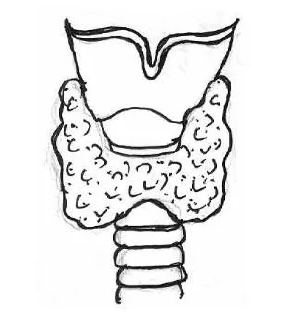
Name the disease caused due to hypersecretion of the above mentioned hormone.
Topic: Exophthalmic goitre
Answer
EXOPHTHALMIC GOITRE (Graves’ disease).
HYPERsecretion of thyroxine causes exophthalmic goitre: a swollen neck TOGETHER WITH PROTRUDING EYEBALLS, a raised metabolic rate, weight loss despite a good appetite, a rapid heartbeat and nervousness.
THE FEATURE THAT SEPARATES THE TWO GOITRES IS THE EYES. Both swell the neck, so a student who looks only at the neck cannot tell them apart: SIMPLE GOITRE — too LITTLE thyroxine (usually from lack of iodine). Eyes NORMAL. EXOPHTHALMIC GOITRE — too MUCH thyroxine. Eyes BULGING.
The name says so: EX-OPHTHALMIC means "eyes outward" (ophthalmic = of the eye). Reading the term answers half the question.
Note that parts (iv) and (v) of this question are OPPOSITE directions of the same hormone — which is exactly what the examiner is testing.