History & Civics — Suggested Paper 5
120 minutes80 marks Questions from 2016–2025
A suggested paper: every question is a real ICSE board question, chosen from different years and arranged in the current pattern. Start the timed test to have your written answers marked.
Part I (30 marks)
Attempt all questions from this Part.
1. Choose the correct answers to the questions from the given options. (Do not copy the questions, write the correct answers only.)
1(i). Which of these is considered to be an exclusive power of the Rajya Sabha?
[1 mark]- (a)It can approve an Ordinary Bill.
- (b)It can make amendments to the Constitution.
- (c)It can empower the Parliament to make laws on the State list.
- (d)It can make laws on subjects in the Union List.
1(ii). An ordinance has to be approved by the Parliament within __________ weeks.
[1 mark]- (a)Two
- (b)Three
- (c)Six
- (d)Eight
1(iii). Tahir is preparing to give a speech about the Sati system in India. Which of the following Indian leader's contribution MUST he mention in his speech?
[1 mark]- (a)Raja Rammohan Roy
- (b)W. C. Bonerjee
- (c)Bipin Chandra Pal
- (d)Jyotiba Phule
1(iv). The plan of Partition of Bengal was proposed by __________.
[1 mark]- (a)Lord Canning
- (b)Lord Dalhousie
- (c)Lord Curzon
- (d)Lord Ripon
1(v). The Rowlatt Act was called the Black Act because the Indians:
[1 mark]- (a)could not possess any arms
- (b)could not export any goods
- (c)could be arrested without a warrant
- (d)could be sent overseas on duty
1(vi). Identify the immediate cause of the above revolt.
[1 mark]- (a)The General Service Enlistment Act.
- (b)The inhuman treatment of indigo cultivators.
- (c)The subsidiary alliance.
- (d)The incident of greased cartridges.
1(vii). The International Court of Justice has __________ judges.
[1 mark]- (a)5
- (b)10
- (c)12
- (d)15
1(viii). Given below are the objectives of the Indian National Army. Identify the odd one out of the following:
[1 mark]- (a)To organise a provisional government of Free India
- (b)Total mobilisation of Indian manpower and money
- (c)Unity, faith and sacrifice
- (d)To train and organise public opinion in the country
1(ix). Identify the principle of Panchsheel.
[1 mark]- (a)Mutual non-aggression
- (b)Regulate armaments
- (c)Take action against aggressor
- (d)Recommend admission of members
1(x). Formation of Congress : 1885 :: Formation of Muslim League : __________
[1 mark]- (a)1905
- (b)1906
- (c)1907
- (d)1908
1(xi). The Lucknow Pact was signed between __________.
[1 mark]- (a)The British and the Congress
- (b)The Congress and the Muslim League
- (c)The Early and the Assertive Nationalists
- (d)The Muslim League and the British
1(xii). Which of the following statements does NOT apply to the Lok Adalat?
[1 mark]- (a)It reduces the burden on High Courts
- (b)Works on the spirit of Compromise
- (c)The cases take a long time to get resolved
- (d)It involves very less expenses
1(xiii). The signatory countries of the Triple Alliance were __________.
[1 mark]- (a)Germany, France, Italy
- (b)France, Britain, Russia
- (c)Germany, Italy, Austria-Hungary
- (d)Britain, Russia, Italy
1(xiv). Which of the following statements about Early Nationalists is false?
[1 mark]- (a)Their leaders were Dadabhai Naoroji and Gopal Krishna Gokhale
- (b)They believed in constitutional means of protest.
- (c)They wanted self-government under British rule
- (d)They wanted to launch violent agitations against the British
1(xv). What were the causes of the Quit India Movement?
[1 mark]- (a)Failure of Simon Commission and Rowlatt Act.
- (b)Failure of the Cripps mission and Declaration of Poorna Swaraj.
- (c)Growing unemployment and Jallianwala Bagh massacre.
- (d)Failure of Cripps Mission and Japanese threat.
1(xvi). Which of the following was a reason for the acceptance of the Mountbatten plan?
[1 mark]- (a)The British forced the congress to accept the plan.
- (b)The Muslim league cooperated in the governance.
- (c)The only alternative to partition was a Federation with a weak Centre.
- (d)The Princely States wanted to accept the plan.
2. Answer briefly each of the questions (a) to (j):
2(i). Mention any two contributions of the INA to the National Movement.
[2 marks]2(ii). Name the two International Organisations that were formed, one as a consequence of World War I and the other after World War II.
[2 marks]2(iii). Name the two books that Dadabhai Naoroji authored explaining the "Drain of India’s Wealth".
[2 marks]2(iv). Mention any two objectives of the Muslim League.
[2 marks]2(v). Mention any two writs issued by the High Court.
[2 marks]2(vi). Imagine you are an Indian ruler who has signed the Subsidiary Alliance. Mention any two conditions of this agreement which will affect you.
[2 marks]2(vii). Name the two cities of Japan which were bombed by America in the year 1945.
[2 marks]Part II - Section A (20 marks)
Attempt any two questions from this Section. (Civics)
3. With reference to the Union Parliament, answer the following questions:
3(a). How many members may be nominated to the Lok Sabha and the Rajya Sabha? Give reasons.
[3 marks]3(b). Mention any three qualifications required for a member to be elected to the Lok Sabha.
[3 marks]3(c). What is meant by the term 'Session'? Name the three Sessions of the Union Parliament.
[4 marks]4. The President is the head of the State and exercises his/her powers on the advice of the Prime Minister and the Council of Ministers. With reference to this, answer the following questions:
4(i). What are the three types of emergencies that can be proclaimed by the President?
[3 marks]4(ii). Mention any three legislative powers of the President.
[3 marks]4(iii). Give any two reasons to justify the need for the indirect election of the President.
[4 marks]5. With reference to the Supreme Court, answer the following:
5(a). What are the qualifications of the Judges of the Supreme Court?
[3 marks]5(b). Explain the composition of the Supreme Court.
[3 marks]5(c). Explain the cases in which the Supreme Court enjoys Original Jurisdiction.
[4 marks]Part II - Section B (30 marks)
Attempt any three questions from this Section. (History)
6. The period between 1920 and 1947 was marked with major events and reforms that finally led us to our independence. In this context, answer the following questions:
6(a). State three provisions of the Gandhi-Irwin Pact as a result of the Civil Disobedience Movement.
[3 marks]6(b). How did the Congress and the Muslim League respond to the Cabinet Mission Plan?
[3 marks]6(c). Mention any four clauses of the Cabinet Mission Plan.
[4 marks]7. With reference to the Second World War and the Non-Aligned Movement, answer the following:
7(a). Explain briefly three reasons for the dissatisfaction with the Treaty of Versailles.
[3 marks]7(b). State any three consequences of the Second World War.
[3 marks]7(c). Mention any four chief architects of the Non-Aligned Movement.
[4 marks]8. With reference to the picture given below, answer the following:
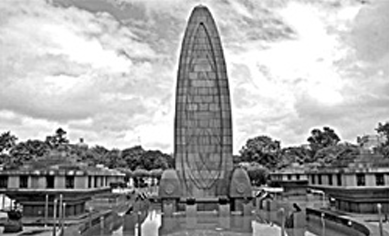
8(a). (i) Identify the Memorial built for those who were killed in this incident. (ii) Where did this incident take place? (iii) Name the movement launched by Gandhi in 1920 as a consequence.
[3 marks]8(b). Explain briefly the reason for the suspension of this particular movement by Gandhi in 1922.
[3 marks]8(c). State any four impacts of the movement.
[4 marks]9. With reference to the Mass Phase of the National Movement, answer the following:
9(a). Briefly explain the Dandi March of 1930.
[3 marks]9(b). State any three reasons for launching of Quit India Movement.
[3 marks]9(c). Explain any four significant effects of Quit India Movement.
[4 marks]10. The oppressive British colonial rule led to the growth of nationalism in India. With reference to this, answer the following questions:
10(i). The repressive policies of Lord Lytton became a catalyst to the growth of nationalism. Mention any three of his repressive policies to justify this statement.
[3 marks]10(ii). Mention any three ways in which the Press promoted nationalism.
[3 marks]10(iii). Who presided over the second session of the Indian National Congress? Mention any three objectives of the Congress.
[4 marks]