History & Civics — Suggested Paper 2
120 minutes80 marks Questions from 2016–2026
A suggested paper: every question is a real ICSE board question, chosen from different years and arranged in the current pattern. Start the timed test to have your written answers marked.
Part I (30 marks)
Attempt all questions from this Part.
1. Choose the correct answers to the questions from the given options. (Do not copy the questions, write the correct answers only.)
1(i). The Rajya Sabha is called a Permanent house because 1/3 members retire every __________.
[1 mark]- (a)two years
- (b)one year
- (c)three years
- (d)six years
1(ii). During a hung assembly when no party gets the majority, the President appoints the Prime Minister. What power is the President exercising?
[1 mark]- (a)Legislative
- (b)Executive
- (c)Discretionary
- (d)Judicial
1(iii). Who was the founder of the Indian National Congress?
[1 mark]- (a)A. O. Hume
- (b)W. C. Banerjee
- (c)Dadabhai Naoroji
- (d)Gopal Krishna Gokhale
1(iv). Read the statements given below and select the option that shows the correct relationship between (A) and (R). Assertion (A): Lord Curzon partitioned Bengal in 1905. Reason (R): The Nationalists felt that the British wanted to divide the Hindus and the Muslims.
[1 mark]- (a)(A) is true and (R) is false.
- (b)(R) is true but (A) is false.
- (c)Both (A) with (R) are independent of each other.
- (d)(R) is the reason for (A).
1(v). Which of these statements is NOT associated with the Jallianwala Bagh massacre?
[1 mark]- (a)It happened in the year 1919
- (b)General Dyer was responsible for the massacre.
- (c)It became cause for the Non-Cooperation movement.
- (d)It became cause for the Civil Disobedience movement.
1(vi). Under which policy of expansion was the place marked in the map annexed by the British?
[1 mark]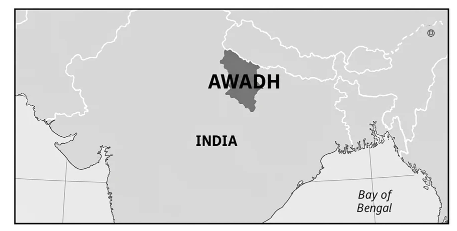
- (a)The Doctrine of Lapse
- (b)The Subsidiary Alliance
- (c)Pretext of misgovernance
- (d)Outright wars
1(vii). Which organ of the United Nations Organisation gives this special power to its permanent members?
[1 mark]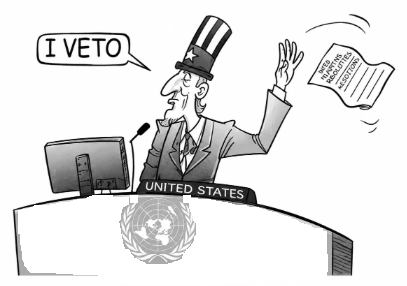
- (a)The General Assembly
- (b)The International Court of Justice
- (c)The Security Council
- (d)The Trusteeship Council
1(viii). Which of the following was an objective of the Indian National Army?
[1 mark]- (a)To formulate and present the demand to the government.
- (b)To make the world aware of the true nature of British rule in India.
- (c)Total mobilization of Indian manpower and money for a total war.
- (d)To establish Home Rule in India.
1(ix). The Sessions Court deals with __________ cases.
[1 mark]- (a)Civil
- (b)Criminal
- (c)Constitutional
- (d)Revenue
1(x). Choose the correct option to replace the underlined word: The collection of State Revenue falls under the Consultative Jurisdiction of the High Court.
[1 mark]- (a)Advisory
- (b)Revisory
- (c)Original
- (d)Appellate
1(xi). Which incident depicted in the above cartoon led to the beginning of the Second World War?
[1 mark]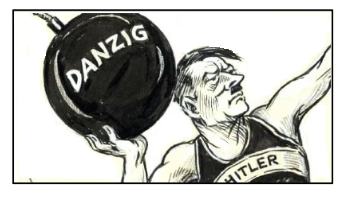
- (a)Hitler's policy of Imperialism
- (b)Hitler's attack on Poland
- (c)Hitler's annexation of Austria
- (d)Hitler's attack on Czechoslovakia
1(xii). Which of the following causes of the First World War is connected to this headline?
[1 mark]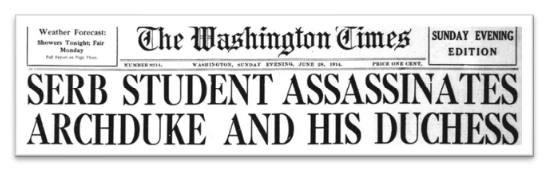
- (a)Imperialism
- (b)Aggressive Nationalism
- (c)Armament Race
- (d)Sarajevo Crisis
1(xiii). In the town of Sundar Nagar, the local government decided to cut down a large number of trees to build a shopping mall. The children were upset because the trees provided a place to play. A group of school students decided to take action based on the lesson they had studied about the Early Nationalists. Which of the following actions are they NOT likely to adopt?
[1 mark]- (a)Hold placards with the message 'Save Our Trees'.
- (b)Write letters to the local newspapers expressing their concerns.
- (c)Plant saplings to show their commitment to the environment.
- (d)Forcibly prevent workers sent by the Government.
1(xiv). Identify the option which shows the correct chronology of the following events: 1. The Lucknow Pact 2. The Surat Split 3. The establishment of the Muslim League
[1 mark]- (a)1-2-3
- (b)1-3-2
- (c)3-2-1
- (d)2-1-3
1(xv). The salaries and allowances of the ministers are decided by the:
[1 mark]- (a)Parliament
- (b)Finance Minister
- (c)President
- (d)Prime Minister
1(xvi). When the Supreme Court reviews any judgement made by it to remove an error, it falls under __________ jurisdiction.
[1 mark]- (a)Advisory
- (b)Revisory
- (c)Original
- (d)Appellate
2. Answer briefly each of the questions (a) to (j):
2(i). Give any two reasons for the rise of Fascism.
[2 marks]2(ii). What impact did the uprising of 1857 have on the Mughal Rule?
[2 marks]2(iv). State the full forms of the following agencies of the United Nations: UNICEF and UNESCO.
[2 marks]2(vii). Name the Presidents who presided over the first two Sessions of the Indian National Congress.
[2 marks]2(iii). Mention any two reasons for the acceptance of the Mountbatten Plan by the Congress.
[2 marks]2. Answer briefly each of the questions (a) to (j):
2(v). Name the countries that formed the Axis Bloc, during World War II.
[2 marks]2(vi). What was the Khilafat Movement?
[2 marks]Part II - Section A (20 marks)
Attempt any two questions from this Section. (Civics)
3. The powers and functions of the Indian Parliament are wide-ranging. In this context answer the following:
3(a). Explain three ways in which the Legislature exercises control over the Executive.
[3 marks]3(b). Mention any three Special powers of the Rajya Sabha that are usually not enjoyed by the other House.
[3 marks]3(c). Mention any two Judicial powers and two Electoral powers of the Indian Parliament.
[4 marks]4. With reference to the Supreme Court as the Apex Court of the country, answer the following:
4(a). Mention any three cases that come under the Original Jurisdiction of the Supreme Court.
[3 marks]4(b). Explain the Power of Judicial Review of the Supreme Court.
[3 marks]4(c). Explain the Supreme Court as a Court of Record.
[4 marks]5. With reference to the President and the Vice-President of India, answer the following questions:
5(a). State any three qualifications required for a candidate to be elected as the Vice-President.
[3 marks]5(b). State the three functions of the Vice-President.
[3 marks]5(c). Explain briefly any two Legislative and any two Executive powers of the President.
[4 marks]Part II - Section B (30 marks)
Attempt any three questions from this Section. (History)
6. With reference to the National Movement in its final phase, answer the following questions:
6(a). State two reasons for the launching of the Quit India Movement.
[3 marks]6(b). Give any three effects of the Quit India Movement launched by Gandhi in 1942.
[3 marks]6(c). Give any four clauses of the Mountbatten Plan of 1947.
[4 marks]7. Look at the given emblem and answer the following questions:
7(a). Name the organisation associated with the above emblem. Mention any two of its objectives.
[3 marks]7(b). Mention any three functions of WHO, as its beneficiary.
[3 marks]7(c). Name the Principal Judicial Organ of this organisation and explain its composition.
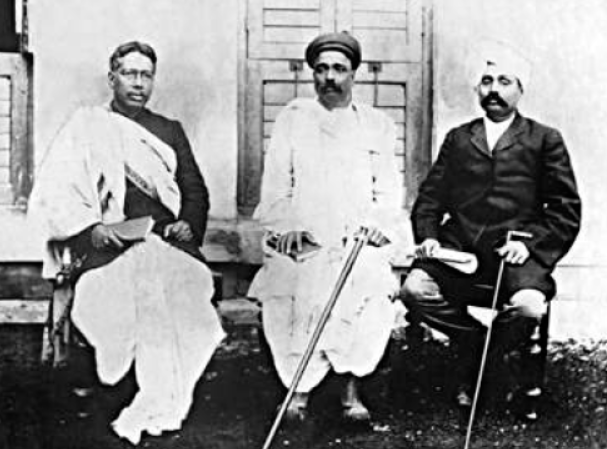
[4 marks]8. The conflict between two sections of the Congress came to the surface in its Session in 1906 at Calcutta. In this context, explain the following:
8(a). The Split in the Congress
[3 marks]8(b). With reference to the picture given below, answer the following: 1) What were the three personalities popularly known as? 2) Which section of the Congress did they represent? 3) Mention two of their popular beliefs.
[3 marks]8(c). State any four methods that they advocated for the achievement of their aims.
[4 marks]9. Read the passage given and answer the following questions:
9. The final act of the long-drawn-out negotiations took place at Versailles on Saturday afternoon, and to-day Germany and the Allies — always with the exception of America — are at peace. Peace is a blessed word, and both the word and the fact are welcome to-day. So far as Germany is concerned there is for the present an end of strife, and at least a formal return to the decent relations of civilised states. — Editorial: Peace in force (12 January 1920), The Guardian
9(i). Mention any three causes of the World War which ended with the signing of the treaty being discussed in the passage above.
[3 marks]9(ii). Name the organisation which was established in 1920 to maintain peace after this war. Mention any two of its objectives.
[3 marks]9(iii). Mention any four clauses of the Treaty which affected Germany.
[4 marks]10. Study the picture given below and answer the following questions:
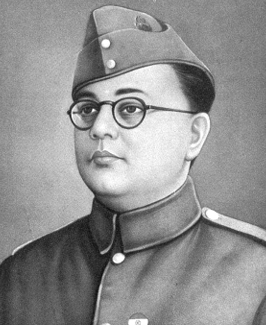
10(a). Identify the leader given in the picture. Name the Political party and the Military Organisation that he formed.
[3 marks]10(b). State any three objectives of the Political party that he founded.
[3 marks]10(c). Mention any four objectives of the Military Organisation.
[4 marks]