History & Civics — Suggested Paper 1
120 minutes80 marks Questions from 2016–2026
A suggested paper: every question is a real ICSE board question, chosen from different years and arranged in the current pattern. Start the timed test to have your written answers marked.
Part I (30 marks)
Attempt all questions from this Part.
1. Choose the correct answers to the questions from the given options. (Do not copy the questions, write the correct answers only.)
1(i). The right of the members to __________ is known as interpellation.
[1 mark]- (a)Ask question.
- (b)Introduce motions.
- (c)Adjourn the house.
- (d)Interrupt the proceedings.
1(ii). Which emergency will be declared by the President if the security of the Nation is under threat?
[1 mark]- (a)General Emergency
- (b)Financial Emergency
- (c)Constitutional Emergency
- (d)President's Rule
1(iii). Which of these statements is NOT associated with Jyotiba Phule?
[1 mark]- (a)He established schools for girls
- (b)He established the Brahmo Samaj
- (c)He established the Satya Shodhak Samaj
- (d)He was against the caste system
1(iv). Which of the following was a nationalist perspective of the partition of Bengal?
[1 mark]- (a)There was only Hindus in West Bengal.
- (b)To divide the Hindus and Muslims.
- (c)There were many riots in Bengal.
- (d)It was an administrative necessity as Bengal was a large territory.
1(v). How did the Lahore session of 1929 lead to the Civil Disobedience movement?
[1 mark]- (a)The Declaration of Poorna Swaraj was passed
- (b)Subhas Chandra Bose was made the President of the Congress
- (c)Simon Commission recommendations were accepted
- (d)Congress passed a resolution to begin the Civil Disobedience movement
1(vi). Which policy of expansion led to the annexation of Awadh?
[1 mark]- (a)Subsidiary alliance
- (b)Doctrine of Lapse
- (c)Pretext of alleged misrule
- (d)Outright wars
1(vii). The International Court of Justice has __________ judges.
[1 mark]- (a)15
- (b)10
- (c)9
- (d)5
1(viii). Read the two statements given below and select the option that shows the correct relationship between (A) and (R): Assertion (A): Forward Bloc had the objective of abolishing Zamindari System. Reason (R): Subhash Chandra Bose wanted to establish a socialist state.
[1 mark]- (a)A is true but R is false
- (b)R is the reason for A
- (c)Both A and R are false
- (d)Only R is true, A is false
1(ix). The Lok Adalat has many advantages. Which of the following statements about the advantages of the Lok Adalat is best described in the picture given above?
[1 mark]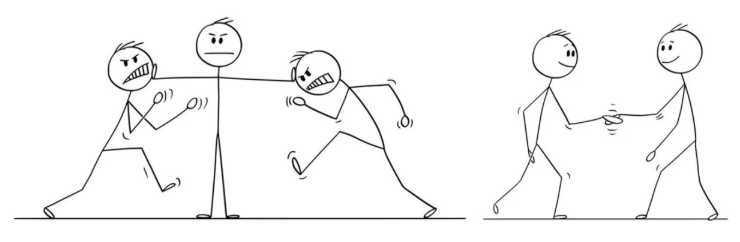
- (a)It is inexpensive
- (b)It is organised in various parts of the country
- (c)It works on the spirit of compromise
- (d)It reduces the burden of the higher courts
1(x). Given below are details of Indian citizens. Select the ones who are eligible for appointment as a High Court Judge: P — 65 — Is a distinguished jurist Q — 61 — Has been a High Court Advocate for 10 years R — 67 — Has been a High Court Advocate for 5 years S — 56 — Has held a judicial office for at least 10 years
[1 mark]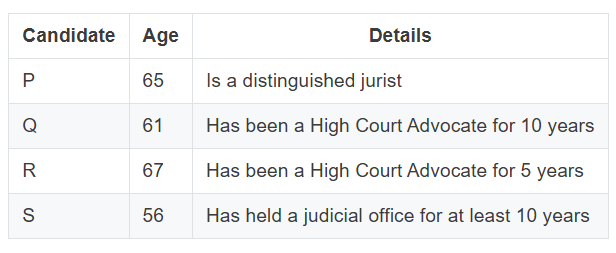
- (a)P and R
- (b)Q and S
- (c)R and P
- (d)Q and R
1(xi). Which of the following is NOT a consequence of the Second World War?
[1 mark]- (a)Austria and Hungary became separate states
- (b)Defeat of the axis powers
- (c)Beginning of the Cold War
- (d)Formation of the United Nations
1(xii). The immediate cause of the First World War was __________.
[1 mark]- (a)Imperialism
- (b)Alliance System
- (c)Sarajevo Crisis
- (d)Arms Race
1(xiii). Tina is inspired by the methods of the Early Nationalists and wants to follow them. She notices that the road leading to her school is damaged and has many potholes. Which of the following methods is she MOST LIKELY to follow, to solve this problem?
[1 mark]- (a)Boycott the civic authorities
- (b)Gather a group of students and protest
- (c)Write a petition to the authorities highlighting the problem
- (d)Block the entrance to the road
1(xiv). From the given list, identify the objective of the Muslim League.
[1 mark]- (a)To train and organise public opinion in the country.
- (b)To promote friendly relation between nationalist political workers.
- (c)To promote among Muslims of India support for the British Government.
- (d)To agitate through constitutional means.
1(xv). The junior category of ministers who assist senior ministers:
[1 mark]- (a)Cabinet Ministers
- (b)Ministers of State
- (c)Deputy Ministers
- (d)Council of Ministers
1(xvi). The term Non-Alignment means
[1 mark]- (a)not to form any new alliance
- (b)not to align with any of the power blocs
- (c)not to participate in the world affairs
- (d)to be part of military alliances
2. Answer briefly each of the questions (a) to (j):
2(i). Name the Signatory Countries of the Triple Alliance.
[2 marks]2(ii). Name the last Viceroy of India. State any one of the provisions of the Indian Independence Act of 1947.
[2 marks]2(iii). Why is October 16, 1905 regarded as an important day in the history of the Indian National Movement?
[2 marks]2(iv). Give any two examples of Human Rights violations.
[2 marks]2(v). Mention any two functions of the UNESCO in the field of education.
[2 marks]2(vi). Mention any two causes of the Quit India Movement.
[2 marks]2(vii). Mention any two powers of the Prime Minister with reference to the Cabinet.
[2 marks]Part II - Section A (20 marks)
Attempt any two questions from this Section. (Civics)
3. With reference to the President of India, answer the following:
3(a). How is the President elected?
[3 marks]3(b). Mention three types of Emergencies that the President is empowered to proclaim.
[3 marks]3(c). Explain briefly any four 'Executive Powers' of the President.
[4 marks]4. The judiciary is the system of courts that interprets and guards the Indian Constitution. With reference to the Supreme Court of India, answer the following:
4(i). What is the composition of the Supreme Court? Why is it called the Court of Record?
[3 marks]4(ii). Explain the power of Judicial Review.
[3 marks]4(iii). What is meant by the term Original Jurisdiction? Mention any three cases which come under this jurisdiction.
[4 marks]5. With reference to the High Court, answer the following:
5(a). Who appoints the judges of the High Court? State any three qualifications required for a person to be appointed as a judge of the High Court.
[3 marks]5(b). Explain the term Court of Record with reference to the High Court.
[3 marks]5(c). Name the four Writs that the High Court can issue for the enforcement of Fundamental Rights.
[4 marks]Part II - Section B (30 marks)
Attempt any three questions from this Section. (History)
6. Look at the picture given below and answer the following questions:
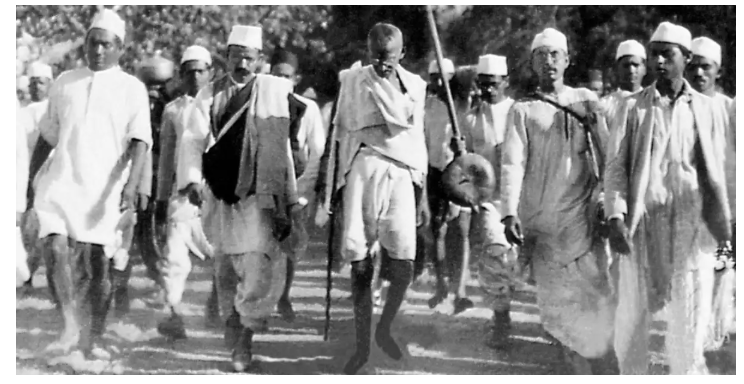
6(i). Name the march being led by Gandhiji in the picture. What did it lead to?
[3 marks]6(ii). What were the three causes of the Non-Cooperation Movement?
[3 marks]6(iii). Mahatma Gandhi and Lord Irwin signed a pact. Mention any four terms of this pact.
[4 marks]7. With reference to the rise of 'National Consciousness' in India, explain the following:
7(a). The influence of the Western Education
[3 marks]7(b). Any three contributions of Raja Ram Mohan Roy
[3 marks]7(c). The development of modern means of transport and communication
[4 marks]8. Read the passage given and answer the following questions:
8. In an effort to secure resources for its expanding industries, Japan invaded the northern Chinese province of Manchuria. Although many Western nations protested the Japanese action, most members of the League of Nations, including Canada, opposed any form of military intervention to defend Chinese sovereignty. A League of Nations commission, headed by the British diplomat Lord Lytton, was dispatched to Manchuria to investigate. — Loyal Edmonton Regiment Museum
8(i). How did the incident being described above become a cause for the Second World War?
[3 marks]8(ii). Mention any three reasons for Hitler's attack on Poland.
[3 marks]8(iii). Mention any four reasons for the failure of the League of Nations.
[4 marks]9. With reference to the Revolt of 1857, answer the following questions:
9(a). Explain any three political causes of the Revolt of 1857.
[3 marks]9(b). Briefly explain the immediate cause of the Great Revolt.
[3 marks]9(c). State any four changes in the administration of the British Government as a consequence of the Revolt.
[4 marks]10. The heroism of the Indians was revealed by the courage of Subhas Chandra Bose and the Indian National Army. With reference to this, answer the following questions:
10(i). Mention any three objectives of the Forward Bloc.
[3 marks]10(ii). Mention any three contributions of Subhas Chandra Bose.
[3 marks]10(iii). Who was the founder of the Indian National Army? Mention any three objectives of the INA.
[4 marks]