History & Civics — Suggested Paper 3
120 minutes80 marks Questions from 2016–2026
A suggested paper: every question is a real ICSE board question, chosen from different years and arranged in the current pattern. Start the timed test to have your written answers marked.
Part I (30 marks)
Attempt all questions from this Part.
1. Choose the correct answers to the questions from the given options. (Do not copy the questions, write the correct answers only.)
1(i). If an Adjournment Motion is passed in the Lok Sabha __________.
[1 mark]- (a)the Lok Sabha will be dissolved.
- (b)the House will discuss a matter of urgent public importance.
- (c)the President ends the session.
- (d)the Government will fall.
1(ii). Which of the following statements about Ordinances is false?
[1 mark]- (a)Promulgated by the President.
- (b)Issued when the Parliament is not in session.
- (c)Has to be approved within six months from the re-assembly of the Parliament.
- (d)Has to be approved by both the houses of the Parliament.
1(iii). Who among the following is MOST associated with this picture?
[1 mark]- (a)Jyotiba Phule
- (b)Raja Ram Mohan Roy
- (c)Swami Dayanand Saraswati
- (d)Aurobindo Ghosh
1(iv). When was Bengal partitioned?
[1 mark]- (a)1905
- (b)1907
- (c)1906
- (d)1911
1(v). People protested against the __________ because it had seven British members and no Indian representation.
[1 mark]- (a)Simon Commission
- (b)Lucknow Pact
- (c)Ilbert Bill
- (d)Cabinet Mission
1(vi). The British showed total disregard towards the soldiers. In this context, which of the following statements is NOT true?
[1 mark]- (a)They were deprived of allowances.
- (b)They were forced to go overseas on duty.
- (c)They were given the same salaries as that of the British soldiers.
- (d)They could not rise above the rank of Subedar.
1(vii). Which of the following countries is NOT a permanent member of the Security Council?
[1 mark]- (a)France
- (b)China
- (c)Germany
- (d)Britain
1(viii). Identify the famous slogan of Subhas Chandra Bose.
[1 mark]- (a)Give me blood and I shall give you freedom
- (b)Swaraj is my birthright and I shall have it.
- (c)Do or die
- (d)Vande Mataram
1(ix). Court of District Judge : Civil Cases :: Sessions Court : __________ Cases
[1 mark]- (a)Advisory
- (b)Criminal
- (c)Constitutional
- (d)Appellate
1(x). The High Court Judge can remain in office till he/she attains the age of
[1 mark]- (a)60 years
- (b)65 years
- (c)62 years
- (d)55 years
1(xi). Assertion (A): Hitler attacked Poland to capture the Danzig Port. Reason (R): Poland was accused of committing atrocities against the Germans.
[1 mark]- (a)(A) is true and (R) is false.
- (b)(A) is false and (R) is true.
- (c)Both (A) and (R) are true and (R) is the correct explanation of (A).
- (d)Both (A) and (R) are true but (R) is not the correct explanation of (A).
1(xii). Identify the odd one out of the following signatories of the Triple Entente.
[1 mark]- (a)France
- (b)Russia
- (c)Japan
- (d)England
1(xiii). The full form of UNESCO is
[1 mark]- (a)United Nations Educational, Scientific and Cultural Organisation
- (b)United Nations Economic, Scientific and Cultural Organisation
- (c)United Nations Educational, Social and Cultural Organisation
- (d)United Nations Educational, Scientific and Commercial Organisation
1(xiv). Which of these leaders was an architect of the Non-Aligned Movement?
[1 mark]- (a)Joseph Stalin
- (b)Abdel Nasser
- (c)Winston Churchill
- (d)Franklin Roosevelt
1(xv). Identify the Early Nationalist leader.
[1 mark]- (a)Gopal Krishna Gokhale
- (b)Bipin Chandra Pal
- (c)Jyotiba Phule
- (d)Bal Gangadhar Tilak
1(xvi). __________ was one of the causes of the Quit India Movement.
[1 mark]- (a)Failure of the Second Round Table Conference
- (b)Rowlatt Act
- (c)Mountbatten Plan
- (d)Failure of the Cripps Mission
2. Answer briefly each of the questions (a) to (j):
2(i). Name the famous Pact that demonstrated the unity between the Congress and the Muslim League. When was it signed?
[2 marks]2(iii). Why was Mountbatten's Plan finally accepted by the Congress?
[2 marks]2(ii). Name any two leaders of the Khilafat Movement.
[2 marks]2(iv). Mention any two objectives of the Forward Bloc.
[2 marks]2(vii). Imagine you are an Early Nationalist leader. Mention any two methods you would follow to fight against the British.
[2 marks]2(v). Mention the two alliances formed in Europe before the beginning of World War I.
[2 marks]2. Answer briefly each of the questions (a) to (j):
2(vi). Mention any two economic factors responsible for the growth of nationalism in India.
[2 marks]Part II - Section A (20 marks)
Attempt any two questions from this Section. (Civics)
3. The Union Parliament is the supreme legislative body in the country. With reference to the Indian Parliament answer the following questions:
3(i). The Rajya Sabha is called a Permanent House. Explain this statement.
[3 marks]3(ii). Explain the composition of the Rajya Sabha.
[3 marks]3(iii). Mention any two exclusive powers of the Lok Sabha and two powers exclusive to the Rajya Sabha.
[4 marks]4. The Constitution of India provides for a High Court for each State. With reference to the High Courts and Subordinate Courts, answer the following questions:
4(i). Who appoints the judges of the High Court? Mention any two qualifications required for a person to be appointed as a judge of a High Court.
[3 marks]4(ii). What is meant by the Original Jurisdiction of a High Court? Mention any two cases which come under it.
[3 marks]4(iii). What is a Lok Adalat? Mention any two advantages of the Lok Adalat.
[4 marks]5. The Union Executive, which consists of the President, Prime Minister and the Council of Ministers, is a powerful body in a Parliamentary democracy. In this context answer the following questions:
5(a). State the position of the Prime Minister and state any two of his powers in relation to the President.
[3 marks]5(b). Mention the three categories of Ministers in order of their rank and status.
[3 marks]5(c). Mention any four legislative powers of the Cabinet.
[4 marks]Part II - Section B (30 marks)
Attempt any three questions from this Section. (History)
6. The United Nations Organisation aims to maintain international peace. With reference to its organs and agencies, answer the following:
6(i). What is the composition of the Security Council? What is the term of the non-permanent members?
[3 marks]6(ii). Mention any three functions of the General Assembly.
[3 marks]6(iii). Give the full form of UNESCO. Mention any three of its functions.
[4 marks]7. By 1857, conditions were ripe for a mass uprising in India. With reference to this, state:
7(a). Any three Economic causes for the Revolt of 1857.
[3 marks]7(b). Any three Military causes of the revolt.
[3 marks]7(c). Any four Political causes of the revolt.
[4 marks]8. Study the picture given below and answer the following questions:
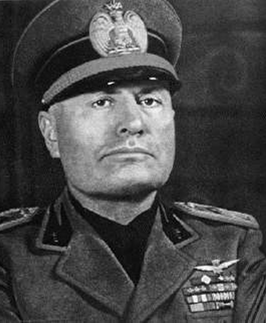
8(a). Identify the leader in the picture. Give two examples to state that the leader followed an expansionist policy.
[3 marks]8(b). State three factors that led to the rise of Fascism.
[3 marks]8(c). State four similarities between the ideologies of Nazism and Fascism.
[4 marks]9. The world wars marked a turning point in the history of the world. With reference to this period, answer the following questions:
9(i). Mention any three similarities between the ideologies of Fascism and Nazism.
[3 marks]9(ii). State the three consequences of the Second World War.
[3 marks]9(iii). Mention any four causes of the Second World War.
[4 marks]10. The Indian National Movement is divided into three phases. With reference to the Second Phase of the Indian National Movement, answer the following questions:
10(i). Who partitioned Bengal? Mention any two points to explain the perspective of the Nationalists regarding the actual motive behind the decision of Partition.
[3 marks]10(ii). What was the objective of the Assertive Nationalists? Mention any two contributions of Bal Gangadhar Tilak.
[3 marks]10(iii). In which year was the Muslim League formed? Mention any three objectives of the Muslim League.
[4 marks]