MCQ1 mark
Shared context
Choose the correct answers to the questions from the given options. (Do not copy the questions, write the correct answers only.)
What the board keeps coming back to, measured across every Chemistry paper from 2016–2026. Revise these first — then sit a full paper and get it marked.
How many of the 11 papers each chapter appeared in, and the marks it carries in an average paper.
The same idea, set in different years. If it came up this often, expect it.
11 years
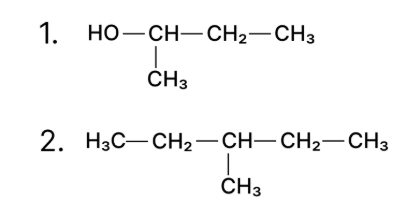
Organic chemistry: structure, nomenclature and reactions
Organic Chemistry
11 years
Electrolysis, electrolytes and electrode processes
Electrolysis
11 years
Qualitative analysis using NaOH and NH₄OH
Analytical Chemistry: Uses of Ammonium Hydroxide and Sodium Hydroxide
10 years
Periodic properties and trends
Periodic Table, Periodic Properties and Variations of Properties
10 years
Metallurgy, ores, extraction and alloys
Metallurgy
10 years
Mole concept, gas volumes and stoichiometry
Mole Concept and Stoichiometry
10 years
Sulphuric acid: preparation and properties
Sulphuric Acid
10 years
Chemical bonding and electron structures
Chemical Bonding
10 years
Acids, bases, salts and pH
Acids, Bases and Salts
10 years
Nitric acid: preparation and properties
Study of Compounds – Nitric Acid
9 years
Ammonia: preparation, properties and reactions
Study of Compounds – Ammonia
9 years
Practical tests and observations
Practical Work
One from each of the most-asked chapters. Pick an answer — it is marked straight away.
Choose the correct answers to the questions from the given options. (Do not copy the questions, write the correct answers only.)
Choose the correct answers to the questions from the given options. (Do not copy the questions, write the correct answers only.)
Choose the correct answers to the questions from the given options. (Do not copy the questions, write the correct answers only.)
Choose the correct answers to the questions from the given options. (Do not copy the questions, write the correct answers only.)
Choose the correct answers to the questions from the given options. (Do not copy the questions, write the correct answers only.)
The latest time each of the top repeated topics was set.
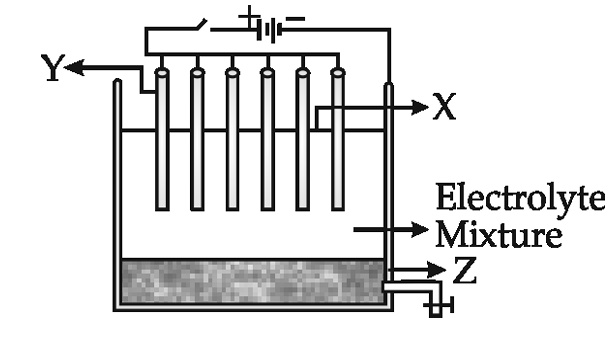
The following sketch illustrates the process of conversion of Alumina to Aluminium: Study the diagram and answer the following:
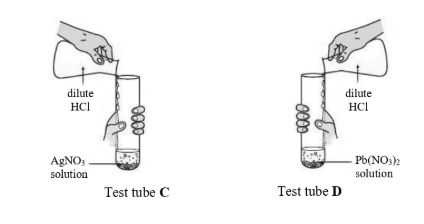
Rohit took two different salt solutions in test tubes C and D as shown in the figure below. He added dilute HCl to each of the two test tubes. The products formed in the test tubes C and D are silver chloride and lead chloride respectively. State:
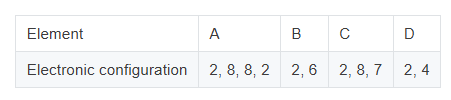
The following table shows the electronic configuration of the atoms A, B, C and D.
Free with an account
A suggested paper built from these questions in the current board pattern. Write it on paper, upload photos, and see where the marks went — question by question.