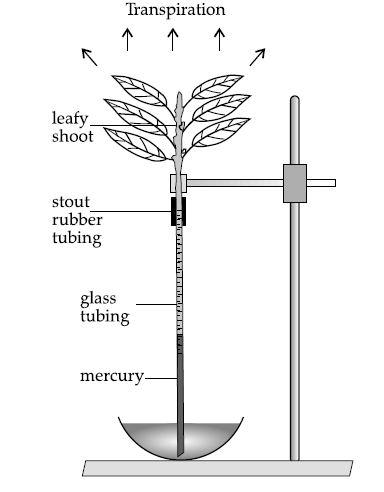
The diagram below represents an experiment to demonstrate a certain phenomenon in a green plant (a leafy shoot fixed by rubber tubing to a glass tube standing in mercury): The diagram below represents an experiment to demonstrate a certain phenomenon in a green plant (a leafy shoot fixed by rubber tubing to a glass tube standing in mercury):
Draw a neat labelled diagram of a Plasmolysed cell.
Topic: Plasmolysed cell — diagram
Answer
Your diagram must show: • the CELL WALL, rigid and unchanged in shape • the PROTOPLASM SHRUNKEN AWAY from the wall, with a clear GAP between them • that gap filled with the external HYPERTONIC (plasmolysing) SOLUTION • the PLASMA MEMBRANE bounding the shrunken protoplasm • a reduced VACUOLE and the NUCLEUS within the protoplasm
Labels required: cell wall, plasma membrane, cytoplasm, vacuole, nucleus, plasmolysing (hypertonic) solution.
THE FEATURE THAT IDENTIFIES A PLASMOLYSED CELL is the GAP between the shrunken protoplasm and the cell wall. In a TURGID cell there is no gap at all — the membrane is pressed tight against the wall. If the gap is visible, the cell is plasmolysed.
THE SUBTLE LABEL is the gap itself. Students often think it is empty, or label it "air". It is filled with the HYPERTONIC SOLUTION, which passed straight through the cell WALL — the wall is FREELY PERMEABLE. It is the PLASMA MEMBRANE that is selectively permeable and holds the protoplasm in.
WHAT HAPPENED: placed in a strong solution, the cell lost water by EXOSMOSIS, the vacuole shrank, and the protoplasm contracted away from the wall. Returned to pure water it would undergo DEPLASMOLYSIS — provided it has not been left too long.