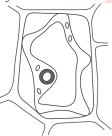
Given below is the diagram of a plasmolysed cortical cell of a root. Copy the diagram and label the following parts: (a) Cytoplasm (b) Hypertonic solution (c) Plasma membrane
Topic: Plasmolysed cortical cell — diagram
Answer
In your copied diagram: • CYTOPLASM — the shrunken protoplasmic mass that has pulled away from the cell wall. • HYPERTONIC SOLUTION — the strong external solution, filling the GAP between the shrunken protoplasm and the cell wall (it enters through the freely permeable wall). • PLASMA MEMBRANE — the thin membrane bounding the shrunken protoplasm, now separated from the cell wall.
THE FEATURE THAT IDENTIFIES A PLASMOLYSED CELL is the GAP between the shrunken protoplasm and the cell wall. In a TURGID cell there is no gap — the membrane is pressed tight against the wall. If you can see that gap in a diagram, the cell is plasmolysed.
THE SUBTLE LABEL is (b). Students often think the gap is empty, or label it "air". It is filled with the HYPERTONIC SOLUTION, which has passed through the cell WALL — the wall is FREELY PERMEABLE and lets anything through. It is the PLASMA MEMBRANE that is selectively permeable and holds the protoplasm in.
WHAT HAPPENED: placed in a strong solution, the cell lost water by EXOSMOSIS, the vacuole shrank, and the protoplasm contracted away from the wall.
Put the cell back in pure water and DEPLASMOLYSIS occurs — provided it has not been left too long, in which case the cell dies.