The diagram given below shows the internal structure of a spinal cord depicting a phenomenon. Study the diagram and answer the questions: The diagram given below shows the internal structure of a spinal cord depicting a phenomenon. Study the diagram and answer the questions:
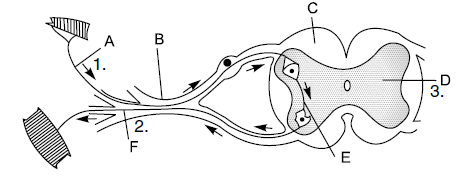
Name the phenomenon that is depicted in the diagram. Define the phenomenon.
Topic: Reflex action
Answer
The phenomenon is REFLEX ACTION (a simple reflex).
A REFLEX ACTION is an automatic, spontaneous and INVOLUNTARY response of the body to a stimulus, occurring without the conscious will of the individual and controlled by the SPINAL CORD rather than the brain.
Both halves must be answered: the NAME and the DEFINITION.
The essential words are AUTOMATIC, INVOLUNTARY and RAPID.
WHY THE SPINAL CORD RATHER THAN THE BRAIN: the impulse takes the short route through the spinal cord and back, saving the time a journey to the brain would cost. That is the entire purpose — you pull your hand off a hot pan BEFORE you consciously feel the pain, and the brain is informed afterwards.
The pathway is the REFLEX ARC: receptor → sensory neuron → spinal cord → motor neuron → effector → response.
Example: instantly withdrawing the hand on touching a hot object.