The figure given below is a diagrammatic representation of a part of the cross section of the root in the root hair zone. Study the same and then answer the questions that follow: The figure given below is a diagrammatic representation of a part of the cross section of the root in the root hair zone. Study the same and then answer the questions that follow:
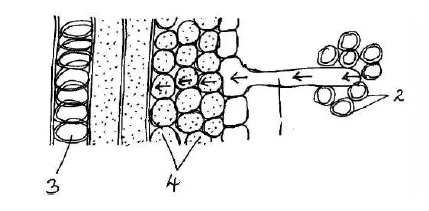
Draw a well labelled diagram of the root hair cell as it would appear if an excess of fertiliser is added to the soil close to it.
Topic: Plasmolysed root hair — diagram
Answer
Draw a PLASMOLYSED root hair cell, showing: • the CELL WALL keeping its original shape • the PROTOPLASM SHRUNKEN AWAY from the wall, with a clear GAP between them • that gap filled with the CONCENTRATED FERTILISER SOLUTION, which has passed freely through the cell wall • the PLASMA MEMBRANE bounding the shrunken protoplasm • a reduced VACUOLE and the NUCLEUS within • the root hair itself limp and collapsed
Labels required: cell wall, plasma membrane, cytoplasm, shrunken vacuole, nucleus, concentrated fertiliser (hypertonic) solution.
THE FEATURE THAT IDENTIFIES A PLASMOLYSED CELL is the GAP between the shrunken protoplasm and the cell wall. In a normal turgid cell there is no gap at all.
WHAT HAPPENED: excess fertiliser makes the soil solution HYPERTONIC — more concentrated than the cell sap. Water therefore leaves the root hair by EXOSMOSIS instead of entering it, the vacuole shrinks, and the protoplasm pulls away from the wall. The plant wilts, and farmers call this FERTILISER BURN.
THE SUBTLE LABEL is the gap. Students often think it is empty, or label it "air". It is filled with the FERTILISER SOLUTION, which passed straight through the cell WALL — the wall being FREELY PERMEABLE. Only the PLASMA MEMBRANE is selective, and that is what stopped it.