- (a)P and Q
- (b)R and S
- (c)P and R
- (d)Q and S
Genetics – Some Basic Fundamentals
Appeared in 10 of the 11 available papers.
Appears almost every year — treat as core
Average per paper it appears in · 62 marks in total
27% of this chapter's 62 questions
5 questions carry a figure — practise drawing them
Question-type distribution
- Short answer17
- MCQ14
- Definition13
- Reasoning10
- Biological term5
- Odd one out2
- Analogy1
Most frequent topics
Showing 25 of 62 matching questions (62 marks).
25 questions
Select the correct answers to the questions from the given options. (Do not copy the questions, write the correct answer only.)
- (a)25%
- (b)50%
- (c)75%
- (d)0%
- (a)All the offsprings will be tailless.
- (b)There will be a mix of tailed and tailless offsprings.
- (c)All the offsprings will have tails.
- (d)Tail of the offsprings cannot be predicted.
- (a)Both the parents are homozygous dominant.
- (b)Both the parents are homozygous recessive.
- (c)One parent is homozygous dominant, and the other is homozygous recessive.
- (d)Both the parents are heterozygous dominant.
A farmer cultivates a unique species of tomato plants. The two traits selected for breeding were the colour of the fruits and the height of the plants. The farmer initially crosses a homozygous tall plant bearing red fruits (TTRR) with a dwarf plant bearing yellow fruits (ttrr), and the genotype of all the offsprings of the F1 generation was TtRr. Next, he crosses two F1 generation plants (TtRr).
Select the correct answers to the questions from the given options. (Do not copy the questions, write the correct answer only.)
- (a)Will depend on the chromosome inherited from the mother
- (b)Girl
- (c)Either boy or a girl
- (d)Boy
- (a)P and Q
- (b)R and S
- (c)P and R
- (d)Q and S
Given below is a schematic representation of the inheritance of the shape of seeds of garden pea. Answer the questions that follow.
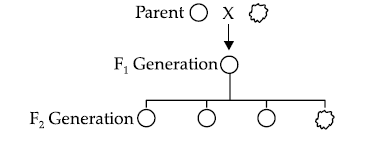
Select the correct answer to the questions from the given options. (Do not copy the questions, write the correct answer only.)
- (a)X chromosome
- (b)Y chromosome
- (c)Both X and Y chromosome
- (d)Either X or Y chromosome
Name the following:
Name the following by choosing the correct option:
- (a)Homozygous
- (b)Heterozygous
- (c)Dominant
- (d)Recessive
Complete the following statements by choosing the appropriate option for each blank:
- (a)Rr
- (b)RR
- (c)rr
- (d)RRr
- (a)Chromosomes
- (b)Chromatids
- (c)Genes
- (d)Centrosome
Choose the correct answer from each of the four options given below:
- (a)2:1
- (b)1:1
- (c)1:2:1
- (d)3:1
Explain the following terms:
- (a)Out of a pair of contrasting alleles present together, only the recessive allele is able to express itself while the dominant remains suppressed
- (b)Out of a pair of contrasting alleles present together, only the dominant allele is able to express itself while the recessive remains suppressed
- (c)Out of a pair of contrasting alleles present together, both dominant and recessive cannot express themselves
- (d)Out of a pair of contrasting alleles present together, both dominant and recessive can express themselves
- (a)It is a sudden change in one or more genes in an organism’s cells which is heritable
- (b)It is a change in the number of centrosomes in an organism’s cell which is heritable
- (c)It is a change in the structure of cell membrane in an organism’s cells which is heritable
- (d)It is a change in the shape of cells which is heritable