Physics — Suggested Paper 5
2 hours80 marks Questions from 2016–2025
A suggested paper: every question is a real ICSE board question, chosen from different years and arranged in the current pattern. Start the timed test to have your written answers marked.
Answers to this Paper must be written on the paper provided separately. You will not be allowed to write during the first 15 minutes. This time is to be spent in reading the question paper. The time given at the head of this Paper is the time allowed for writing the answers. The intended marks for questions or parts of questions are given in brackets [ ].
Section A (40 marks)
Attempt all questions from this Section.
1. Choose the correct answers to the questions from the given options. (Do not copy the questions, write the correct answers only.)
1(i). A door lock is opened by turning the lever (handle) of length 0.2 m. If the moment of force produced is 1 Nm, then the minimum force required is: (a) 5 N (b) 10 N (c) 20 N (d) 0.2 N
[1 mark]1(ii). For a lever, a graph is plotted with load on Y-axis and effort on X-axis. Which of the following represents the slope of the graph? (a) Mechanical advantage (b) Velocity ratio (c) 1/Velocity ratio (d) 1/Mechanical advantage
[1 mark]1(iii). When a body vibrates under a periodic force, the vibrations of the body are always: (a) natural vibrations (b) damped vibrations (c) forced vibrations (d) resonant vibrations
[1 mark]1(iv). The heaviest nuclear radiation is : (a) x-radiation (b) α-radiation (c) γ-radiation (d) β−radiation
[1 mark]1(v). Each of the substances given below is supplied with same amount of heat. Which one will attain the highest temperature? (a) Aluminium (b) Copper (c) Iron (d) Lead
[1 mark]
1(vi). When a bell fixed on a cycle rings, then the energy conversion that takes place is: (a) gravitational potential energy to sound energy (b) kinetic energy to sound energy (c) sound energy to electrical energy (d) sound energy to mechanical energy
[1 mark]1(vii). The potential difference between terminals of a cell in a closed electric circuit is: (a) terminal voltage (b) electro motive force (c) voltage drop (d) none of these
[1 mark]1(viii). Linear magnification(m) produced by a concave lens is : (a) m < 1 (b) m > 1 (c) m = 1 (d) m = 2
[1 mark]1(ix). A block of glass is pushed into the path of the light as shown below. Then the converging point X will : (a) Move away from the slab (b) Move towards the slab (c) Not shift (d) Move towards the left side of the lens
[1 mark]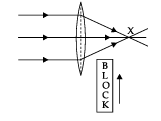
1(x). The colour of white light which is deviated least by a prism is: (a) green (b) yellow (c) red (d) violet
[1 mark]1(xi). A conductor AB is kept along north south direction of the earth above a magnetic needle as shown below. When the key K is closed then: (a) the needle will not show any deflection. (b) the needle will deflect towards east. (c) the needle will turn in the opposite direction i.e. towards south. (d) the needle will deflect towards west.
[1 mark]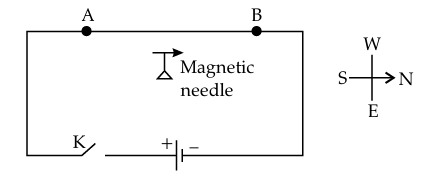
1(xii). (i) A body is acted upon by two equal and opposite forces, that are NOT along the same straight line. The body will: (a) remain stationary (b) have only rotational motion (c) have only rectilinear motion (d) have both rectilinear and rotational motion
[1 mark]1(xiii). Which of the following is a class III lever? (a) Pair of scissors (b) Wheelbarrow (c) Crowbar (d) Human forearm
[1 mark]1(xiv). Free vibrations are : (a) the vibrations under the influence of a periodic force. (b) the vibrations with larger amplitude. (c) the vibrations when the frequency continuously decreases. (d) the vibrations with a constant frequency and constant amplitude.
[1 mark]1(xv). A radioactive element P emits one α-particle and transforms to a new element Q. What will be the position of the element Q in the periodic table? (a) One group to the left of P (b) One group to the right of P (c) Two groups to the right of P (d) Two groups to the left of P
[1 mark]2(i). Complete the following by choosing the correct answers from the bracket:
2(i)(a). In uniform circular motion the centrifugal force acts ............... [towards the centre/away from the centre/along the tangential direction].
[1 mark]2(i)(b). Refractive index of a medium is independent of ............... [temperature/angle of incidence/wavelength of light].
[1 mark]2(i)(c). Heat absorbed during change of phase depends on ............... [mass/change in temperature/specific heat capacity] of the substance.
[1 mark]2(i)(d). Emf of a cell is ............... [greater than/less than/equal to] the terminal voltage when the cell is in open circuit.
[1 mark]2(i)(e). In a step-up transformer the turns ratio is ............... [more than 1/ less than 1/ equal to 1].
[1 mark]2(i)(f). The nuclear radiation with lowest ionising power is ............... [α/β/γ].
[1 mark]2(ii)(i). Define critical angle.
[1 mark]2(ii)(ii). State one important factor which affects the critical angle of a given medium
[1 mark]2(iii)(i). Why is a nuclear fusion reaction called a thermo nuclear reaction?
[1 mark]2(iii)(ii). Complete the reaction: ³He₂ + ²H₁ ⟶ ⁴He₂ + ¹H₁ + Energy
[1 mark]3(i)(i). Name the physical quantity which is measured in calories.
[1 mark]3(i)(ii). How is calorie related to the S.I. unit of that quantity?
[1 mark]3(ii). Which class of lever will always have MA > 1 and why?
[2 marks]3(iii). A man playing a flute is able to produce notes of different frequencies. If he closes the holes near his mouth, will the pitch of the note produced, increase or decrease? Give a reason.
[2 marks]3(iv). A fuse is rated 5 A. Can it be used with a geyser rated 1540 W, 220 V? Write Yes or No. Give supporting calculations to justify your answer.
[2 marks]3(v). A copper conductor is placed over two stretched copper wires whose ends are connected to a D.C. supply as shown in the diagram.
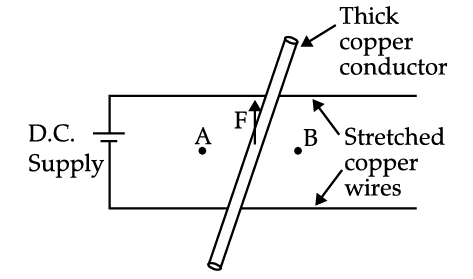
3(v)(a). What should be the magnetic poles at the points A and B lying on either side of the conductor to experience the force in the upward direction?
[1 mark]3(v)(b). Name the law used to find these polarities.
[1 mark]3(vi). Calculate the power spent by a crane while lifting a load of mass 2000 kg, at velocity of 1.5 ms-1. (g = 10 ms-2).
[2 marks]3(vii)(a). In the following atoms, which one is a radioisotope? Give one use of this isotope. O16, C14, N14, He4
[2 marks]3(vii)(b). Name the class of the lever shown in the picture below :
[1 mark]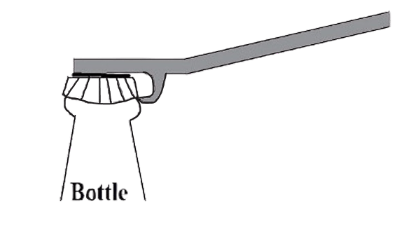
Section B (40 marks)
Attempt any four questions from this Section.
4(i). The image of a candle flame placed at a distance of 36 cm from a spherical lens, is formed on a screen placed at a distance of 72 cm from the lens. Calculate the focal length of the lens and its power.
[3 marks]4(ii). Below is an incomplete table showing the arrangement of electromagnetic spectrum in the increasing order of their wavelength. Complete the table.

4(ii)(a). Identify the radiation A.
[1 mark]4(ii)(b). Name the radiation used to detect fracture in bones.
[1 mark]4(ii)(c). Name one property common to both A and Radio waves.
[1 mark]4(iii)(a). Why do we use red colour as a danger signal on the top of a skyscraper?
[1 mark]4(iii)(b). The diagram below shows the path of a blue ray through the prism :
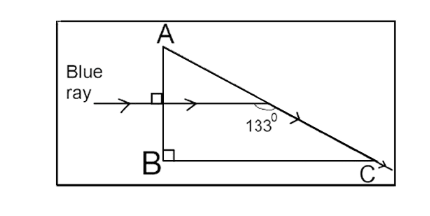
4(iii)(b)(1). Calculate the critical angle of the material of the prism for blue colour.
[1 mark]4(iii)(b)(2). What is the measure of the angle of this prism (A)?
[1 mark]4(iii)(b)(3). Which colour should replace the blue ray, for the ray to undergo Total Internal Reflection?
[1 mark]5(a)(i). Which particles are responsible for current in conductors?
[1 mark]5(a)(ii). To which wire of a cable in a power circuit should the metal case of a geyser be connected?
[1 mark]5(a)(iii). To which wire should the fuse be connected?
[1 mark]5(b)(i). Name the transformer used in the power transmitting station of a power plant.
[1 mark]5(b)(ii). What type of current is transmitted from the power station?
[1 mark]5(b)(iii). At what voltage is this current available to our household?
[1 mark]5(c). A battery of e.m.f. 12 V and internal resistance 2 Ω is connected with two resistors A and B of resistance 4 Ω and 6 Ω respectively joined in series.
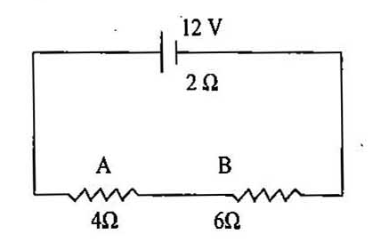
5(c). Find:
5(c)(i). Current in the circuit.
[1 mark]5(c)(ii). The terminal voltage of the cell.
[1 mark]5(c)(iii). The potential difference across 6 Ω Resistor.
[1 mark]5(c)(iv). Electrical energy spent per minute in 4 Ω Resistor.
[1 mark]6(i)(a). Which characteristic of sound is affected due to the larger surface of a school bell?
[1 mark]6(i)(b). Calculate the distance covered by the Ultrasonic wave having a velocity of 1.5 kms-1 in 14 s, when it is received after reflection by the receiver of the SONAR.
[2 marks]6(ii)(a). Complete the following nuclear changes:
[2 marks]
6(ii)(b). Name the nuclear radiation which has the highest ionizing power.
[1 mark]6(iii). We are able to see the T.V. channels clearly when we set T.V. on auto-tuning.
6(iii)(a). Which phenomenon led to the clear visibility of the channels, due to auto tuning?
[1 mark]6(iii)(b). Define the above phenomenon mentioned by you.
[2 marks]6(iii)(c). Give any one more example of this phenomenon.
[1 mark]7(a)(i). Write a relationship between angle of incidence and angle of refraction for a given pair of media.
[1 mark]7(a)(ii). When a ray of light enters from one medium to another having different optical densities it bends. Why does this phenomenon occur?
[1 mark]7(a)(iii). Write one condition where it does not bend when entering a medium of different optical density.
[1 mark]7(b). A lens produces a virtual image between the object and the lens.
7(b)(i). Name the lens.
[1 mark]7(b)(ii). Draw a ray diagram to show the formation of this image.
[2 marks]7(c). What do you understand by the term 'Scattering of light'? Which colour of white light is scattered the least and why?
[4 marks]8(i)(a). 85 g of water at 30°C is cooled to 5°C by adding certain mass of ice. Find the mass of ice required. [Specific heat capacity of water = 4.2 J g⁻¹ °C⁻¹, Specific latent heat of fusion = 336 J g⁻¹]
[3 marks]8(ii)(a). Why does it become pleasantly warm when the lakes start freezing?
[1 mark]8(ii)(b). Water freezes to form ice. What change would you expect in the average kinetic energy of the molecules?
[1 mark]8(ii)(c). Which will contain more heat energy: 1 g of ice at 0°C or 1 g of water at 0°C?
[1 mark]8(iii)(a). State one factor that affects the magnitude of induced current in an AC generator.
[1 mark]8(iii)(b). Given below is a circuit to study the magnetic effect of electric current. ABCD is a cardboard kept perpendicular to the conductor XY. A magnetic compass is placed at the point P of the cardboard. P1 and P2 are the positions of the magnetic compass, before and after passing a current through XY respectively.
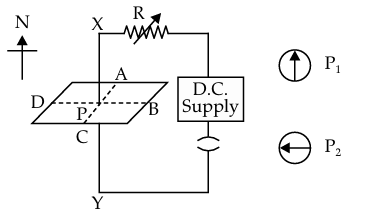
8(iii)(b)(1). Name the rule that is used to predict the direction of deflection of the magnetic compass.
[1 mark]8(iii)(b)(2). State the direction of current in the conductor (X to Y or Y to X) when the circuit is complete.
[1 mark]8(iii)(b)(3). If resistance R is increased, then what will be the effect on the magnetic lines of force around the conductor?
[1 mark]9(a). A body of mass 10 kg is kept at a height of 5 m. It is allowed to fall and reach the ground.
9(a)(i). What is the total mechanical energy possessed by the body at the height of 2 m assuming it is a frictionless medium?
[1.5 marks]9(a)(ii). What is the kinetic energy possessed by the body just before hitting the ground? Take g = 10 m s-2.
[1.5 marks]9(b). A uniform metre scale is in equilibrium as shown in the diagram :

9(b)(i). Calculate the weight of the metre scale.
[1.5 marks]9(b)(ii). Which of the following options is correct to keep the ruler in equilibrium when 40 gf wt is shifted to 0 cm mark?
[1.5 marks]9(c). The diagram below shows a pulley arrangement :
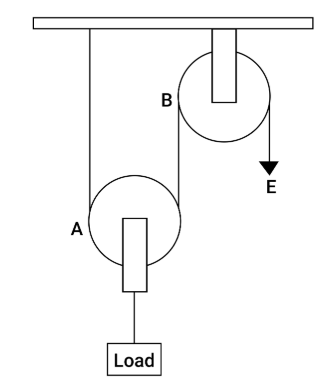
9(c)(i). Copy the diagram and mark the direction of tension on each strand of the string.
[1 mark]9(c)(ii). What is the velocity ratio of the arrangement?
[1 mark]9(c)(iii). If the tension acting on the string is T, then what is the relationship between T and effort E?
[1 mark]9(c)(iv). If the free end of the string moves through a distance x, find the distance by which the load is raised.
[1 mark]