Physics — Suggested Paper 1
2 hours80 marks Questions from 2016–2026
A suggested paper: every question is a real ICSE board question, chosen from different years and arranged in the current pattern. Start the timed test to have your written answers marked.
Answers to this Paper must be written on the paper provided separately. You will not be allowed to write during the first 15 minutes. This time is to be spent in reading the question paper. The time given at the head of this Paper is the time allowed for writing the answers. The intended marks for questions or parts of questions are given in brackets [ ].
Section A (40 marks)
Attempt all questions from this Section.
1. Choose the correct answers to the questions from the given options. (Do not copy the questions, write the correct answers only.)
1(i). The energy transformation taking place during photosynthesis in plants is: (a) heat to chemical (b) chemical to light (c) light to chemical (d) chemical to heat
[1 mark]1(ii). Water is used in car radiators because : (a) it is a good conductor of heat. (b) it conducts heat faster as compared to the other substances and cools the engine quickly. (c) its specific heat capacity is very low. (d) its specific heat capacity is very high so it can cool the engine without a greater increase in its own temperature.
[1 mark]1(iii). The wave length range of visible light is: (a) 40 nm to 80 nm (b) 4000 nm to 8000 nm (c) 4 nm to 8 nm (d) 400 nm to 800 nm
[1 mark]1(iv). Assertion (A) : As the level of water in a tall measuring cylinder kept under running tap rises, the pitch of sound gradually increases. Reason (R) : Frequency of sound is inversely proportional to the length of the water column. (a) Both (A) and (R) are true and (R) is correct explanation of (A). (b) Both (A) and (R) are true and (R) is not the correct explanation of (A). (c) (A) is true but (R) is false. (d) (A) is false but (R) is true.
[1 mark]1(v). When a current I flows through a wire of resistance R for time t then the electrical energy produced is given by: (a) I2Rt (b) IR2t (c) IRt (d) IRt2
[1 mark]1(vi). Small air bubbles rising up a fish tank appear silvery when viewed from some particular angle is due to the: (a) reflection (b) refraction (c) dispersion (d) total internal reflection
[1 mark]1(vii). For a body to be in dynamic equilibrium, its: (a) momentum should be zero (b) acceleration should be zero (c) kinetic energy should be zero (d) velocity should be zero
[1 mark]1(viii). In the diagram shown below, the velocity ratio of the arrangement is: (a) 1 (b) 2 (c) 3 (d) 0
[1 mark]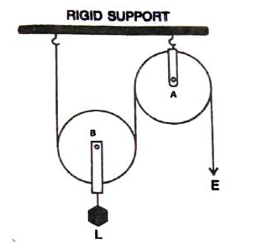
1(ix). A radioactive element is placed in an evacuated chamber. Then the rate of radioactive decay will: (a) Decrease (b) Increase (c) Remain unchanged (d) Depend on the surrounding temperature
[1 mark]1(x). Speed of blue light in water is: (a) more than green light (b) more than orange light (c) more than violet light (d) more than red light
[1 mark]1(xi). The diagram below shows the top view of the Wire A shown by a cross (X), carrying current into the plane of the paper. Which of the compasses is correctly aligned with the magnetic field produced by the current carrying wire? (a) Only 1 is aligned (b) Only 2 is aligned (c) Both 1 and 2 are aligned (d) Both 1 and 2 are not aligned
[1 mark]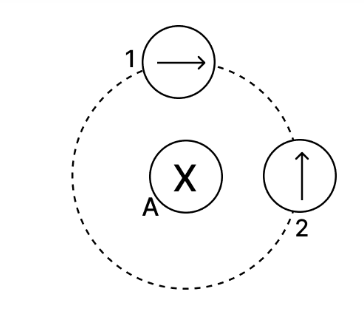
1(xii). A main switch in the main distribution board is present in : (a) a live wire (b) a neutral wire (c) a live as well as neutral wire (d) an earth wire
[1 mark]1(xiii). What is the correct energy transformation during burning of a candle? (a) heat --> kinetic + potential (b) heat --> chemical + light (c) chemical --> heat + light (d) mechanical --> chemical + heat
[1 mark]1(xiv). During melting of ice at 0°C the : (a) energy is released and temperature remains constant. (b) energy is absorbed and temperature remains constant. (c) energy is released and temperature decreases. (d) energy is absorbed and temperature increases.
[1 mark]1(xv). When a blackened bulb thermometer is moved beyond the red region of the visible spectrum, there is a rapid rise in the temperature. This is due to the presence of : (a) Infrared radiations (b) Ultraviolet radiations (c) X-rays (d) Radio waves
[1 mark]2(i). Complete the following by choosing the correct answers from the bracket:
2(i)(a). In uniform circular motion the centrifugal force acts ............... [towards the centre/away from the centre/along the tangential direction].
[1 mark]2(i)(b). Refractive index of a medium is independent of ............... [temperature/angle of incidence/wavelength of light].
[1 mark]2(i)(c). Heat absorbed during change of phase depends on ............... [mass/change in temperature/specific heat capacity] of the substance.
[1 mark]2(i)(d). Emf of a cell is ............... [greater than/less than/equal to] the terminal voltage when the cell is in open circuit.
[1 mark]2(i)(e). In a step-up transformer the turns ratio is ............... [more than 1/ less than 1/ equal to 1].
[1 mark]2(i)(f). The nuclear radiation with lowest ionising power is ............... [α/β/γ].
[1 mark]2(ii). The human ear can detect continuous sounds in the frequency range from 20 Hz to 20000 Hz. Assuming that the speed of sound in air is 330 ms-1 for all frequencies, calculate the wavelengths corresponding to the given extreme frequencies of the audible range
[2 marks]2(iii). Define a kilowatt hour. How is it related to joule ?
[2 marks]3(i). Copper wire is wound around a steel bar FT. Current is allowed to pass through the coil for some time and then the bar is removed.
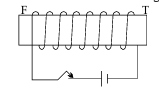
3(i)(a). Draw only the magnetised bar FT and mark its poles.
[1 mark]3(i)(b). Trace two magnetic lines of force around FT clearly indicating the direction
[1 mark]3(ii). How much heat is required to convert 500 g of ice at 0°C to water at 0°C? The latent heat of fusion of ice is 330 J g⁻¹.
[2 marks]3(iii). When does the nucleus of an atom tend to be radioactive?
[2 marks]3(iv). A crane 'A' lifts a heavy load in 5 seconds, whereas another crane 'B' does the same work in 2 seconds. Compare the power of n crane 'A' to that of crane 'B'.
[2 marks]3(v)(i). If the lens is placed in water instead of air, how does it's focal length change?
[1 mark]3(v)(ii). Which lens, thick or thin has greater focal length?
[1 mark]3(vi). How does an increase in the temperature affect the specific resistance of a :
3(vi)(i). Metal and
[1 mark]3(vi)(ii). Semiconductor?
[1 mark]3(vii). A monochromatic ray strikes the surface of identical prisms (A, B and C) at different angles of incidence. The diagram below shows their refracted rays. Study the path of these refracted rays and identify in which of the diagrams:
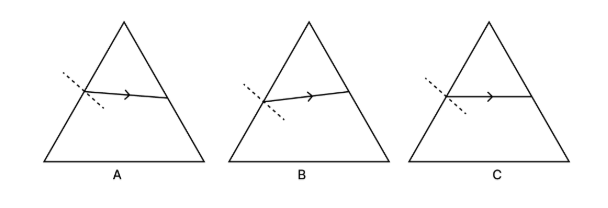
3(vii)(a). the angle of incidence is maximum.
[1 mark]3(vii)(b). the angle of incidence is minimum.
[1 mark]3(vii)(c). the angle of incidence is equal to the angle of emergence.
[1 mark]Section B (40 marks)
Attempt any four questions from this Section.
4(i). The diagram shows wiring in a meter room of a building.
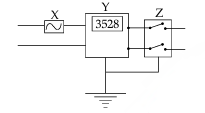
4(i)(a). What is the current rating of device X?
[1 mark]4(i)(b). What is the difference between the switch Z shown in the diagram and the switches you use to operate different appliances at home?
[1 mark]4(i)(c). What is the unit of the physical quantity displayed in Y?
[1 mark]4(ii). Study the diagram given below and answer the questions that follow :
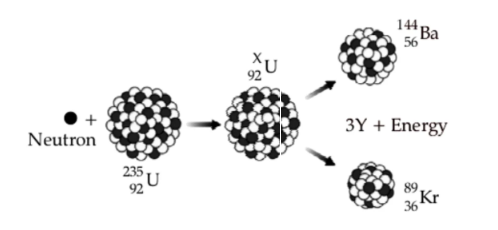
4(ii)(a). Name the process depicted in the diagram.
[1 mark]4(ii)(b). What is the value of X?
[1 mark]4(ii)(c). Identify Y, the missing product of the reaction.
[1 mark]4(iii). Three identical bulbs B1, B2 and B3 each of power rating 18 W, 12 V are connected to a battery of 12 V.
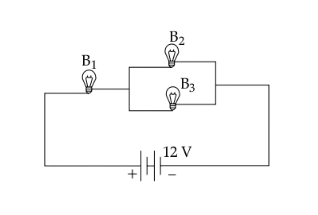
4(iii)(a). Calculate : the resistance of each bulb the current drawn from the cell
[3 marks]4(iii)(b). If the bulb B3 is removed from the circuit, then will the brightness of the bulb B1 increase, decrease or remain the same?
[1 mark]5(i). A convex lens of focal length 10 cm is placed at a distance of 60 cm from a screen. How far from the lens should an object be placed so as to obtain a real image on the screen?
[3 marks]5(ii)(a). A coin kept inside water [µ= 4/3 ] when viewed from air in a vertical direction appears to be raised by 3.0 mm. Find the depth of the coin in water.
[2 marks]5(ii)(b). How is the critical angle related to the refractive index of a medium?
[1 mark]5(iii)(a). Infrared radiations are used in warfare. Explain with reason, why.
[2 marks]5(iii)(b). A ray of light is incident at 45° on an equilateral prism in the diagram below.
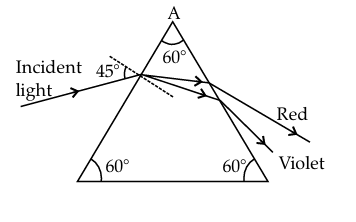
5(iii)(b)(1). Name the phenomenon exhibited by the ray of light when it enters and emerges out of the prism.
[1 mark]5(iii)(b)(2). State the cause of the above phenomenon mentioned by you.
[1 mark]6(a)(i). How is the transference of heat energy by radiation prevented in a calorimeter ?
[1 mark]6(a)(ii). You have a choice of three metals A, B and C, of specific heat capacities 900 J kg-1 °C-1, 380 / kg-1 °C-1 and 460 J kg-1 °C-1 respectively, to make a calorimeter. Which material will you select ? Justify your answer.
[2 marks]6(b). Calculate the mass of ice needed to cool 150 g of water contained in a calorimeter of mass 50 g at 32°C such that the final temperature is 5°C. Specific heat capacity of calorimeter 0.4 J g-1 °C-1 Specific heat capacity of water = 4.2 J g-1 °C-1 Latent heat capacity of ice 330 J g-1
[3 marks]6(c)(i). Name the radiations which are absorbed by greenhouse gases in the earth’s atmosphere.
[1 mark]6(c)(ii). A radiation X is focused by a particular device on the bulb of a thermometer and mercury in the thermometer shows a rapid increase. Name the radiation X.
[1 mark]6(c)(iii). Name two factors on which the heat energy liberated by a body depends.
[2 marks]7(i).
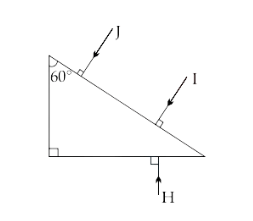
7(i)(a). Out of the three rays (I, J, H) shown in the diagram, which ray will suffer Total Internal Reflection while inside the prism? (Critical angle of the prism is 42°.)
[1 mark]7(i)(b). Copy the diagram to complete the path of the ray which you have named in (a) till it comes out of the prism.
[2 marks]7(ii). A rectangular glass block of refractive index 1.5 has an air bubble trapped inside it as shown in the diagram. When seen from the surface AB, it appears to be 4 cm deep.
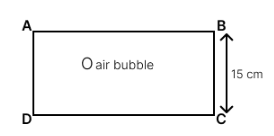
7(ii)(a). Calculate the actual depth of the air bubble from the surface AB.
[1 mark]7(ii)(b). For which colour of light, blue or yellow, the apparent depth will be greater?
[1 mark]7(ii)(c). Turning the glass block upside down, DOES NOT change the apparent depth of the air bubble. State True or False.
[1 mark]7(iii)(a). An object is placed at 2F position of a convex lens. Draw a ray diagram showing the formation of the image.
[3 marks]7(iii)(b). How will the size of the image change if we, ONLY replace the lens in the above arrangement with another lens of a greater focal length?
[1 mark]8(a). Give reasons for the following :
8(a)(i). Clouds appear white.
[1.5 marks]8(a)(ii). Sky appears blue.
[1.5 marks]8(b)(i). Name the system which enables us to locate underwater objects by transmitting ultrasonic waves and detecting the reflecting impulse.
[1.5 marks]8(b)(ii). What are acoustically measurable quantities related to pitch and loudness ?
[1.5 marks]8(c)(i). When a tuning fork [vibrating] is held close to ear, one hears a faint hum. The same [vibrating tuning fork] is held such that its stem is in contact with the table surface, then one hears a loud sound. Explain.
[2 marks]8(c)(ii). A man standing in front of a vertical cliff fires a gun. He hears the echo after 3.5 seconds. On moving closer to the cliff by 84 m, he hears the echo after 3 seconds. Calculate the distance of the cliff from the initial position of the man.
[2 marks]9(a). Arrange α, β and γ rays in ascending order with respect to their
9(a)(i). Penetrating power.
[1 mark]9(a)(ii). Ionising power.
[1 mark]9(a)(iii). Biological effect.
[1 mark]9(b)(i). In a cathode ray tube what is the function of anode?
[1 mark]9(b)(ii). State the energy conversion taking place in a cathode ray tube.
[1 mark]9(b)(iii). Write one use of cathode ray tube.
[1 mark]9(c)(i). Represent the change in the nucleus of a radioactive element when a β particle is emitted.
[2 marks]9(c)(ii). What is the name given to elements with same mass number and different atomic number?
[1 mark]9(c)(iii). Under which conditions does the nucleus of an atom tend to be radioactive?
[1 mark]