Physics — Suggested Paper 4
2 hours80 marks Questions from 2017–2026
A suggested paper: every question is a real ICSE board question, chosen from different years and arranged in the current pattern. Start the timed test to have your written answers marked.
Answers to this Paper must be written on the paper provided separately. You will not be allowed to write during the first 15 minutes. This time is to be spent in reading the question paper. The time given at the head of this Paper is the time allowed for writing the answers. The intended marks for questions or parts of questions are given in brackets [ ].
Section A (40 marks)
Attempt all questions from this Section.
1. Choose the correct answers to the questions from the given options. (Do not copy the questions, write the correct answers only.)
1(i). In a closed circuit containing a bulb and a cell, the electromotive force (ε) and the terminal voltage (V) is related as. (Given I is current and r is internal resistance.) (a) V = ε + Ir (b) V = ε – Ir (c) V = ε ÷ Ir (d) V = ε × Ir
[1 mark]1(ii). The graph given below shows heat energy supplied against change in temperature when no energy is lost to the surrounding. The slope of this graph will give : (a) Specific heat capacity (b) Latent heat of fusion (c) Latent heat of vaporization (d) Heat capacity
[1 mark]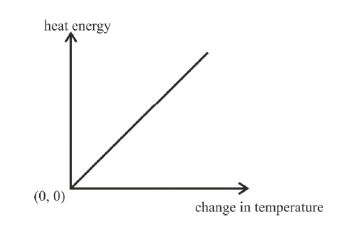
1(iii). The refractive index of a diamond is 2.4. It means that: (a) the speed of light in vacuum is equal to 1/2.4 times the speed of light in diamond (b) the speed of light in the diamond is 2.4 times the speed of light in a vacuum. (c) the speed of light in a vacuum is 2.4 times the speed of light in the diamond, (d) the wavelength of light in diamond is 2.4 times the wavelength of light in vacuum.
[1 mark]1(iv). From the figure given below, the refractive index of medium B with respect to medium A (ₐμᵦ) is: (a) sin 45° / sin 30° (b) sin 30° / sin 45° (c) sin 45° / sin 60° (d) sin 60° / sin 45°
[1 mark]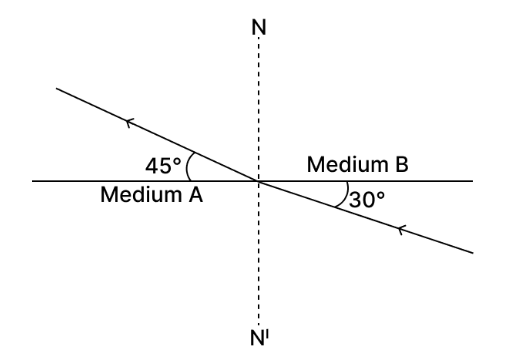
1(v). Which among the following is a vector quantity? (a) work (b) power (c) energy (d) moment of couple.
[1 mark]1(vi). A coolie raises a load upwards against the force of gravity then the work done by the load is: (a) zero. (b) positive work. (c) negative work. (d) none of these.
[1 mark]1(vii). Two notes are produced from two different musical instruments, such that they have same loudness and same pitch. The produced notes differ in their: (a) Waveform (b) Frequency (c) Wavelength (d) Speed
[1 mark]1(viii). A radioactive nucleus containing 128 nucleons emits a β – particle. After β – emission the number of nucleons present in the nucleus will be : (a) 128 (b) 129 (c) 124 (d) 127
[1 mark]1(ix). The energy conversion in a washing machine is from ............... (a) magnetic to electrical (b) electrical to mechanical (c) electrical to magnetic (d) magnetic to electrical
[1 mark]1(x). The distance (V) of a virtual image formed by a lens of focal length 15 cm never exceeds a certain finite value, then this value will be: (a) less than 15 cm (b) between 15 cm to 30 cm (c) less than or equal to 30 cm (d) less than or equal to 15 cm
[1 mark]1(xi). If the strength of the current flowing through a wire is increased, the strength of the magnetic field produced by it: (a) decreases (b) increases (c) remains the same (d) first increases then decreases
[1 mark]1(xii). Choose the correct relation for e.m.f. (ε) and terminal voltage V: (a) ε = V [always] (b) V > ε [always] (c) V < ε [when the cell is in use] (d) None of these
[1 mark]1(xiii). Three substances A, B and C of same mass are present at their respective melting points. On heating, if they melt completely in 5 minutes, 7 minutes and 3 minutes respectively, then which substance has the highest specific latent heat? (Assume heat is absorbed at the same rate) (a) Substance A (b) Substance B (c) Substance C (d) All the substances have same specific latent heat
[1 mark]1(xiv). The ratio of velocities of light of wavelength 400 nm and 800 nm in a vacuum is: (a) 1:1 (b) 1:2 (c) 2:1 (d) 1:3
[1 mark]1(xv). When a ray of light travels normal to the given surface, then the angle of refraction is: (a) 180° (b) 90° (c) 0° (d) 45°
[1 mark]2(i). Complete the following by choosing the correct answers from the bracket:
2(i)(a). In uniform circular motion the centrifugal force acts ............... [towards the centre/away from the centre/along the tangential direction].
[1 mark]2(i)(b). Refractive index of a medium is independent of ............... [temperature/angle of incidence/wavelength of light].
[1 mark]2(i)(c). Heat absorbed during change of phase depends on ............... [mass/change in temperature/specific heat capacity] of the substance.
[1 mark]2(i)(d). Emf of a cell is ............... [greater than/less than/equal to] the terminal voltage when the cell is in open circuit.
[1 mark]2(i)(e). In a step-up transformer the turns ratio is ............... [more than 1/ less than 1/ equal to 1].
[1 mark]2(i)(f). The nuclear radiation with lowest ionising power is ............... [α/β/γ].
[1 mark]2(ii). How is the refractive index of a material related to :
2(ii)(i). real and apparent depth ?
[1 mark]2(ii)(ii). velocity of light in vacuum or air and the velocity of light in a given medium ?
[1 mark]2(iii)(a). What should be the angle between the direction of force and the direction of displacement, for work to be negative?
[1 mark]2(iii)(b). Name the physical quantity obtained using the formula U/h, where U is the potential energy and h is the height.
[1 mark]3(i). A solid metal weighing 150 g melts at it's melting point of 800 °C by providing heat at the rate of 100 W. The time taken for it to completely melt at the same temperature is 4 min. What is the specific latent heat of fusion of the metal?
[2 marks]3(ii). Draw a graph between displacement from mean position and time for a body executing free vibration in a vacuum.
[2 marks]3(iii). The power of a lens is –5D.
3(iii)(i). Find it's focal length.
[1 mark]3(iii)(ii). Name the type of lens.
[1 mark]3(iv). Copy and complete the nuclear reaction by filling in the blanks: ²³⁵₉₂U + ¹₀n → ___Ba + ___Kr⁹² + 3¹₀n
[2 marks]
3(v). The wave lengths for the light of red and blue colours are nearly 7.8 × 10⁻⁷ m and 4.8 × 10⁻⁷ m respectively.
3(v)(i). Which colour has the greater speed in a vacuum ?
[1 mark]3(v)(ii). Which colour has a greater speed in glass ?
[1 mark]3(vi).
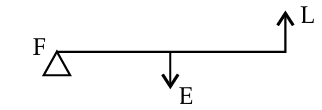
3(vi)(i). Identify the class of the lever shown in the diagram :
[1 mark]3(vi)(ii). How is it possible to increase the M.A. of the above lever without increasing its length ?
[1 mark]3(vii)(a). In the following atoms, which one is a radioisotope? Give one use of this isotope. O16, C14, N14, He4
[2 marks]3(vii)(b). Name the class of the lever shown in the picture below :
[1 mark]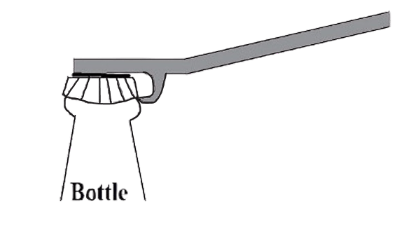
Section B (40 marks)
Attempt any four questions from this Section.
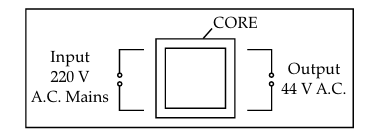
4(a). The diagram below shows the core of a transformer and its input and output connections.
4(a)(i). State the material used for the core.
[1 mark]4(a)(ii). Copy and complete the diagram of the transformer by drawing input and output coils.
[2 marks]4(b)(i). What are superconductors ?
[1 mark]4(b)(ii). Calculate the current drawn by an appliance rated 110 W, 220 V when connected across 220 V supply.
[1 mark]4(b)(iii). Name a substance whose resistance decreases with the increase in temperature.
[1 mark]4(c). The diagram above shows three resistors connected across a cell of e.m.f. 1.8 V and internal resistance r. Calculate :
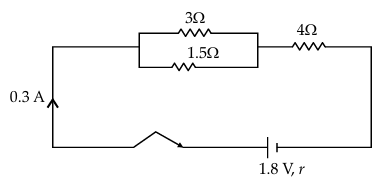
4(c)(i). Current through 3 W resistor.
[2 marks]4(c)(ii). The internal resistance r.
[2 marks]5(a)(i). Write one advantage of connecting electrical appliances in parallel combination.
[1 mark]5(a)(ii). What characteristics should a fuse wire have?
[1 mark]5(a)(iii). Which wire in a power circuit is connected to the metallic body of the appliance?
[1 mark]5(b). The diagram below shows a dual control switch circuit connected to a bulb.
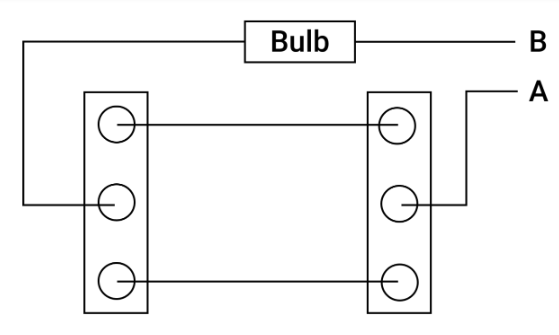
5(b)(i). Copy the diagram and complete it so that the bulb is switched ON.
[2 marks]5(b)(ii). Out of A & B which one is the live wire and which one is the neutral wire?
[1 mark]5(c). The diagram shows a circuit with the key k open. Calculate:
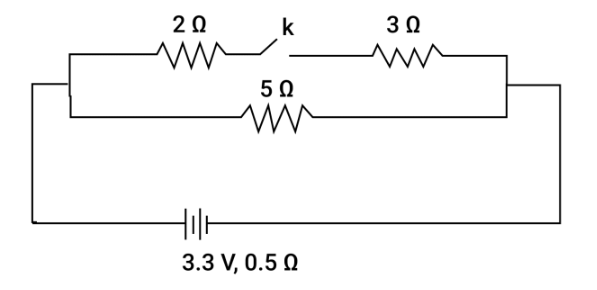
5(c)(i). the resistance of the circuit when the key k is open.
[1 mark]5(c)(ii). the current drawn from the cell when the key k is open.
[1 mark]5(c)(iii). the resistance of the circuit when the key k is closed.
[1 mark]5(c)(iv). the current drawn from the cell when the key k is closed.
[1 mark]6(a). Labelled diagram of an AC generator is as shown:
[3 marks]6(b)(i). Define nuclear fission.
[1 mark]6(b)(ii). Rewrite and complete the following nuclear reaction by filling in the atomic number of Ba and mass number of Kr : ²³⁵₉₂U + ¹₀n ⟶ ¹⁴⁴₅₆Ba + ⁸⁹₃₆Kr + 3¹₀n + Energy
[2 marks]6(c). The diagram below shows a magnetic needle kept just below the conductor AB which is kept in North South direction.
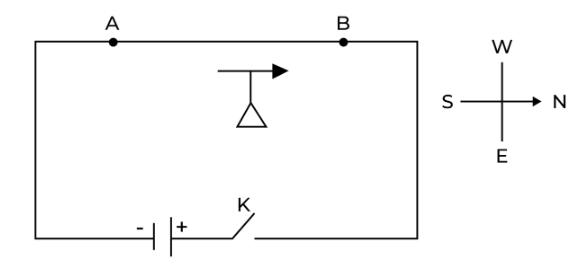
6(c)(i). In which direction does the needle deflect when the key is closed ?
[1 mark]6(c)(ii). Why is the deflection produced?
[1 mark]6(c)(iii). What will be the change in the deflection if the magnetic needle is taken just above the conductor AB ?
[1 mark]6(c)(iv). Name one device which works on this principle.
[1 mark]7(i). 30 g of ice at 0°C is used to bring down the temperature of a certain mass of water at 70°C to 20°C. Find the mass of water. [Specific heat capacity of water = 4.2 J g⁻¹ °C⁻¹ and specific latent heat of ice = 336 J g⁻¹]
[3 marks]7(ii)(a). A certain amount of heat will warm 1 g of material X by 10°C and 1 g of material Y by 40°C. Which material has higher specific heat capacity?
[1 mark]7(ii)(b). Which material, X or Y, would you select to make a calorimeter?
[1 mark]7(ii)(c). The specific heat capacity of a substance remains the same when it changes its state from solid to liquid. State True or False.
[1 mark]7(iii). A copper rod PQ carrying current is kept in a magnetic field as shown in the diagram.
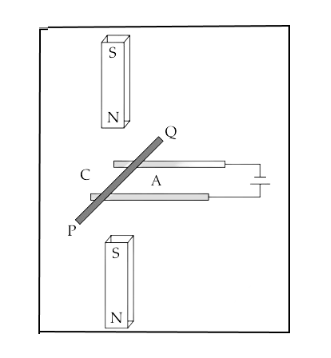
7(iii)(a). The copper rod PQ will move towards C. State True or False.
[1 mark]7(iii)(b). Name the law used to determine the direction of motion of PQ.
[1 mark]7(iii)(c). What will be the effect on the force experienced, if the rod PQ is replaced by another copper rod of same length but of greater cross-sectional area?
[1 mark]7(iii)(d). Justify your answer in (c).
[1 mark]- (c).
8(i). The diagram below shows the ray OP travelling through an equilateral prism of a certain material.
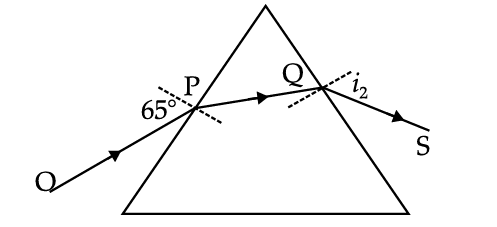
8(i)(a). Calculate the value of i2, if the angle of deviation is 43°.
[2 marks]8(i)(b). What is the ray QS called?
[1 mark]8. Copy the diagram given below and complete the path of the light ray PQ, as it emerges out of the prism by marking necessary angles. The critical angle of glass is 42°.
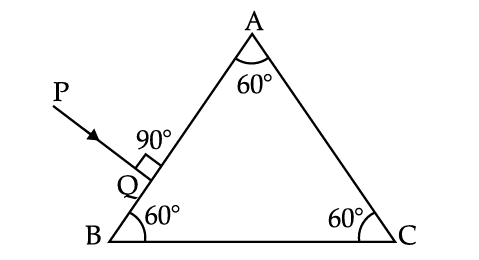
8(ii). Copy the diagram given below and complete the path of the light ray PQ, as it emerges out of the prism by marking necessary angles. The critical angle of glass is 42°.
[3 marks]8(iii). The diagram below shows two parallel rays A (Orange) & B (Blue) incident from air, on air-glass boundary.
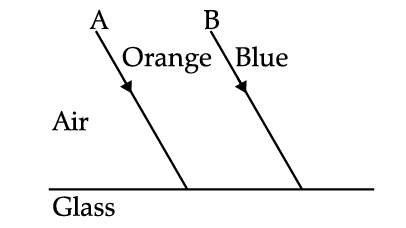
8(iii)(a). Copy and complete the path of the rays A and B.
[2 marks]8(iii)(b). How do the speeds of these rays differ in glass?
[1 mark]8(iii)(c). Are the two refracted rays in glass parallel? Give a reason.
[1 mark]9(i). A block and tackle system of pulleys has velocity ratio 4.
9(i)(a). Draw a labelled diagram of the system indicating clearly, the direction of the load and the effort.
[2 marks]9(i)(b). What is the value of the mechanical advantage of the given pulley system if it is an ideal pulley system?
[1 mark]9(ii). A metre scale of weight 50 gf can be balanced at 40 cm mark without any weight suspended on it.

9(ii)(a). If this ruler is cut at its centre then state which part [0 to 50 cm or 50 to 100 cm] of the ruler will weigh more than 25 gf.
[1.5 marks]9(ii)(b). What minimum weight placed on this metre ruler can balance this ruler when it is pivoted at its centre?
[1.5 marks]9(iii). A car of mass 120 kg is moving at a speed 18 km/h and it accelerates to attain a speed of 54 km/h in 5 seconds. Calculate:
9(iii)(a). the work done by the engine.
[3 marks]9(iii)(b). the power of the engine.
[1 mark]