NumericalModerate1.5 marks
8(iii)
Study the diagram :
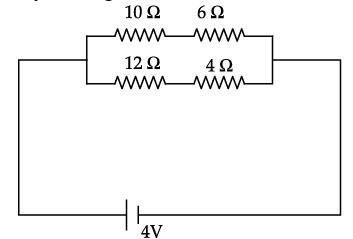
Calculate the total resistance of the circuit.
Topic: Series-parallel resistance
Question wording verified against source paper
Answer
Exam answer
From the circuit, the 10 Ω and 6 Ω are in series in one branch, the 12 Ω and 4 Ω are in series in the other, and the two branches are in parallel.
Upper branch: R₁ = 10 + 6 = 16 Ω
Lower branch: R₂ = 12 + 4 = 16 Ω
The two in parallel: R = (16 × 16) ÷ (16 + 16) = 256 ÷ 32 = 8 Ω
Total resistance of the circuit = 8 Ω
Explanation
Reduce each branch to a single value first, then combine. Both branches happen to come to 16 Ω, and two EQUAL resistors in parallel always give exactly half of one of them — so 8 Ω, without needing the formula at all.
Check against the rule: 8 Ω is smaller than either 16 Ω branch ✓. Adding all four resistors gives 32 Ω, which is what you get by treating the whole thing as series.
More from Current Electricity
In the circuit given below, identify the lamp (L1, L2, L3 and L4) whose failure would not interrupt the power supply to the other lamps.
(a) L1
(b) L2
(c) L3
(d) L42026The correct formula to calculate the equivalent resistance of two resistors R₁ and R₂ when connected in parallel, is:
(a) (R₁ + R₂) / (R₁R₂)
(b) (R₁R₂) / (R₁ + R₂)
(c) (R₁ − R₂) / (R₁R₂)
(d) (R₁R₂) / (R₁ − R₂)2026A substance whose resistance becomes almost negligible at a temperature near absolute zero is called a ............... [semiconductor / superconductor].2026How will the voltmeter reading change? (increase / decrease / remain the same)2026Justify your answer stated in (a) above.2026Calculate the ratio V1 : V2.2026