Bulb A rated 160 W, 40 V and Bulb B rated 40 W, 40 V are connected as shown in the diagram.
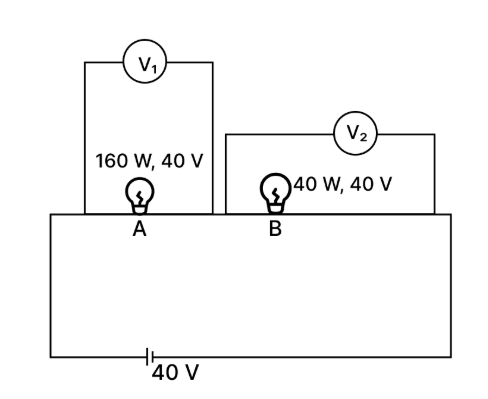
Calculate the ratio V1 : V2.
Topic: Power rating and resistance of bulbs
Answer
Given: Bulb A rated 160 W, 40 V; Bulb B rated 40 W, 40 V; connected in series.
Find each resistance from R = V² ÷ P, using the RATED values: R_A = (40)² ÷ 160 = 1 600 ÷ 160 = 10 Ω R_B = (40)² ÷ 40 = 1 600 ÷ 40 = 40 Ω
In series the two bulbs carry the same current I, so the voltage across each is proportional to its resistance: V₁ ÷ V₂ = (I R_A) ÷ (I R_B) = R_A ÷ R_B
V₁ : V₂ = 10 : 40 = 1 : 4
Ratio V₁ : V₂ = 1 : 4
Two steps: turn each rating into a resistance, then use the fact that series resistors share the voltage in proportion to their resistance.
Note that the HIGHER-power bulb has the LOWER resistance — 160 W gives 10 Ω while 40 W gives 40 Ω. At a fixed voltage, more power means less resistance. Getting this backwards inverts the whole answer to 4 : 1.
The consequence is worth understanding: in series, the 40 W bulb drops four times the voltage of the 160 W bulb, so the bulb designed to be DIMMER glows brighter. Bulbs of different ratings should not be put in series for exactly this reason.