The diagram below shows the path of a blue ray through the prism :
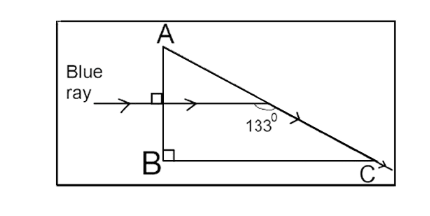
Calculate the critical angle of the material of the prism for blue colour.
Topic: Critical angle of a prism
Answer
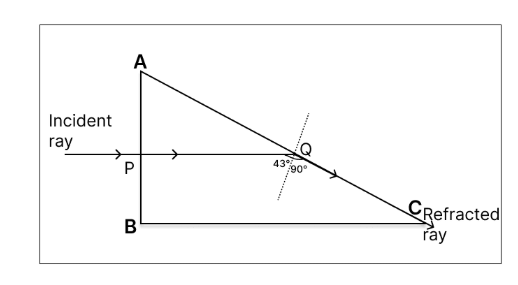
From the diagram, the blue ray enters the prism normally through face AB (the small square marks a right angle), so it passes straight in without bending and meets the face AC.
The angle between the ray and the surface AC is marked 133°.
The normal is perpendicular to the surface, so the angle of incidence at AC is i = 133° − 90° = 43°
The ray is shown just grazing along the surface as it emerges, which means the angle of refraction is 90°. By definition, the angle of incidence that produces a 90° angle of refraction is the critical angle.
Critical angle for blue light, C = 43°
Angles in prism diagrams are usually marked from the SURFACE, but every formula in optics measures from the NORMAL. Subtract from 90° (or from 180°, as here, where the marked angle is obtuse) to convert.
Then recognise the definition being tested: the critical angle is the angle of incidence in the denser medium for which the refracted ray grazes along the surface at exactly 90°. The diagram shows that grazing ray, which is the clue that the incidence angle IS the critical angle.
Using 133° itself is impossible — an angle of incidence can never exceed 90°, so that answer should stop you immediately.