Short answerEasy1 mark
3(vii)
A monochromatic ray strikes the surface of identical prisms (A, B and C) at different angles of incidence. The diagram below shows their refracted rays. Study the path of these refracted rays and identify in which of the diagrams:
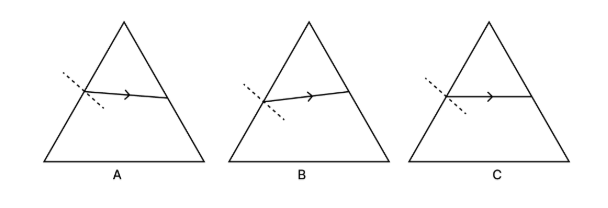
the angle of incidence is maximum.
Topic: Refraction through a prism
Question wording verified against source paper
Answer
Exam answer
Prism B.
Explanation
Its internal refracted ray indicates the largest angle of incidence.
More from Refraction of Light at Plane Surfaces
From the figure given below, the refractive index of medium B with respect to medium A (ₐμᵦ) is:
(a) sin 45° / sin 30°
(b) sin 30° / sin 45°
(c) sin 45° / sin 60°
(d) sin 60° / sin 45°2026When a ray of light passes from a denser to a rarer medium, its wavelength ............... [decreases / increases].2026the angle of incidence is minimum.2026the angle of incidence is equal to the angle of emergence.2026What is the product of the ratio
sin i / sin r
at the first surface and at the second surface?2026State whether the opposite surfaces are parallel or not parallel.2026