Find the value of current I drawn from the cell.
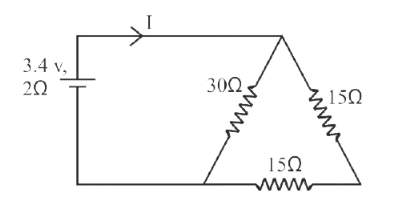
Calculate the terminal voltage.
Topic: Terminal voltage
Answer
Given: ε = 3.4 V, I = 0.2 A (from part (a)), r = 2 Ω
Terminal voltage, V = ε − I r = 3.4 − (0.2 × 2) = 3.4 − 0.4 = 3.0 V
Terminal voltage = 3.0 V
The terminal voltage is always LESS than the e.m.f. whenever current flows, because some of the cell's push is used up driving current through its own internal resistance. That lost part, Ir, is 0.4 V here.
Check it the other way: the terminal voltage is also the voltage across the external resistance, so V = I × R_ext = 0.2 × 15 = 3.0 V ✓. Two independent routes to the same number is the best check you can get.
Adding instead of subtracting gives 3.8 V, which is more than the cell can provide — an impossible answer, and a useful warning sign.