NumericalModerate1 mark
2(iii)
In the below circuit diagram, calculate:
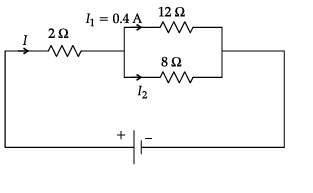
the current I.
Topic: Current, resistance and circuits
Previous-year question practice database
Answer
Exam answer
The main current divides between the two parallel branches, so I = I₁ + I₂
I = 0.4 + 0.6 = 1.0 A
Current I = 1.0 A
Explanation
At a junction, the current arriving equals the total current leaving — that is Kirchhoff's first rule, and here it simply means the two branch currents add up to the main one.
This also gives you a free check on part (b). Work out the total current independently — V across the parallel part is 4.8 V, so I = 4.8 ÷ 4.8 = 1.0 A — and it agrees. Whenever a question gives you the pieces AND the whole, check them against each other before you move on.
More from Current Electricity
In the circuit given below, identify the lamp (L1, L2, L3 and L4) whose failure would not interrupt the power supply to the other lamps.
(a) L1
(b) L2
(c) L3
(d) L42026The correct formula to calculate the equivalent resistance of two resistors R₁ and R₂ when connected in parallel, is:
(a) (R₁ + R₂) / (R₁R₂)
(b) (R₁R₂) / (R₁ + R₂)
(c) (R₁ − R₂) / (R₁R₂)
(d) (R₁R₂) / (R₁ − R₂)2026A substance whose resistance becomes almost negligible at a temperature near absolute zero is called a ............... [semiconductor / superconductor].2026How will the voltmeter reading change? (increase / decrease / remain the same)2026Justify your answer stated in (a) above.2026Calculate the ratio V1 : V2.2026