NumericalModerate2 marks
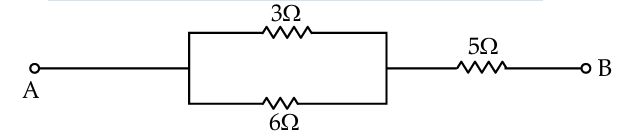
Calculate the total resistance across AB :
Topic: Current, resistance and circuits
Previous-year question practice database
Answer
Exam answer
From the circuit, the 3 Ω and 6 Ω are in parallel, and the 5 Ω is in series with that combination.
Step 1 — the parallel pair: R₁ = (3 × 6) ÷ (3 + 6) = 18 ÷ 9 = 2 Ω
Step 2 — in series with the 5 Ω: R = 5 + 2 = 7 Ω
Total resistance across AB = 7 Ω
Explanation
Do the parallel part first, then add the series resistor — always work from the inside of the network outwards.
Check the parallel step: 2 Ω is less than 3 Ω, the smaller branch ✓. Adding all three in series gives 14 Ω, which is what you get by not reading the diagram.
For two resistors in parallel where one is a whole multiple of the other, the product-over-sum is quick: 3 and 6 give 18/9 = 2.
More from Current Electricity
In the circuit given below, identify the lamp (L1, L2, L3 and L4) whose failure would not interrupt the power supply to the other lamps.
(a) L1
(b) L2
(c) L3
(d) L42026The correct formula to calculate the equivalent resistance of two resistors R₁ and R₂ when connected in parallel, is:
(a) (R₁ + R₂) / (R₁R₂)
(b) (R₁R₂) / (R₁ + R₂)
(c) (R₁ − R₂) / (R₁R₂)
(d) (R₁R₂) / (R₁ − R₂)2026A substance whose resistance becomes almost negligible at a temperature near absolute zero is called a ............... [semiconductor / superconductor].2026How will the voltmeter reading change? (increase / decrease / remain the same)2026Justify your answer stated in (a) above.2026Calculate the ratio V1 : V2.2026