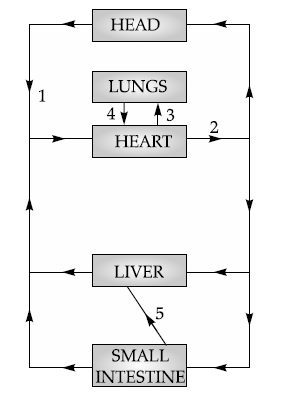
The diagram given below represents the simplified pathway of the circulation of blood. Answer the questions that follow: The diagram given below represents the simplified pathway of the circulation of blood. Answer the questions that follow:
Draw a diagram of the different blood cells as seen in a smear of human blood.
Topic: Blood cells — diagram
Answer
Your diagram must show three kinds of cell: • ERYTHROCYTES (red blood cells) — numerous, round, BICONCAVE discs with NO nucleus, drawn with a pale centre • LEUCOCYTES (white blood cells) — larger, fewer, irregular in shape, each WITH a prominent nucleus (show a lobed nucleus for a neutrophil and a large round one for a lymphocyte) • THROMBOCYTES (blood platelets) — very small, irregular fragments with no nucleus
Labels required: erythrocyte (RBC), leucocyte (WBC), thrombocyte (platelet).
THE THREE FEATURES that must be visibly different, because this is how the examiner tells whether you know them: SIZE — white cells are the LARGEST, platelets the SMALLEST NUCLEUS — present only in the WHITE cells. Drawing a nucleus in a red cell is the commonest error and loses the mark, since a mature mammalian RBC has none. NUMBER — red cells should greatly outnumber the others in your smear, which is true of real blood (about 600 red to every white).
Draw the red cells with a PALE CENTRE to show the biconcave shape — it is thinner in the middle, which is why it looks lighter there under a microscope.
Draw large, in pencil, with labels outside on straight lines.