Given below is a diagram of a human blood smear. Study the diagram and answer the questions that follow: Given below is a diagram of a human blood smear. Study the diagram and answer the questions that follow:
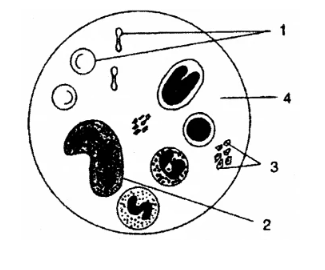
Mention two structural differences between the parts ‘1’ and ‘2’.
Topic: Red and white blood cells
Answer
RED BLOOD CELL: a BICONCAVE DISC, with NO NUCLEUS, and containing HAEMOGLOBIN.
WHITE BLOOD CELL: IRREGULAR and AMOEBOID in shape, WITH A NUCLEUS, and containing NO haemoglobin.
The question says STRUCTURAL differences, so keep to structure — writing that one carries oxygen and the other fights disease is a FUNCTIONAL difference and does not answer it.
The NUCLEUS is the single clearest structural difference and should always be given.
Note the qualifier MATURE MAMMALIAN: young red cells do have a nucleus, and it is lost as they mature — which is why the word appears in careful wording of this point.
| Point of difference | Red blood cell | White blood cell |
|---|---|---|
| Shape | Biconcave disc | Irregular, amoeboid |
| Nucleus | Absent (in mature mammalian RBC) | Present |
| Haemoglobin | Present | Absent |
| Number | About 5 million per cubic mm | About 7,000 per cubic mm |