Given below is a diagram depicting a defect of the human eye. Study the same and then answer the questions that follow: Given below is a diagram depicting a defect of the human eye. Study the same and then answer the questions that follow:
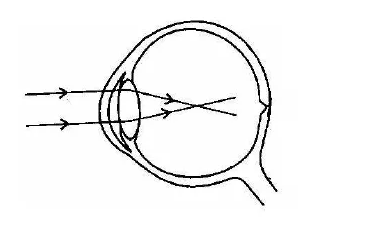
What are the two possible reasons that cause this defect?
Topic: Causes of myopia
Answer
- The EYEBALL IS LENGTHENED from front to back, so the retina lies behind the point of focus.
- The LENS IS TOO CURVED (too convex or rounded), so it bends the light too strongly.
TWO reasons are asked for, and both amount to the same thing — the eye bends light TOO MUCH, or has too far to travel, so the focus falls too early.
THE SYMMETRY with hypermetropia makes both defects derivable rather than memorised: MYOPIA — eyeball too LONG or lens too CONVEX — bends light TOO MUCH — image IN FRONT of the retina — CONCAVE lens HYPERMETROPIA — eyeball too SHORT or lens too FLAT — bends light TOO LITTLE — image BEHIND the retina — CONVEX lens Each is the exact opposite of the other in every respect, so learning one gives you the other free.