Tara’s grandmother is 70 years old and has a passion for embroidery. She faces difficulty in threading the needle as the eye of the needle appears blurred. The ophthalmologist diagnosed it as an age-related disorder.
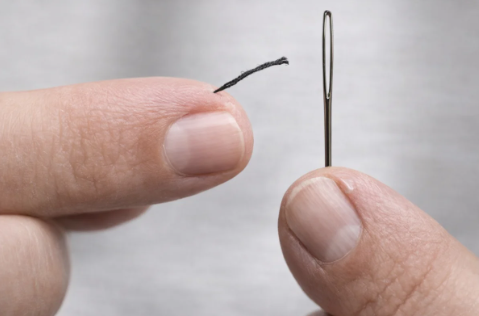
How can the above defect be corrected?
Topic: Correction of presbyopia
Answer
By wearing spectacles with a CONVEX (converging) LENS.
A convex lens converges the light rays BEFORE they enter the eye, so that the weakened lens has less bending left to do and the image falls on the retina instead of behind it.
THE PAIR TO LEARN, because one is always asked with the other: MYOPIA (short sight) — image forms IN FRONT of the retina — corrected by a CONCAVE lens. HYPERMETROPIA and PRESBYOPIA (long sight) — image forms BEHIND the retina — corrected by a CONVEX lens.
A way to keep them straight: a CONCAVE lens is thin in the middle and spreads rays apart; a CONVEX lens is thick in the middle and brings them together. If the image is falling short, you need to bring the rays together sooner — convex.
Elderly people often need BIFOCAL lenses, with a convex portion below for reading and a different correction above for distance.