English Language — Suggested Paper 3
120 minutes80 marks Questions from 2020–2026
A suggested paper: every question is a real ICSE board question, chosen from different years and arranged in the current pattern. Start the timed test to have your written answers marked.
Paper (80 marks)
Attempt all five questions.
1. Write a composition (300-350 words) on the following. (Do not spend more than 30 minutes on this question.)
1(i). Write an original short story beginning with the words: It was midnight and the doorbell rang...
[20 marks]1(ii). If you could change one period in your school timetable, which one would you choose? Why do you think it needs to be changed and with which subject or activity would you replace it?
[20 marks]1(iii). You and your family enjoy eating out. Give a description of your favourite restaurant or food stall, and the sights and smells that attract you to the place. Explain why you like eating here.
[20 marks]1(iv). 'Homework is a necessary evil.' Express your views either for or against this statement.
[20 marks]1(v). Study the picture given below. Write a story or a description or an account of what it suggests to you. Your composition may be about the subject of the picture, or you may take suggestions from it. However, there must be a clear connection between the picture and your composition.
[20 marks]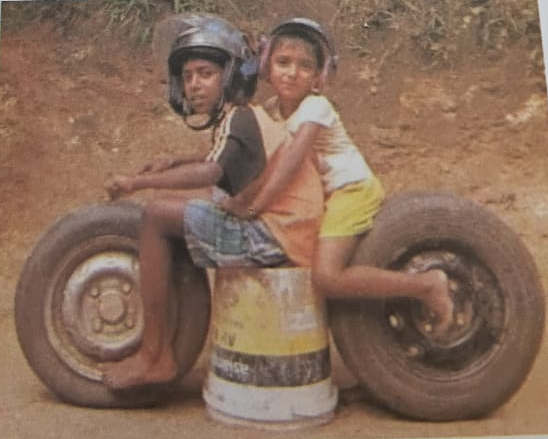
2. Select any one of the following. (Do not spend more than 20 minutes on this question.)
2(i). Your friend was absent from school on a day when an unfortunate incident took place for which you were blamed. Write a letter to your friend giving details about the incident, your role in it and how the matter was finally resolved.
[10 marks]2(ii). You wish to stage a play to create awareness about the importance of saving electricity. Write a letter to the Manager of a nearby shopping mall/supermarket requesting permission to use the space in front of the shopping mall/supermarket to stage the play. Give him/her details about your requirements and state why the play will be beneficial to the shoppers.
[10 marks]3(a). Your school is organising a fete / carnival to raise funds for victims of the recent floods in your State. Write a notice to be put up on the school notice board giving details of the event.
[5 marks]3(b). Write an e-mail to the Principal of a neighbouring school, inviting him/her to send their students to attend the fete / carnival.
[5 marks]4(i). For each word given below choose the correct meaning (as used in the passage) from the options provided:
4(i). "This is your teacher today. He’s going to show you all sorts of things." With that the headmaster introduced a new teacher. Totto-chan took a good look at him but he wasn’t dressed like a teacher at all. He wore a striped cotton jacket and he had a towel hanging around his neck. His trousers were of dyed cotton and were full of patches. Instead of shoes, he wore thick socks, while on his head was a rather dilapidated straw hat. The children were all assembled by the pond at the temple. As she stared at the teacher, Totto-chan thought that she had seen him before. "Where?" she wondered. His kindly face was sunburnt and full of wrinkles. She suddenly remembered! "Aren’t you the farmer who works in the field by the stream?" she asked him, delighted. "That’s right," said the ‘teacher’, with a smile wrinkling up his face. "You pass my place every time you go to the village!" "Wow! So you’re going to be our teacher today," cried the children excitedly. "No!" said the man, waving his hand in front of his face. "I’m not a teacher! I’m just a farmer. Your headmaster just asked me to do it, that’s all." "Oh yes, he is, he’s your farming teacher," said the headmaster, standing beside him. "He very kindly agreed to teach you how to plant a field." At an elementary school, anyone who taught the children anything would probably have to have teaching qualifications, but the headmaster didn’t worry about things like that. He thought it important for children to learn by actually seeing things done. "Let’s begin then," said the farming teacher. The farming teacher told the children to get spades and other tools from the car and started them on weeding. He told them all about weeds: how hardy they were; how some grew faster than crops and hid the sun from them; how weeds were good hiding places for bad insects; and how weeds could be a nuisance by taking all the nourishment from the soil. He taught them one thing after another. And while he talked, his hands never stopped pulling out weeds. The children did the same. Then the teacher showed them how to dig, how to make furrows; how to spread fertilizer; and everything else you had to do to grow things in a field, explaining as he demonstrated. A little snake put its head out and very nearly bit the hand of Ta-chan, one of the older boys, but the farming teacher reassured him, "The snakes here are not poisonous, and they won’t hurt you if you don’t hurt them." Besides teaching the children how to plant a field, the farming teacher told them interesting things about insects, birds, and butterflies, about the weather, and about all sorts of other things. [Adapted from ‘Totto-chan - The Little Girl at the Window’ by Tetsuko Kuroyanagi]
4(i)(1). dilapidated
[1 mark]- (a)faded and yellow
- (b)new and shining
- (c)tightly wrapped
- (d)old and ragged
4(i)(2). elementary
[1 mark]- (a)primary
- (b)special
- (c)secondary
- (d)village
4. Read the following passage carefully and answer the questions that follow:
4. "This is your teacher today. He’s going to show you all sorts of things." With that the headmaster introduced a new teacher. Totto-chan took a good look at him but he wasn’t dressed like a teacher at all. He wore a striped cotton jacket and he had a towel hanging around his neck. His trousers were of dyed cotton and were full of patches. Instead of shoes, he wore thick socks, while on his head was a rather dilapidated straw hat. The children were all assembled by the pond at the temple. As she stared at the teacher, Totto-chan thought that she had seen him before. "Where?" she wondered. His kindly face was sunburnt and full of wrinkles. She suddenly remembered! "Aren’t you the farmer who works in the field by the stream?" she asked him, delighted. "That’s right," said the ‘teacher’, with a smile wrinkling up his face. "You pass my place every time you go to the village!" "Wow! So you’re going to be our teacher today," cried the children excitedly. "No!" said the man, waving his hand in front of his face. "I’m not a teacher! I’m just a farmer. Your headmaster just asked me to do it, that’s all." "Oh yes, he is, he’s your farming teacher," said the headmaster, standing beside him. "He very kindly agreed to teach you how to plant a field." At an elementary school, anyone who taught the children anything would probably have to have teaching qualifications, but the headmaster didn’t worry about things like that. He thought it important for children to learn by actually seeing things done. "Let’s begin then," said the farming teacher. The farming teacher told the children to get spades and other tools from the car and started them on weeding. He told them all about weeds: how hardy they were; how some grew faster than crops and hid the sun from them; how weeds were good hiding places for bad insects; and how weeds could be a nuisance by taking all the nourishment from the soil. He taught them one thing after another. And while he talked, his hands never stopped pulling out weeds. The children did the same. Then the teacher showed them how to dig, how to make furrows; how to spread fertilizer; and everything else you had to do to grow things in a field, explaining as he demonstrated. A little snake put its head out and very nearly bit the hand of Ta-chan, one of the older boys, but the farming teacher reassured him, "The snakes here are not poisonous, and they won’t hurt you if you don’t hurt them." Besides teaching the children how to plant a field, the farming teacher told them interesting things about insects, birds, and butterflies, about the weather, and about all sorts of other things. [Adapted from ‘Totto-chan - The Little Girl at the Window’ by Tetsuko Kuroyanagi]
4(ii). Which word in the passage is the opposite of 'boring'?
[1 mark]- (a)important
- (b)nuisance
- (c)nourishment
- (d)interesting
4(iv). In not more than 50 words, give an account of what the farmer taught the children that day.
[8 marks]4(iii). Answer the following questions briefly in your own words:
4(iii). "This is your teacher today. He’s going to show you all sorts of things." With that the headmaster introduced a new teacher. Totto-chan took a good look at him but he wasn’t dressed like a teacher at all. He wore a striped cotton jacket and he had a towel hanging around his neck. His trousers were of dyed cotton and were full of patches. Instead of shoes, he wore thick socks, while on his head was a rather dilapidated straw hat. The children were all assembled by the pond at the temple. As she stared at the teacher, Totto-chan thought that she had seen him before. "Where?" she wondered. His kindly face was sunburnt and full of wrinkles. She suddenly remembered! "Aren’t you the farmer who works in the field by the stream?" she asked him, delighted. "That’s right," said the ‘teacher’, with a smile wrinkling up his face. "You pass my place every time you go to the village!" "Wow! So you’re going to be our teacher today," cried the children excitedly. "No!" said the man, waving his hand in front of his face. "I’m not a teacher! I’m just a farmer. Your headmaster just asked me to do it, that’s all." "Oh yes, he is, he’s your farming teacher," said the headmaster, standing beside him. "He very kindly agreed to teach you how to plant a field." At an elementary school, anyone who taught the children anything would probably have to have teaching qualifications, but the headmaster didn’t worry about things like that. He thought it important for children to learn by actually seeing things done. "Let’s begin then," said the farming teacher. The farming teacher told the children to get spades and other tools from the car and started them on weeding. He told them all about weeds: how hardy they were; how some grew faster than crops and hid the sun from them; how weeds were good hiding places for bad insects; and how weeds could be a nuisance by taking all the nourishment from the soil. He taught them one thing after another. And while he talked, his hands never stopped pulling out weeds. The children did the same. Then the teacher showed them how to dig, how to make furrows; how to spread fertilizer; and everything else you had to do to grow things in a field, explaining as he demonstrated. A little snake put its head out and very nearly bit the hand of Ta-chan, one of the older boys, but the farming teacher reassured him, "The snakes here are not poisonous, and they won’t hurt you if you don’t hurt them." Besides teaching the children how to plant a field, the farming teacher told them interesting things about insects, birds, and butterflies, about the weather, and about all sorts of other things. [Adapted from ‘Totto-chan - The Little Girl at the Window’ by Tetsuko Kuroyanagi]
4(iii)(1). How was the new teacher dressed?
[2 marks]4(iii)(2). Which sentence in the passage tells us that Totto-chan had seen the new teacher before?
[2 marks]4(iii)(3). Why do you think the headmaster had to correct the farmer about his role?
[2 marks]4(iii)(4). Why was the headmaster right in inviting the new teacher to take a class?
[2 marks]4(iii)(5). What did the farmer say that proved that he knew a lot about snakes?
[1 mark]5. Fill in each of the numbered blanks with the correct form of the word given in brackets. Do not copy the passage but write in correct serial order the word or phrase appropriate to the blank space. Example: One day we (0) __________ (lift) the box up. Answer: (0) lifted
5(i). We (1) __________ (find) a dead mouse (2) __________ (lie) among our treasures. It (3) __________ (be) an exciting discovery. A boy took it up by its tail and (4) __________ (wave) it in front of our faces. "What shall we do with it?" he (5) __________ (cry). "It stinks!" someone (6) __________ (shout). "Throw it out of the window quick!" He (7) __________ (hesitate). They all (8) __________ (look) at me.
[4 marks]5(ii). (a) My best friend, John is named __________ his grandfather. (b) A grey mist hung __________ the fields. (c) The little girl spoke __________ against the bully. (d) They accused him __________ theft. (e) The police got the fire __________ control. (f) There is a bridge __________ the river. (g) The driver jumped __________ the car. (h) I have not seen my uncle __________ last summer.
[4 marks]5(iii). Choose the correct option to make one complete sentence without using and, but or so.
5(iii)(1). These are fresh mangoes. I bought them yesterday.
[1 mark]- (a)These are fresh mangoes which I bought yesterday.
- (b)These mangoes were fresher when I bought them yesterday.
- (c)These are fresh mangoes which were bought yesterday.
- (d)These are fresh mangoes brought by me yesterday.
5(iii)(2). The debating teams were very happy. They were declared joint champions.
[1 mark]- (a)The debating teams were very happy as they have been declared joint champions.
- (b)The debating teams are very happy as they are declared joint champions.
- (c)The debating teams were very happy as they had been declared joint champions.
- (d)The debating teams will be very happy as they will be declared joint champions.
5(iii)(3). The rain came down. All the people ran away.
[1 mark]- (a)When the rain came down, all the people ran away.
- (b)When it rained, the people ran away.
- (c)The rain had come down all the people ran away.
- (d)The rain having come, all the people ran away.
5(iii)(4). The disciple was wise. The teacher did not trust him.
[1 mark]- (a)Although the disciple was wise yet the teacher trusted him.
- (b)Although the disciple was not wise the teacher trusted him.
- (c)Although the disciple is wise, the teacher trusted him.
- (d)Although the disciple was wise, the teacher did not trust him.
5(iv). Choose the correct option and rewrite the sentence according to the instruction given after each.
5(iv)(1). The teacher said, "Come early tomorrow, the examination begins at eight o'clock." (Begin: The teacher told us to... )
[1 mark]- (a)The teacher told us to come early the next day as the examination would begin at eight o'clock.
- (b)The teacher told us to come early tomorrow as the examination begins at eight o'clock.
- (c)The teacher told us the examination will begin at eight o’clock so come early tomorrow.
- (d)The teacher told us to come by eight o’clock as the examination will begin early the next day.
5(iv)(2). Rahul not only plays the guitar but also the drums. (Use: 'as well as')
[1 mark]- (a)Rahul plays the guitar as well as the drums.
- (b)Rahul plays the guitar as well the drums.
- (c)Rahul plays the guitar as well as he does the drums.
- (d)Rahul play’s the guitar and the drums as well.
5(iv)(3). She said she would not be available. (Add a question tag)
[1 mark]- (a)Didn’t she say that she would not be available?
- (b)She said she would not be available, did she?
- (c)She said she would not be available, didn’t she?
- (d)She said she would not be available, wouldn’t she?
5(iv)(4). This is the most beautiful painting in the exhibition. (Begin: No other...)
[1 mark]- (a)No other painting is as beautiful as this exhibition.
- (b)No other painting in this exhibition is beautiful.
- (c)No other painting is beautiful as this painting in the exhibition.
- (d)No other painting in the exhibition is as beautiful as this one.
5(iv)(5). I prefer aerobics to yoga. (Use: 'rather')
[1 mark]- (a)I would rather do aerobics to yoga.
- (b)I would rather do aerobics than yoga.
- (c)I would rather prefer aerobics than yoga.
- (d)I would rather do yoga than aerobics.
5(iv)(6). The coach taught the children the rules of the game. (Begin: The rules...)
[1 mark]- (a)The rules have being taught by the coach to the children.
- (b)The rules of the game have been taught by the children to the coach.
- (c)The rules of the game is taught by the coach to the children.
- (d)The rules of the game were taught by the coach to the children.
5(iv)(7). No sooner did the film star arrive than the crowd cheered. (Begin: As soon as...)
[1 mark]- (a)As soon as the film star arrived then the crowd cheered.
- (b)As soon as the film star arrives the crowd starts cheering.
- (c)As soon as the crowd cheers the film star arrives.
- (d)As soon as the film star arrived the crowd cheered.
5(iv)(8). School bags are often too heavy for students to carry. (Use: 'so')
[1 mark]- (a)School bags are so heavy students cannot carry them.
- (b)School bags are often so heavy that students cannot carry them.
- (c)School bags are often so heavy for students to carry.
- (d)School bags are heavy so students cannot carry them.