English Language — Suggested Paper 1
120 minutes80 marks Questions from 2018–2026
A suggested paper: every question is a real ICSE board question, chosen from different years and arranged in the current pattern. Start the timed test to have your written answers marked.
Paper (80 marks)
Attempt all five questions.
1. Write a composition (300-350 words) on any one of the following. (Do not spend more than 30 minutes on this question.)
1(a). Write an original short story entitled 'The Secret'.
[20 marks]1(b). 'A family without pets is an incomplete family'. Express your views either for or against this statement.
[20 marks]1(c). What do you prefer — morning, afternoon, evening or night? Describe your favourite time of the day. What are the sights, sounds, smells and feelings that you associate with your favourite time of the day? Why do you like this part of the day better than the others?
[20 marks]1(d). Have you ever said or done something that changed the life of another person? Give an account of your words or actions that led to this change and describe how the experience made you feel.
[20 marks]1(e). Study the picture given below. Write a story or a description or an account of what it suggests to you. Your composition may be about the subject of the picture or you may take suggestions from it; however, there must be a clear connection between the picture and your composition.
[20 marks]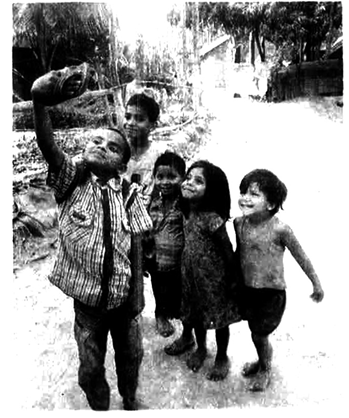
2. Select any one of the following. (Do not spend more than 20 minutes on this question.)
2(a). Your uncle has offered to get you a pet for your birthday. Write a letter to him telling him what you would like, give reasons for your choice and tell him how you would take care of your pet.
[10 marks]2(b). The traffic outside your school is very heavy and chaotic. Write a letter to the Deputy Commissioner of Police (Traffic) pointing out the danger of such heavy and chaotic traffic in a school zone. Suggest possible solutions for the problem.
[10 marks]3(i). Your school is hosting an Inter School Dance Competition. Write a notice to be put up on your school notice board informing the students about the event.
[5 marks]3(ii). Write an email to the Principal of a neighbouring school to request him/her to send their dance teacher to act as a judge for the competition.
[5 marks]4. Read the following passage carefully and answer the questions that follow:
4. Attending classes inside a railway carriage seemed unusual enough, but the seating arrangements turned out to be unusual too. At Totto-chan’s previous school, each pupil was assigned a specific desk. However, here they could sit anywhere they liked at any time. The most unusual thing of all about this school was the lessons themselves. Schools normally schedule one subject, for example history, during the first period, when everyone in the class just did history; then say, arithmetic in the second period, when you just did arithmetic. But here it was quite different. At the beginning of the first period, the teacher made a list of all the problems and questions in the subjects to be studied that day. Then she would say, "Now, start with any of these you like." So, whether you started on history or arithmetic or something else didn’t matter at all. Someone who liked composition might be writing something, while behind you someone who liked chemistry might be boiling something in a flask over an alcohol burner. This method of teaching enabled the teachers to observe as the children progressed to higher grades what they were interested in as well as their way of thinking and their character. It was an ideal way for teachers to really get to know their pupils. As for the pupils, they loved being able to start with their favourite subject, the fact that they had all day to cope with the subjects they disliked meant they could usually manage them somehow. Therefore, study was mostly independent, with pupils free to go and consult the teacher whenever necessary. Then pupils would be given further exercises to work alone. It was study in the truest sense of the word, and it meant there were no pupils just sitting inattentively while the teacher talked and explained. The first-grade pupils hadn’t quite reached the stage of independent study, but even they were allowed to start with any subject they wanted. Some copied letters of the alphabet, some drew pictures, some read books, and some even did physical exercises. Just then the boy sitting behind her got up and walked toward the blackboard with his notebook, apparently to consult the teacher. Totto-chan stopped looking around the room and fixed her eyes on his back as he walked. The boy dragged his leg and his whole body swayed from side to side. Totto-chan wondered at first if he was doing it on purpose, but she soon realized the boy couldn’t help it. The boy said brightly, "My name’s Yasuaki. What’s yours?" She was so glad to hear him speak that she replied loudly, "I’m Totto-chan." — Adapted from Totto-chan
4(a). Give the meaning of the following words as used in the passage. One-word answers or short phrases will be accepted. (i) assigned (line 3) (ii) ideal (line 19) (iii) independent (line 24)
[3 marks]4(c). In not more than 50 words, describe how the children were taught.
[8 marks]4(b). Answer the following questions briefly in your own words.
4(b). Attending classes inside a railway carriage seemed unusual enough, but the seating arrangements turned out to be unusual too. At Totto-chan’s previous school, each pupil was assigned a specific desk. However, here they could sit anywhere they liked at any time. The most unusual thing of all about this school was the lessons themselves. Schools normally schedule one subject, for example history, during the first period, when everyone in the class just did history; then say, arithmetic in the second period, when you just did arithmetic. But here it was quite different. At the beginning of the first period, the teacher made a list of all the problems and questions in the subjects to be studied that day. Then she would say, "Now, start with any of these you like." So, whether you started on history or arithmetic or something else didn’t matter at all. Someone who liked composition might be writing something, while behind you someone who liked chemistry might be boiling something in a flask over an alcohol burner. This method of teaching enabled the teachers to observe as the children progressed to higher grades what they were interested in as well as their way of thinking and their character. It was an ideal way for teachers to really get to know their pupils. As for the pupils, they loved being able to start with their favourite subject, the fact that they had all day to cope with the subjects they disliked meant they could usually manage them somehow. Therefore, study was mostly independent, with pupils free to go and consult the teacher whenever necessary. Then pupils would be given further exercises to work alone. It was study in the truest sense of the word, and it meant there were no pupils just sitting inattentively while the teacher talked and explained. The first-grade pupils hadn’t quite reached the stage of independent study, but even they were allowed to start with any subject they wanted. Some copied letters of the alphabet, some drew pictures, some read books, and some even did physical exercises. Just then the boy sitting behind her got up and walked toward the blackboard with his notebook, apparently to consult the teacher. Totto-chan stopped looking around the room and fixed her eyes on his back as he walked. The boy dragged his leg and his whole body swayed from side to side. Totto-chan wondered at first if he was doing it on purpose, but she soon realized the boy couldn’t help it. The boy said brightly, "My name’s Yasuaki. What’s yours?" She was so glad to hear him speak that she replied loudly, "I’m Totto-chan." — Adapted from Totto-chan
4(b)(i). What was unusual about the seating arrangement?
[2 marks]4(b)(ii). How did the method of teaching help the teacher?
[2 marks]4(b)(iii). Why did the pupils enjoy their lessons at this school?
[2 marks]4(b)(iv). What different things did the first-grade pupils do?
[2 marks]4(b)(v). Which sentence in the passage tells us that the boy had difficulty in walking like other children?
[1 mark]5. Fill in each of the numbered blanks with the correct form of the word given in brackets. Do not copy the passage but write in correct serial order the word or phrase appropriate to the blank space.
5(i). It (1) __________ (glide) slowly over the ruts in the road ahead of me. It was seven or eight feet long and (2) __________ (hold) its flat spoon-shaped head six inches up in the air. I (3) __________ (stop) the car smartly so as not (4) __________ (run) over it. To be truthful, I was so (5) __________ (frighten). I (6) __________ (go) quickly into reverse and (7) __________ (keep) backing away. The fearsome thing (8) __________ (disappear) into the undergrowth.
[4 marks]5(ii). (a) He acted according __________ my instructions. (b) They scaled up the wall __________ means of a rope. (c) Gina has a passion __________ music. (d) Father patted Jai __________ his back for his good results. (e) I have not seen Sonia __________ last May. (f) They worked __________ the night to complete the project on time. (g) Ms. Sharma refused to buy a new car because the cost was __________ her means. (h) Saif knew nothing about the event since it had happened __________ he was born.
[4 marks]5(iii). Choose the correct option to make one complete sentence without using and, but or so.
5(iii)(1). He picked up the bundle. He walked away.
[1 mark]- (a)He picked up the bundle and walked away.
- (b)Packing up the bundle, he walked away.
- (c)Picking up the bundle, he walked away.
- (d)He walked away by picking up the bundle.
5(iii)(2). Ravi is not a technician. Ravi is not a musician.
[1 mark]- (a)Ravi is both a technician also a musician.
- (b)Ravi is neither a technician nor a musician.
- (c)Besides not being a technician, Ravi is a musician.
- (d)Ravi is not a musician but a technician.
5(iii)(3). Tanya is extremely polite. We like her.
[1 mark]- (a)Tanya is extremely polite but we like her.
- (b)We like Tanya despite her being extremely polite.
- (c)Tanya’s extremely polite ways make us like her.
- (d)We like Tanya because she is extremely polite.
5(iii)(4). The construction started on time. It was delayed due to the bad weather.
[1 mark]- (a)Although the construction started on time, it was delayed due to the bad weather.
- (b)Since the construction started on time, it was delayed due to the bad weather.
- (c)The construction started on time, so it was delayed due to the bad weather.
- (d)The construction started on time, as well as got delayed due to the bad weather.
5(iv). Choose the correct option and rewrite the sentence according to the instruction given after each.
5(iv)(1). Samudragupta was one of the greatest of the Indian kings. (End with: ...Samudragupta.)
[1 mark]- (a)No other king is as great as Samudragupta.
- (b)All other kings are greater than Samudragupta.
- (c)Very few Indian kings were as great as Samudragupta.
- (d)Some Indian kings are greatest as Samudragupta.
5(iv)(2). One should keep one’s promises. (Begin with: Promises...)
[1 mark]- (a)Promises should keep one.
- (b)One’s promises are not meant to be kept.
- (c)Promises should be kept.
- (d)Promises are one’s to keep.
5(iv)(3). He said, "I have passed the examination." (Begin: He said that.....)
[1 mark]- (a)He said that he had passed the examination.
- (b)He said that he passed the examination.
- (c)He said that he has passed the examination.
- (d)He said that he will pass the examination.
5(iv)(4). He finished his exercise and put his books away. (Begin: Having.....)
[1 mark]- (a)Having his books put away, he exercised.
- (b)Having put his books away, he finished his exercise.
- (c)Having finished his exercise, he put his books away.
- (d)Having to finish his exercise, he put his books away.
5(iv)(5). Unless she practises every day, she will not be able to meet her goal. (Begin with: If.....)
[1 mark]- (a)If she practises every day, she will be able to meet her goal.
- (b)If she practises every day, she will not be able to meet her goal.
- (c)If she does not practise every day, her goal will be met.
- (d)If she practises every day, her goal will not be met.
5(iv)(6). Rashmi was too late to hear the first speech. (Use: ...so...that...)
[1 mark]- (a)Rashmi was so late for the first speech.
- (b)Rashmi was so late that she could hear the first speech.
- (c)Rashmi is so late that she cannot hear the first speech.
- (d)Rashmi was so late that she could not hear the first speech.
5(iv)(7). There is a slight difference between the two shades. (Use: 'different')
[1 mark]- (a)The slight difference is between two shades.
- (b)The two shades are slightly different.
- (c)The slightly different shades are between two.
- (d)The two different shades are slightly different.
5(iv)(8). Dr. Shetty is a professor and a research scientist. (Begin with: Not only.....)
[1 mark]- (a)Not only was Dr. Shetty a professor but also a research scientist.
- (b)Not only is Dr. Shetty a professor as well as a research scientist.
- (c)Dr. Shetty is both a professor and research scientist.
- (d)Not only is Dr. Shetty a professor but also a research scientist.