IdentificationEasy2 marks
7(iii)
The diagrams given below show two sound boxes A and B with wires of same length (l) and tension (10 kgf) but different cross-sectional areas. Simultaneously, vibrating tuning forks of frequency 300 Hz are placed on the boxes A and B. The paper rider falls off in case of B but not in case of A.
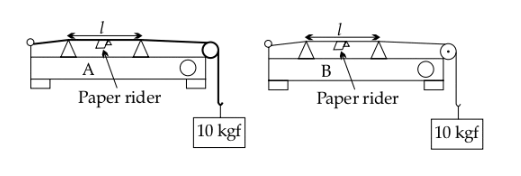
Name and explain the phenomenon responsible for the falling off of the paper rider in B.
Topic: Resonance
Question wording verified against source paper
Answer
Exam answer
Resonance.
Explanation
When the tuning-fork frequency equals the natural frequency of wire B, the wire vibrates with large amplitude and throws off the paper rider.
Example
Include one standard example only where it improves understanding.
More from Sound
Equal volumes of water are added to three cylindrical jars A, B and C of same height and radii rA, rB and rC respectively with rB < rA < rC. If you blow air into the mouth of these jars, which tube will produce the shrillest note?
(a) A
(b) B
(c) C
(d) All will produce the notes of same shrillness2026Quality of sound depends on its ............... [amplitude / waveform].2026Define natural vibrations.2026How is this vibration different from damped vibrations in terms of their amplitudes?2026One end of a plastic foot ruler is held tightly at the edge of a table and the other end is plucked. Name the vibrations produced in the ruler.2026Now the ruler is pushed inside partially and plucked again from its free end. State with a reason whether the frequency of vibration increases or decreases.2026