Richa weighing 40 kgf leaves point P on her skateboard and reaches point Q on the ground with velocity 10 ms-1. Calculate.
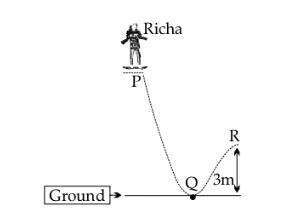
the vertical height of point P above the ground. (use g as 10 m/s2 and neglect friction)
Topic: Conservation of mechanical energy
Answer
Given: KE at Q = 2 000 J (from part (a)), m = 40 kg, g = 10 m s⁻², friction neglected.
With no friction between P and Q, all the potential energy at P has turned into kinetic energy at Q: PE at P = KE at Q m g h = 2 000
40 × 10 × h = 2 000 400h = 2 000 h = 2 000 ÷ 400 h = 5 m
Vertical height of P above the ground = 5 m
This is conservation of mechanical energy. "Neglect friction" is the permission slip: with nothing lost to friction, every joule of potential energy at the top becomes kinetic energy at the bottom, so you can equate the two directly.
Note that the shape of the slope makes no difference at all — only the VERTICAL height matters. A gentle ramp and a steep one from the same height give the same speed at the bottom.
You could also use v² = 2gh: 100 = 2 × 10 × h, giving h = 5 m. Same answer, and the mass cancels out entirely, which is worth noticing.