1(xiii)2026
MCQEasy1 mark
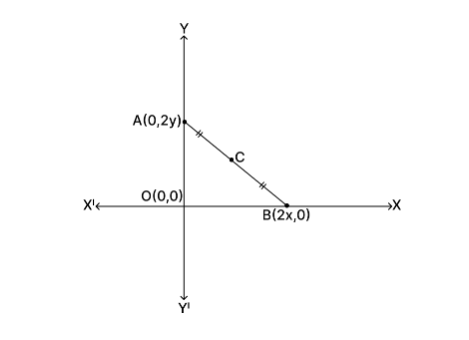
- (a)(x, y)
- (b)(y, x)
- (c)(x/2, y/2)
- (d)(2x/3, 2y/3)
Appeared in 9 of the 11 available papers.
Appears in most years
Average per paper it appears in · 31 marks in total
84% of this chapter's 19 questions
7 questions carry a figure — practise drawing them
Showing 19 of 19 matching questions (31 marks).
19 questions
Choose the correct answers to the questions from the given options. (Do not copy the questions, write the correct answers only.)
A(−10, −2) and B(2, 10) are two end points of a line segment. If AB intersects the x-axis at P, find the :
In the given graph ABCD is a parallelogram.
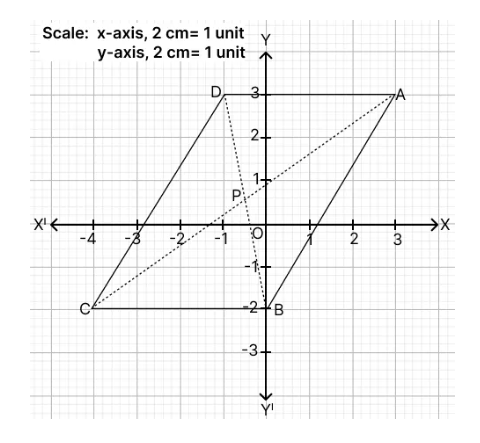
Using the graph, answer the following:
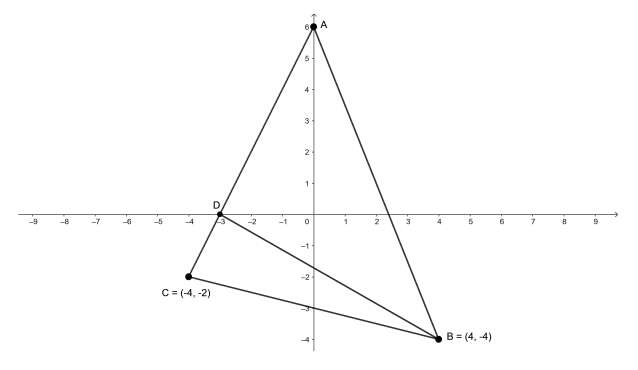
In the given diagram, ABC is a triangle, where B(4, -4) and C(-4, -2). D is a point on AC.
Choose the correct answers to the questions from the given options. (Do not copy the questions, write the correct answers only.)
ABC is a triangle whose vertices are A(1, -1), B(0, 4) and C(-6, 4), D is the mid-point of BC. Find the :
Choose the correct answers to the questions from the given options. (Do not copy the questions, write the correct answers only.)
M and N are two points on the X axis and Y axis respectively. P(3, 2) divides the line segment MN in the ratio 2 : 3. Find:
A(-1, 3), B(4, 2) and C(3, -2) are the vertices of a triangle.
The slope of a line joining P(6, k) and Q(1 - 3k, 3) is 1 / 2. Find
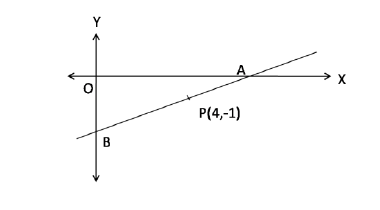
A line AB meets X – axis at A and Y –axis at B. P (4, -1) divides AB in the ratio 1 : 2.