Short answerEasy2 marks
7(c)
An aqueous solution of nickel (II) sulphate was electrolyzed using nickel electrodes. Observe the diagram and answer the questions that follow:
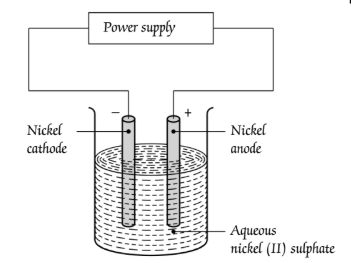
What do you observe at the cathode and anode respectively?
Topic: Electrolysis, electrolytes and electrode processes
Previous-year question practice database
Answer
Exam answer
Nickel is deposited at the cathode, while the nickel anode dissolves and loses mass.
More from Electrolysis
With respect to the electrolysis of copper (II) sulphate solution using copper electrodes, which statement is correct?2026Assertion (A): Dilute Sulphuric acid is a stronger electrolyte than concentrated Sulphuric acid.
Reason (R): Dilute Sulphuric acid has a higher concentration of mobile ions.2026Assertion (A): In the electrolysis of acidified water, the volume of hydrogen liberated is twice the volume of oxygen formed.
Reason (R): Water has hydrogen and oxygen in the ratio of 1:2 by volume.2026In the electrolysis of molten aluminium oxide for extraction of aluminium, the following reactions take place:
Al³⁺ + 3e⁻ → Al
2O²⁻ → O₂ + 4e⁻
C + O₂ → CO₂
Al₂O₃ ⇌ 2Al³⁺ + 3O²⁻
The reaction that takes place at the negative electrode is:2026The reaction that takes place at the anode during the electrolysis of molten lead bromide is ............... . [2Br - 2e– ⟶ 2Br– / 2Br– - 2e– ⟶ Br₂]2026Electrolyte and Metallic conductor (the particles conducting electricity)2026