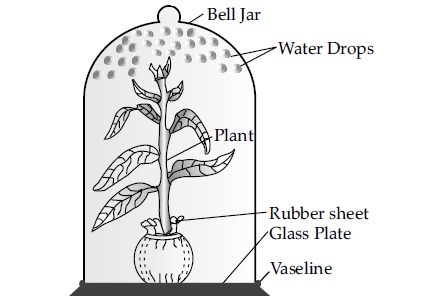
Given below is an apparatus which was set up to investigate a physiological process in plants. The setup (a potted plant under a bell jar, the pot sealed in a rubber sheet, standing on a glass plate with vaseline) was placed in bright sunlight. Answer the questions that follow: Given below is an apparatus which was set up to investigate a physiological process in plants. The setup (a potted plant under a bell jar, the pot sealed in a rubber sheet, standing on a glass plate with vaseline) was placed in bright sunlight. Answer the questions that follow:
Draw a neat, labelled diagram of a stomatal apparatus.
Topic: Stomatal apparatus — diagram
Answer
Your diagram must show: • the STOMA — the central pore • two bean-shaped GUARD CELLS bounding it, with the INNER wall (facing the pore) drawn THICKER than the outer • CHLOROPLASTS inside the guard cells • the NUCLEUS of each guard cell • the surrounding SUBSIDIARY (epidermal) CELLS
Labels required: stoma, guard cell, chloroplast, nucleus, subsidiary (epidermal) cell.
THE DETAIL THAT EARNS THE MARK is the UNEQUAL THICKENING: draw the inner wall of each guard cell noticeably thicker than the outer. That is not decoration — it is the entire mechanism.
HOW IT WORKS: when the guard cells absorb water they become TURGID. Because the inner wall is thicker and less elastic, the outer wall stretches more, so the cells bow OUTWARDS and the pore OPENS. When they lose water they become flaccid, straighten, and the pore CLOSES.
SHOW THE CHLOROPLASTS. Guard cells are the ONLY epidermal cells containing them — which is what distinguishes them from the subsidiary cells around them, and a point examiners look for.