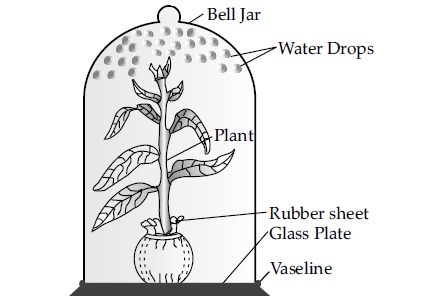
Given below is an apparatus which was set up to investigate a physiological process in plants. The setup (a potted plant under a bell jar, the pot sealed in a rubber sheet, standing on a glass plate with vaseline) was placed in bright sunlight. Answer the questions that follow: Given below is an apparatus which was set up to investigate a physiological process in plants. The setup (a potted plant under a bell jar, the pot sealed in a rubber sheet, standing on a glass plate with vaseline) was placed in bright sunlight. Answer the questions that follow:
List two adaptations in plants to reduce the above process.
Topic: Adaptations to reduce transpiration
Answer
- SUNKEN STOMATA — the stomata lie in pits below the leaf surface, where moist air is trapped, reducing evaporation.
- A THICK WAXY CUTICLE, impermeable to water, which cuts cuticular transpiration.
(Also acceptable: fewer stomata; narrow or reduced leaves, or spines; a hairy leaf surface; rolled or folded leaves.)
Two adaptations, and for each state the FEATURE and WHY it works.
THE PRINCIPLE behind almost all of them: evaporation slows when the air immediately outside the stoma is ALREADY MOIST. Sunken pits, surface hairs and rolled leaves all work by trapping a layer of humid air against the leaf.
These are XEROPHYTIC adaptations, found in plants of dry habitats — which is why desert plants have SMALL, THICK, reduced leaves or spines, and not the "large thin leaves" that the 2026 paper’s assertion-reason question wrongly claims.