The diagram below represents a process in plants (a leafy shoot in a flask of water with a layer of oil on top, the whole standing on a weighing machine). The setup was placed in bright sunlight. Answer the following questions: The diagram below represents a process in plants (a leafy shoot in a flask of water with a layer of oil on top, the whole standing on a weighing machine). The setup was placed in bright sunlight. Answer the following questions:
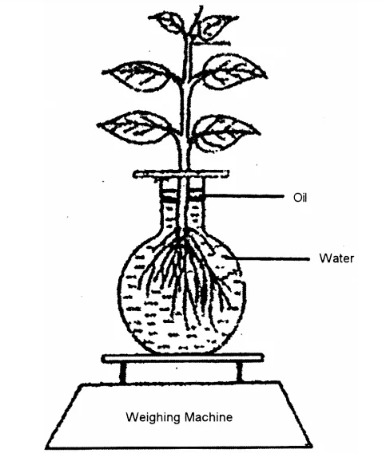
What happens to the level of water when this setup is placed in: 1. Humid conditions? 2. Windy conditions?
Topic: Humidity and wind
Answer
- HUMID conditions — the water level REMAINS THE SAME (or falls very little). Moist air already holds a great deal of water vapour, so little more can diffuse out of the leaf and transpiration is very slow.
- WINDY conditions — the water level FALLS (reduces) rapidly. Wind carries the water vapour away from the leaf surface, keeping the surrounding air dry, so transpiration is fast.
Give the direction AND the reason for each.
THE UNDERLYING PRINCIPLE, which makes both derivable rather than memorised: evaporation depends on the DIFFERENCE in water-vapour concentration between the inside of the leaf and the air outside. Anything that WIDENS that gap speeds transpiration; anything that narrows it slows transpiration. HUMID air narrows the gap — slower WIND removes the moist layer clinging to the leaf and keeps the gap wide — faster
The four external factors, with humidity the odd one working in the opposite direction: TEMPERATURE up, LIGHT up and WIND up all INCREASE transpiration; HUMIDITY up DECREASES it.