The diagram below represents a process in plants (a leafy shoot in a flask of water with a layer of oil on top, the whole standing on a weighing machine). The setup was placed in bright sunlight. Answer the following questions: The diagram below represents a process in plants (a leafy shoot in a flask of water with a layer of oil on top, the whole standing on a weighing machine). The setup was placed in bright sunlight. Answer the following questions:
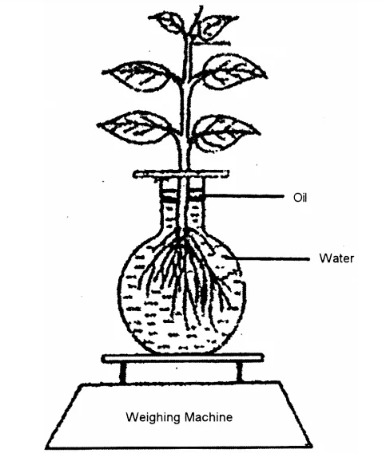
When placed in bright sunlight for four hours, what do you observe with regard to the initial and final weight of the plant? Give a suitable reason for your answer.
Topic: Weight change in the potometer
Answer
The FINAL WEIGHT IS LESS than the initial weight — the weight of the apparatus DECREASES.
Reason: in bright sunlight the rate of TRANSPIRATION is greater than the rate of absorption of water, so the plant loses more water as vapour than it takes up, and the total weight falls.
State the OBSERVATION and then the REASON — the question asks for both.
The reason must compare the two RATES: transpiration exceeds absorption. Since the oil prevents evaporation from the flask, the only route by which water can leave the system is through the leaves.
WHY BRIGHT SUNLIGHT MATTERS: light opens the stomata and raises the temperature, and both increase transpiration — so the loss is greatest under exactly these conditions.
This is the principle of the POTOMETER: the water lost is measured as a proxy for the water transpired. Note the limitation, tested in the 2024 paper — not all the water absorbed is transpired, so the reading is an approximation.