The diagram below represents a process in plants (a leafy shoot in a flask of water with a layer of oil on top, the whole standing on a weighing machine). The setup was placed in bright sunlight. Answer the following questions: The diagram below represents a process in plants (a leafy shoot in a flask of water with a layer of oil on top, the whole standing on a weighing machine). The setup was placed in bright sunlight. Answer the following questions:
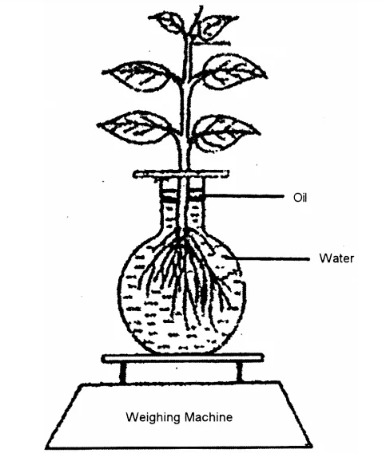
Name the physiological process depicted in the diagram. Why was oil added to the water?
Topic: Absorption and transpiration
Answer
The processes depicted are the ABSORPTION OF WATER BY THE ROOTS and TRANSPIRATION by the leaves.
The OIL was added to PREVENT EVAPORATION of water from the surface of the water in the flask — so that any loss in weight must be due to transpiration by the plant alone.
Both halves must be answered, and the oil is the more important of the two.
THE OIL IS THE CONTROL FEATURE of the experiment. Without it, water would evaporate from the open surface of the flask, the weight would fall for that reason as well, and the result would prove nothing about the plant.
THE HABIT TO FORM in every experimental question: ask what each part of the apparatus RULES OUT. Examiners award marks for understanding the control, not merely the result.
Compare the 2019 paper, where a pot was sealed in a RUBBER SHEET for exactly the same purpose — to exclude evaporation from the soil.